- Identify the appliance and follow the route that carries smoke and gases outdoors.
- Read the manual, cleaning history and inspection report for their different jobs.
- Ask the insurer and local authority what applies to this address and intended use.
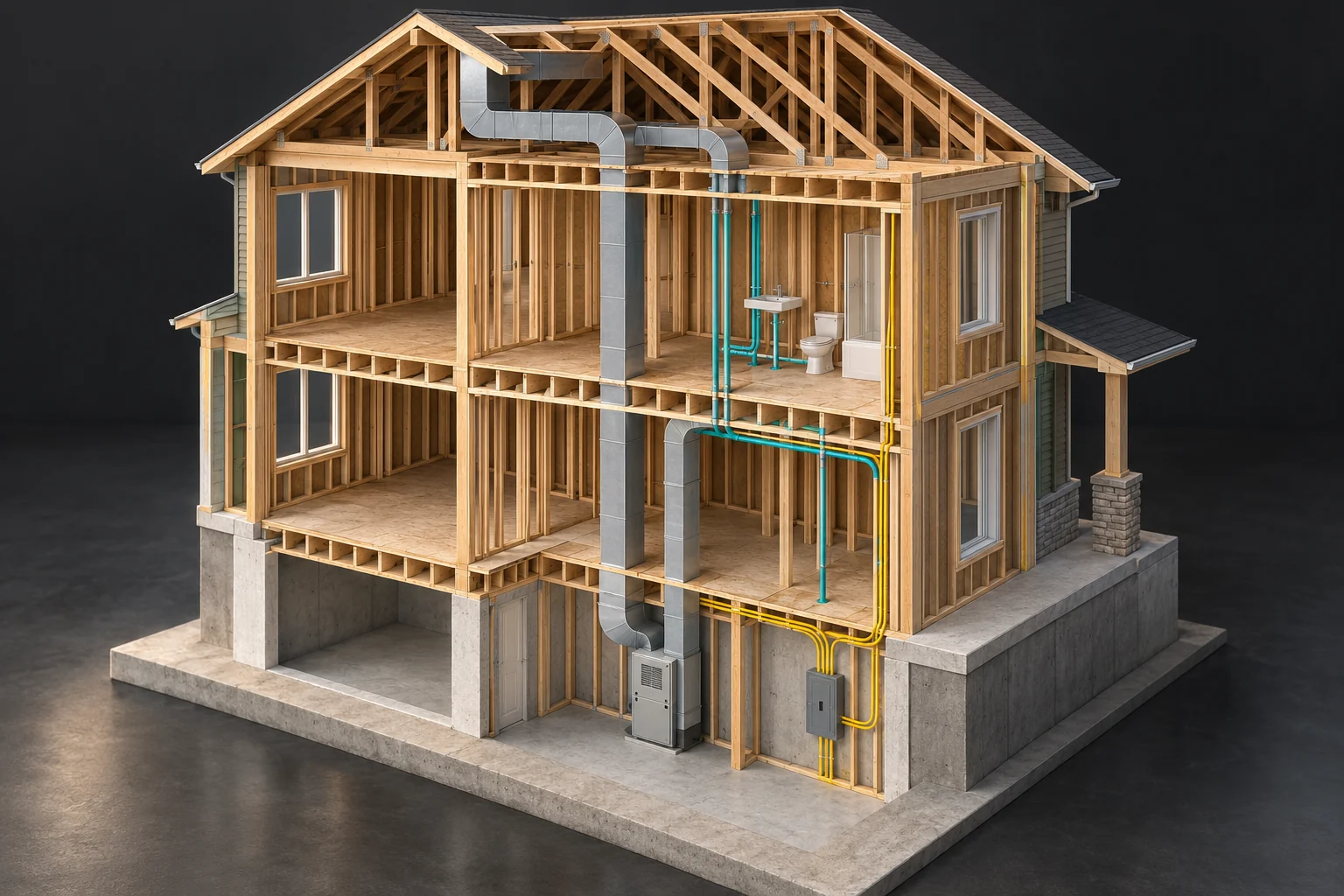
Conceptual architecture. Layout, sizes and routes are illustrative; the picture does not describe your home’s condition.
Explore this in the visual atlas ↗4 picture lessons appear beside the questions in this guide. Use them to understand the explanation, then consider what it means for your home.
Identify what is installed and how you intend to use it
A wood stove or fireplace burns fuel to make heat. The chimney carries the resulting smoke and gases outdoors. Start a purchase discussion by identifying the equipment and how you expect to use it: an occasional fire, backup heat or regular heating. Those are different household plans, even when the listing describes all of them as “wood heat.”
Ask the seller for the appliance model, manual, installation records and later changes. Have the qualified wood-heating provider explain whether you are looking at a fireplace, an insert fitted into a fireplace, a free-standing stove or another arrangement. Match the papers to what is installed now, including the chimney and connections.
Observe accessible parts from a normal safe position, with permission. Record the model information you can read without moving equipment or removing covers. Stay off the roof and out of concealed passages. A warm room at a showing tells you about that moment; it does not answer how the full installation behaves in other conditions.
Do not light a fire, adjust unfamiliar controls or ask for an improvised safety demonstration. Give the provider your intended use and the question that matters before buying. For example: does the supplied report assess the present stove and chimney together, or is a further visit needed?
An insert and a free-standing stove need their own records
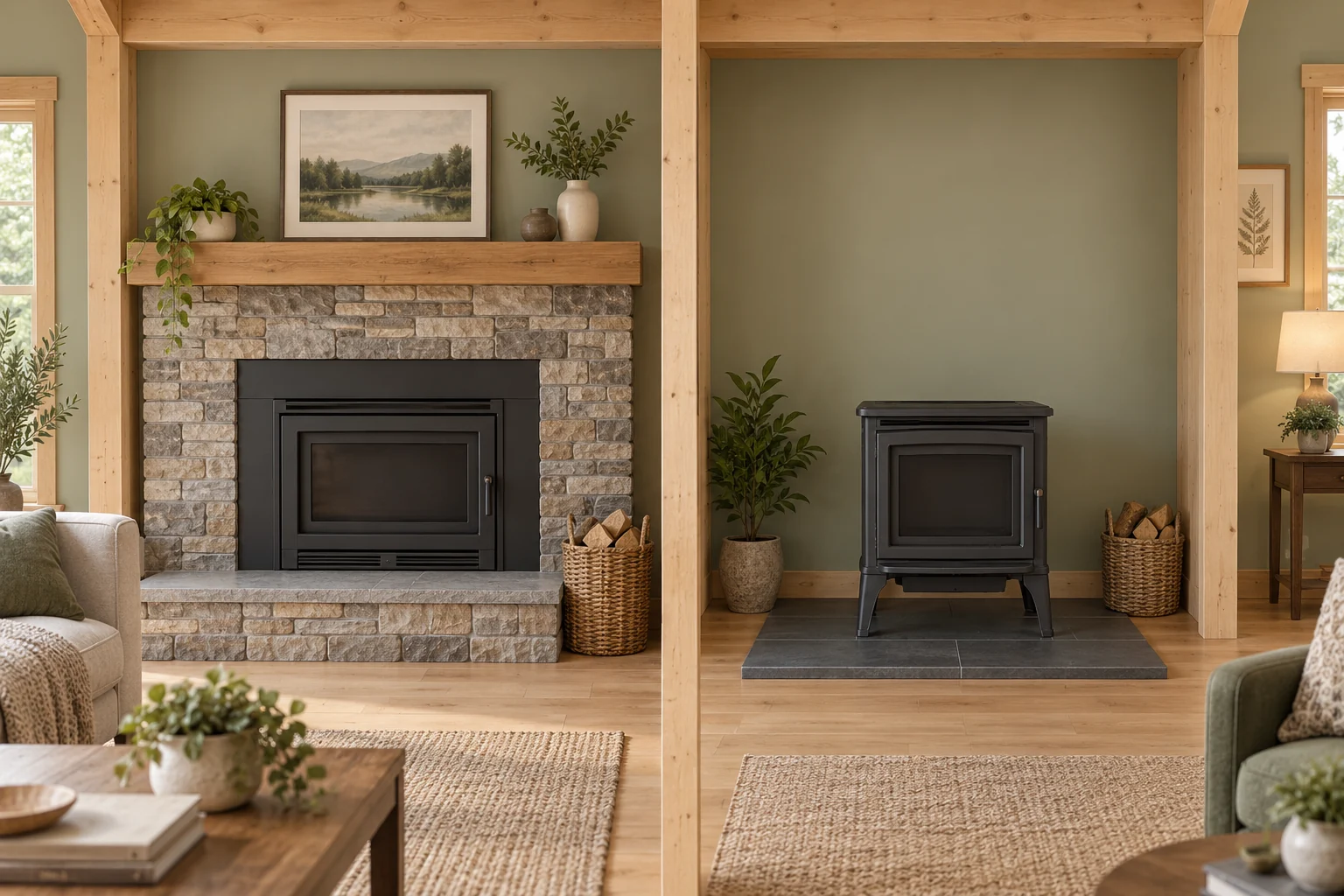
The left appliance sits within a fireplace opening; the right appliance stands separately. This is an appliance-type comparison, not a placement or clearance plan.
Numbers identify the parts explained below.
- Fireplace opening and insert
Identify the actual fireplace and inserted appliance, then match their manuals and installation records.
- Free-standing stove
Identify the actual stove and its intended use. A similar silhouette does not establish its model, output or condition.
- Connections out of view
Neither complete venting route is drawn. Ask how the appliance connects to the chimney and what was inspected.
What does this illustration leave out?
No label, connection, clearance measurement, chimney condition, approval or operating result is supplied. Furniture, hearths and surrounding finishes are illustrative, not recommended positions. Do not light or operate unfamiliar equipment to prove safety at a showing. Use accessible records and an appropriately qualified assessment. Keep roof, chimney, firebox and concealed-component access within the professional’s agreed scope.
Is this a fireplace, insert or free-standing stove, and which records describe the appliance and its actual connection to the building?
Explore this with HomeAI ↗Opens an editable question. Nothing is sent until you choose to send it.Understand combustion and the venting path
Burning wood needs air and produces heat, smoke and gases. The firebox is where the fuel burns. The venting arrangement carries combustion products outside. Ask the specialist to identify the connection from the appliance, the chimney passage and the outdoor outlet, and explain how these parts work together in this home.
Draft is the pressure difference that moves gases through the venting route. In a natural-draft arrangement, warmer gases can rise through the chimney by buoyancy. Temperature, chimney conditions and indoor pressure affect that movement. NRCan explains why gases can spill indoors when the intended route does not work as expected.
An obstruction, unsuitable chimney arrangement, equipment problem or pressure condition can contribute to spillage. More than one factor may matter. A soot mark or reported smoky smell is a reason to ask what happened and when; it does not identify the cause. The provider should explain the assessment method, reached areas and remaining gaps.
If a CO alarm sounds, leave immediately for fresh air. Do not look for the source. Once outside, call 9-1-1, the local fire department or emergency services. Health Canada says to return only after a professional fixes the problem. Smoke spilling indoors also needs prompt qualified attention; a purchase report cannot authorize continued operation.
Follow the stove, connector and chimney
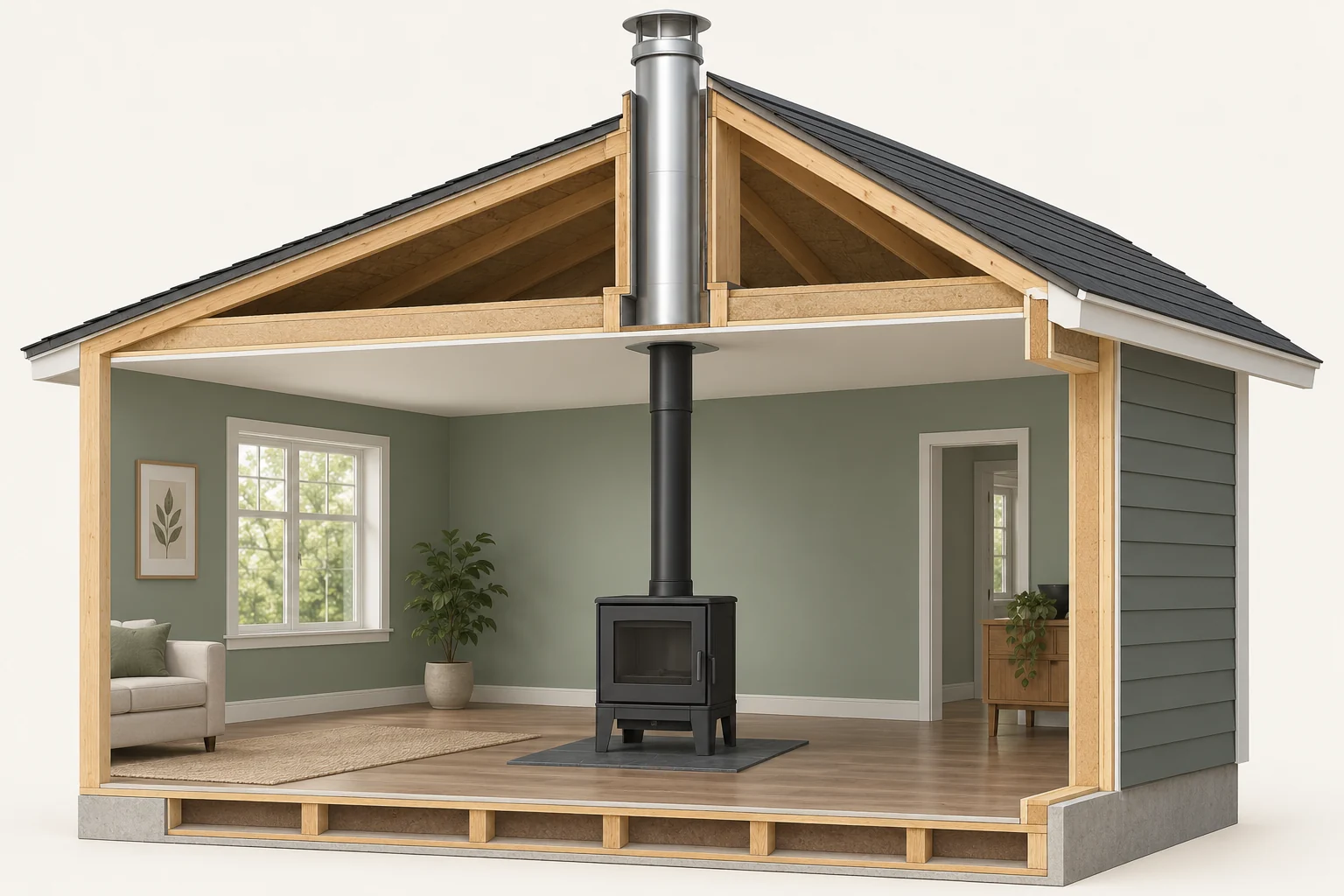
The stove is the appliance, the dark pipe is its connector, and the chimney route continues above the roof. This simplified model explains the parts; it supplies no installation clearances or operating result.
Numbers identify the parts explained below.
- Stove
The appliance contains the fire during intended use. This pictured stove is closed and unlit; its appearance establishes no safe operation.
- Connector
The visible pipe joins the appliance to the chimney arrangement. Its joints and suitability need the actual equipment records and assessment.
- Chimney and outside end
The chimney carries combustion products toward the outside in a working arrangement. This picture demonstrates no draft, internal condition or weatherproofing.
What does this illustration leave out?
Joint, support, shielding, penetration, clearance and sealing details are concealed or simplified. The room contents are illustrative. The scene is not a construction detail or permission to operate; actual model-matched instructions and a qualified assessment govern the installed arrangement. Observe from accessible positions. Do not open equipment, climb onto a roof, adjust dampers or run an informal venting test for this lesson.
Which appliance, connector and chimney did the assessment cover, and what remains concealed or outside its scope?
Explore this with HomeAI ↗Opens an editable question. Nothing is sent until you choose to send it.Follow the parts and their jobs
- FireboxThe place where wood burns and produces heat and combustion products. Ask the provider to identify the actual appliance.
- Connection and chimney routeThe arrangement carrying smoke and gases from the appliance toward outdoors. Ask which sections were examined and which were concealed.
- Air and draftThe appliance needs combustion air, while pressure and chimney conditions affect the venting movement. Ask which operating conditions the assessment covered.
- Showing observationA visible flame or warm room describes that moment. Obtain the relevant professional assessment for the present installation and intended use.
Read certification and installation evidence separately
A product label helps identify the appliance. A certification mark has a stated product and evaluation scope. Ask the provider to explain that scope and locate the matching instructions. The separate installation question is how that particular appliance connects with this building, chimney and surrounding materials.
Request the actual model manual and the records for its installation and later changes. Ask which professional compared the present arrangement with the applicable instructions and local requirements. Clearances are the required separation from nearby materials. Have them assessed for the actual equipment; a photograph or another stove’s manual cannot supply the answer.
The NRC Codes Canada FAQ is archived. It explains the distinction between national model codes and locally adopted requirements, but it is not today’s approval checklist. Ask the relevant local authority and provider which requirements, permits and completion records apply to this address, project and date.
Keep product information, installation findings and insurance correspondence together, with their different purposes clear. Ask the insurer exactly which documents it wants. This guide makes no promise that a particular mark, report name or credential will secure coverage, or that every Canadian wood-heating installation needs one universal certificate.
Ask what cleaning and inspection actually covered
Cleaning removes accumulated material from the areas included in the job. An inspection records assessed conditions within its agreed scope. A cleaning invoice can therefore be useful without answering whether the current appliance, connections and every chimney section were examined. Read the complete report before describing the visit as a full-system assessment.
Ask which appliance and chimney were reached, what was observed and which areas were inaccessible. Keep recommendations and follow-up findings with the report. A repair to one connection should be described as that repair. Missing papers remain an unanswered question; they do not establish that the chimney is damaged.
Health Canada recommends professional inspection and chimney maintenance. Read its current guidance alongside the actual manufacturer instructions, and ask the qualified provider to establish the plan for this system and use. A service date alone cannot settle its present condition. Keep the work performed and the next required assessment visible beside that date.
Build a simple timeline: equipment installed, cleaning performed, concern reported, assessment made, repair completed and follow-up recorded. Enter only documented events, and identify a seller’s account as reported history. In particular, cleaning before a stove replacement should not become an inspection of the later installation.
Four records help answer different buying questions
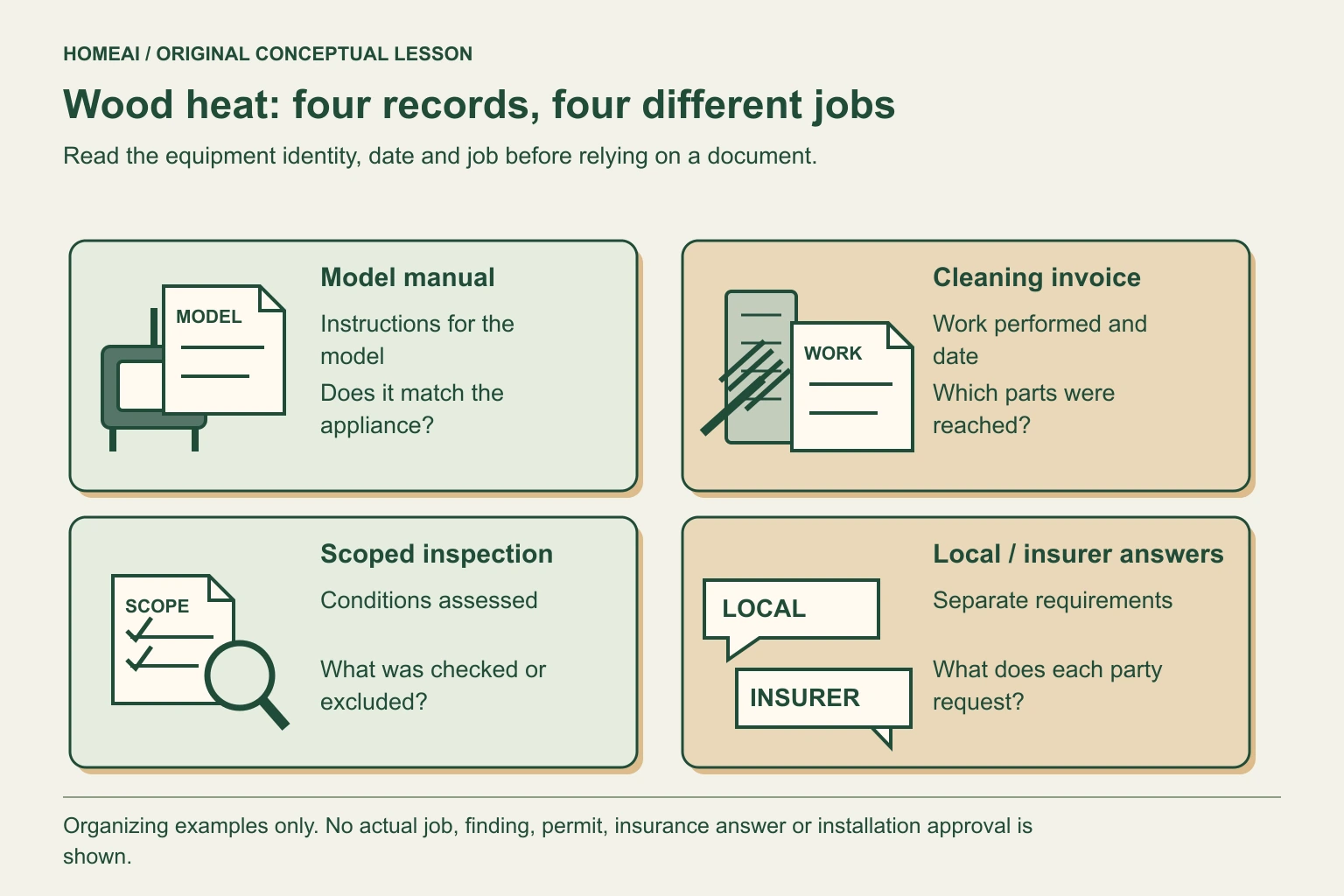
A model manual, cleaning job, scoped assessment and separate local/insurer answers appear in four labelled panels, each with its own question.
Numbers identify the parts explained below.
- Match the manual
Identify the actual model and the instructions that belong to it.
- Read the visit scope
A cleaning invoice and inspection report describe different jobs. Ask what was reached and assessed.
- Ask the responsible party
The local authority and insurer answer their own questions for this address and use.
What does this illustration leave out?
These organizing examples show no actual appliance manual, performed job, inspection finding, permit or insurance decision. Use the full original documents and keep the responsible parties’ answers separate. Original document-reading lesson. No official label, certification mark, clearance dimension, service interval or completed transaction is represented.
Which record answers the buying question, and which responsible person must supply the remaining answer?
Explore this with HomeAI ↗Opens an editable question. Nothing is sent until you choose to send it.Read the job before relying on the record.
The actual model instructions, completed cleaning work, assessed conditions and responsible-party requirements answer different questions. Keep the original dates, equipment identities, scope and qualifications.
- Model manual
- Its job: Gives instructions for the identified appliance or component.
- Next question: Does it match the equipment now installed, and who compared it with the present arrangement?
- Cleaning invoice
- Its job: Describes the named cleaning work, component and date.
- Next question: Which parts were reached, and does a separate report record assessed conditions?
- Scoped inspection
- Its job: Records the agreed assessment, findings, access limits and recommendations.
- Next question: Which appliance, chimney sections and operating conditions were assessed, and what remains open?
- Local and insurer answers
- Its job: Each responsible party gives its own answer about applicable requirements or proposed coverage.
- Next question: What does the actual authority or insurer request for this address, project and intended use?
Keep the records’ different jobs clear
- Model manualInstructions for the identified product. Ask whether they match the equipment now installed.
- Cleaning invoiceThe task, component and date described by that job. Ask what was reached and whether separate findings were supplied.
- Scoped inspection reportThe conditions assessed, methods, access limits and recommendations for its identified arrangement. Ask whether later changes need another review.
- Local and insurer answersWritten answers from the responsible authority and insurer for their own requirements. Ask what applies to this address, project and intended use.
Connect the appliance with the building’s air system
A kitchen hood, dryer or other exhaust equipment moves air out of the home. Replacement air must enter through the available routes. NRCan explains that indoor pressure can fall enough to interfere with natural-draft venting. This connects a wood-heating question with the rest of the building’s air arrangement.
Tell the specialist about a new hood, ventilation equipment, other combustion appliances and air-sealing or renovation work. Include dates and records where available. Ask whether the present combination was assessed. An older report may describe the equipment accurately while leaving a later building change outside its scope.
Do not run combinations of fans, open appliance doors, block air openings or use smoke to create your own draft test. The qualified provider should choose safe methods and explain the operating conditions assessed. An energy evaluation, routine cleaning and combustion assessment can answer different questions.
If the provider recommends changing equipment or air supply, ask which problem the proposal addresses and what needs checking afterward. NRCan explains that an air-supply change alone may leave chimney or pressure problems unresolved. Replacing the stove also does not answer an unassessed chimney question.
Kitchen exhaust and wood heat share the home’s air context
A kitchen hood, wood stove and surrounding rooms belong to one home. Ask how the actual exhaust equipment and building changes were considered together; no air direction or spillage is shown.
Numbers identify the parts explained below.
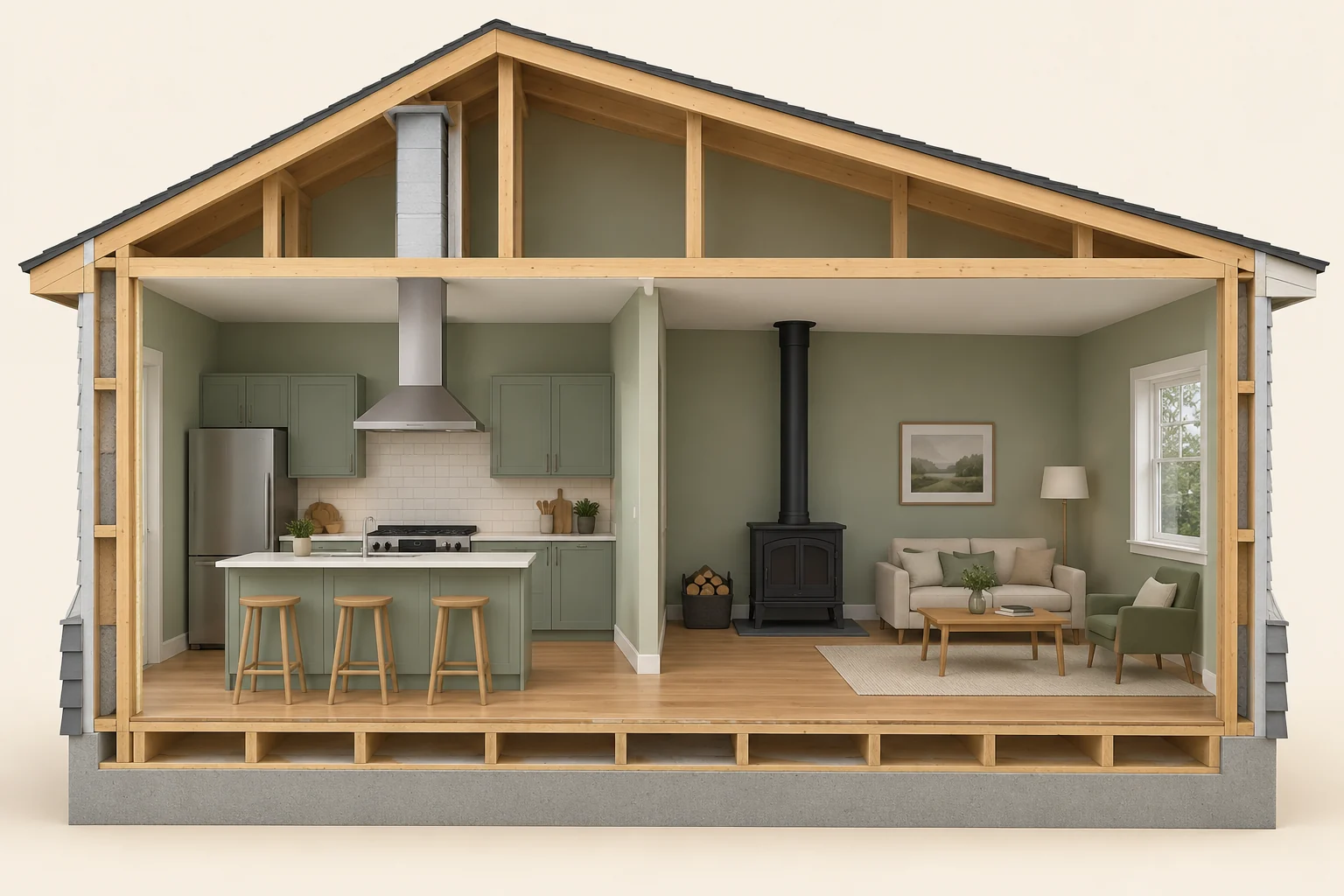
- Kitchen hood
An exhaust hood moves indoor air outside in its actual exhaust arrangement. This drawing does not establish whether this particular hood is ducted outdoors or its airflow.
- Wood-burning equipment
The appliance and its venting need suitable operating conditions. A new hood or air-sealing work belongs in the specialist’s history.
- Building boundary
Walls, windows and openings affect the building-air question. The model gives no leakage, pressure or combustion-air measurement.
What does this illustration leave out?
The hood’s final destination and the stove’s complete venting route are not shown. The illustration proves no pressure imbalance, safe draft, spillage cause or air-supply design. Furniture and equipment placement are illustrative; follow actual instructions and professional advice. Do not combine fan and appliance settings to create your own spillage test or block air openings. A CO alarm or immediate danger calls for the safety response described in the guide.
Did the professional consider the current exhaust equipment, building changes and wood-burning installation together, and which conditions were assessed?
Explore this with HomeAI ↗Opens an editable question. Nothing is sent until you choose to send it.Consider smoke exposure as well as heating comfort
Wood smoke contains particles and gases, including carbon monoxide. Health Canada explains that it can enter from nearby wood-burning homes, while fuel is added, or through faults in poorly maintained equipment. A comfortable temperature is therefore a separate question from smoke exposure.
Ask occupants whether smoke or odour has been noticed, in which room and under what conditions. Keep their account attributed and ask for any assessment. An odour does not establish the pollutant concentration or source. Health symptoms need healthcare or public-health advice; a home showing cannot diagnose them.
Ask the local authority about current smoke advisories, nuisance rules and any restrictions relevant to the intended use. Health Canada’s wildfire guidance directs readers to local air-quality information, including AQHI and Quebec’s InfoSmog. That helps with changing outdoor conditions; it does not inspect this home’s chimney or determine its local operating permissions.
Particle filtration and combustion safety have different jobs. A particle cleaner does not resolve a CO alarm or establish safe venting. Have the heating provider address the equipment and route; use appropriate public-health guidance for exposure questions. Keep both answers in the buying plan if wood heat is important to the household.
Put insurer, specialist and transaction questions in the right hands
Send the insurer the actual address, appliance details, intended use and complete reports it requests. Obtain its written answer about the proposed coverage and any further information needed. Keep the technical report’s access limits attached. The insurer’s answer and the specialist’s installation findings each have their own job.
Your realtor can coordinate document requests and assessment access. Confirm any particular training and availability instead of assuming it from a brand. The qualified wood-heating provider answers the booked technical questions; your legal and transaction advisors address the purchase terms, deadlines and commitments.
For recommended work, obtain a proposal that names the appliance, chimney or building areas involved. Ask about access, related work, restoration and how completion will be checked. Two prices with different scopes are not direct alternatives. An appliance price alone may leave the connected chimney and building work unanswered.
If the seller offers repairs before possession, agree through the actual transaction process on the work and completion documents to be supplied. Ask who will review them and which questions will remain. Keep a paid invoice as the record of its stated work; do not summarize it as an unrestricted approval of the whole installation.
Build a handover that supports safe future decisions
Keep one findable file with the model manual, installation documents, complete inspection reports, cleaning history, repairs, recommendations and relevant insurer correspondence. Preserve dates and locations. A future provider should be able to see which appliance and arrangement each record describes.
Keep alarm instructions and emergency contacts easy to find. Alarms warn of a hazard; they do not replace maintenance or assessment. For a CO alarm, leave for fresh air immediately, call emergency help from outside and follow professional direction. Do not wait for HomeAI or troubleshoot the stove first.
After buying, follow the actual manufacturer instructions and qualified maintenance plan. Ask for a review when equipment, venting or the building’s air arrangement changes. Preserve completed work and any follow-up. HomeAI explains the parts and prepares questions, while the responsible professionals establish the address-specific findings.
Before accepting a limited report, ask who can answer a consequential question outside its scope, such as a concealed chimney section or a changed exhaust arrangement. Keep that question and the proposed next assessment in the handover. Neither a missing answer nor a reassuring photograph settles it.
Practice the distinction.
A new stove and an older chimney
In this fictional example, buyer Amira receives a recent stove receipt and an older chimney-cleaning invoice. The seller also reports a later kitchen-hood replacement. No report assessing the current combination has been supplied.
Reported observations
- The stove receipt names a purchase, while the earlier invoice describes its own cleaning work.
- The chimney report supplied does not identify an assessment after the stove change.
- The hood replacement is reported history until its actual records are obtained.
Compare the explanations
Expand each possibility to see the evidence needed to distinguish it. Similar symptoms can have different mechanisms.
The earlier records are accurate for their jobs
A purchase and cleaning may be documented correctly while leaving the present installation question open.
Complete records matched to the equipment, task and dates, with the provider’s explanation of their scope.
The current combination needs another assessment
The stove, chimney and later exhaust change may require questions that the older visit did not cover.
A qualified provider’s agreed assessment of the present arrangement, operating conditions and access limits.
A useful next question
Amira asks for the current manual and installation records, obtains the insurer’s exact document request and books the appropriate scoped review. Her transaction advisors address timing through the actual agreement.
The example is invented. It establishes no damaged chimney, unsafe stove, suitable installation, accepted insurance coverage or completed inspection.
Know what the words mean.
- Draft
- The pressure difference that moves smoke and gases through a chimney or venting route; its behaviour depends on the actual equipment and conditions.
- Spillage
- Smoke or other combustion gases entering the room instead of being carried outdoors through the intended venting route.
- Certification scope
- The particular product and requirements covered by a certification mark or document. Ask what it evaluates separately from this home’s installation.
Questions to bring
to the conversation.
- Which equipment and chimney arrangement do the supplied records describe?
- Which parts and operating conditions did the assessment cover?
- Did later appliance, hood or building changes create another question?
- Who will answer each remaining technical, insurance and transaction question?
Separate a showing observation, an existing record and a new professional assessment. Unknown means a question remains; it does not automatically mean a defect.
Use the evidence planner ↗Go to the source.
Original HomeAI explanation informed by these public references. Sources support the underlying guidance; they have not reviewed or endorsed HomeAI. Diagrams are conceptual, and calculator outputs depend on your inputs.
Chapter references reviewed for this refresh on October 5, 2026. Health Canada and NRCan explain smoke, combustion and building-air relationships. The retained NRC FAQ is archived historical model-code context, not current local approval. Appliance instructions, inspection scope and the actual local authority and insurer must answer this property’s questions.
Publication & source review
First published .
Sources reviewed .
Have a question about your home?
Start with the symptom, timing and what you have observed.
Ask HomeAI