- The grille, fan, duct, outdoor end and incoming room air each have a job.
- A running fan, a product rating and an installed airflow result describe different things.
- A cold mirror, plumbing leak or exterior-water problem may need a different explanation.
- Use normal-use observations and a scoped professional assessment to choose the next work.
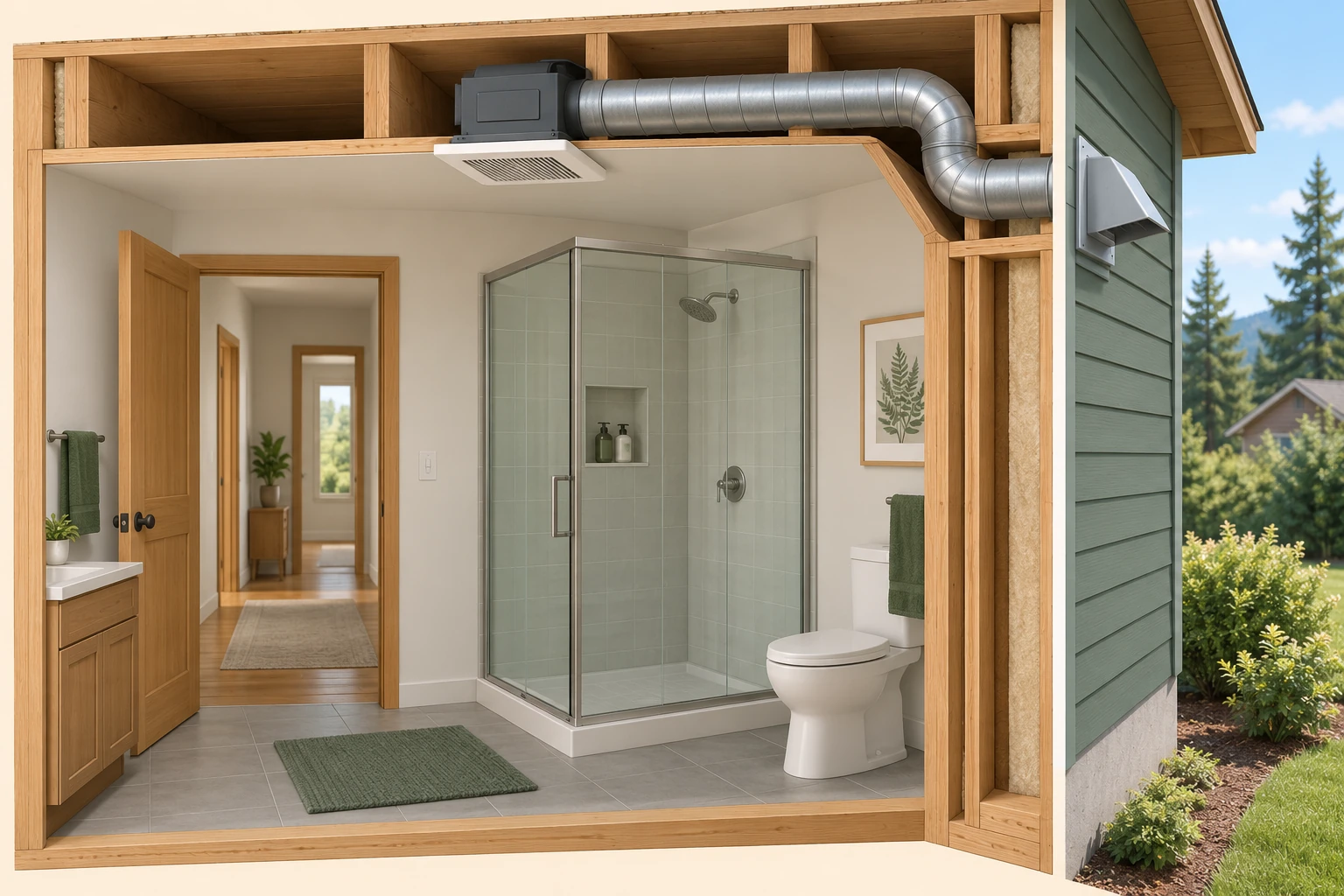
In this local-fan example, room air enters the grille, passes through the fan and connected duct, then leaves outdoors. The doorway introduces the separate need for replacement air to reach the room.
About this illustration
This is not a surveyed route or duct design. It measures no airflow, leakage or door gap, and does not approve a terminal, duct material or installation. This is a conceptual teaching model, not an assessment of your home.
4 picture lessons appear beside the questions in this guide. Use them to understand the explanation, then consider what it means for your home.
What equipment actually serves this bathroom grille?
The bathroom grille is the opening where room air enters the exhaust system. Behind it may be a local ceiling fan, a duct to a central fan, or an extract connection on an HRV or ERV. Start by finding which arrangement serves this room.
A local fan’s motor moves air into a connected duct. A central arrangement can move air from several rooms through one remote unit. An HRV or ERV has a wider whole-house job. A visible grille does not tell you which equipment sits behind the ceiling.
Use existing model information, manuals and any ventilation drawing to identify the arrangement. Ask which normal control operates the bathroom connection. A light and a fan have different functions, even when they share a wall control or housing.
Keep observation at ordinary room access: the grille, controls and available paperwork. Do not remove covers or enter an attic to trace a route for this lesson. A qualified ventilation professional or shared-building manager can explain the concealed connections.
Where must the moist room air actually go?
Bathing adds water vapour to room air. A ducted bathroom exhaust system is intended to carry that air outdoors: through the grille, fan, connected duct and outdoor end. The outdoor end is called the termination. Exhausting into an attic leaves moisture inside the building.
Replacement air must also reach the room as air is removed. A restricted incoming route can reduce the exhaust system’s performance. Ask the contractor how the room receives replacement air with the normal door arrangement; do not cut a door or alter a shared-building opening from a generic gap dimension.
The full route matters. A working motor and suction at the grille cannot establish that the duct remains connected or reaches the right outdoor hood. A visible wall hood may serve a different appliance. Ask what records or inspected route actually connect it to this room.
One illustrated local-fan route is a conceptual example. Your room may connect to a central system instead. Keep the fan or central unit, identified duct extent and actual termination together in the record, including any portion the assessment could not see.
Follow room air from the grille to outdoors
In this local-fan example, room air enters the grille, passes through the fan and connected duct, then leaves outdoors. The doorway introduces the separate need for replacement air to reach the room.
Numbers identify the parts explained below.
- Grille and fan
The grille is the room opening; the fan moves air in this conceptual local-fan arrangement.
- Duct to outside
The connected duct takes the air to the outside hood. Ask where your actual route ends and which concealed sections were checked.
- Room air supply
Air must be able to reach the bathroom as air leaves. The doorway gives context without prescribing a gap or alteration.
What does this illustration leave out?
This is not a surveyed route or duct design. It measures no airflow, leakage or door gap, and does not approve a terminal, duct material or installation. Observe from normal safe access. Leave electrical work, concealed-route investigation and inaccessible outside ends to the appropriate provider.
Where does this bathroom’s exhaust go, how does replacement air reach the room, and what was actually assessed?
Explore this with HomeAI ↗Opens an editable question. Nothing is sent until you choose to send it.Why are noise, a light and a tissue test incomplete evidence?
A light shows its own operation. Motor sound suggests the fan is running. A tissue demonstration may show local suction. The useful next question is how much air the installed system moves in its ordinary operating condition, not whether one of those signs can stand in for every other result.
The product rating describes the fan under its stated rating conditions. Installed airflow describes air moving at the stated measurement location in this bathroom’s system. Room moisture observations describe a later outcome. Those three pieces of information have different jobs.
Broan’s reviewed manual says existing ductwork can prevent a fan from achieving its rated airflow. NRCan’s ENERGY STAR information describes independent product-efficiency certification. Neither a catalogue number nor that certification is a measurement of this installed room’s airflow.
Do not put objects into a grille or remove its cover to create a home test. Keep a reported tissue demonstration as a limited observation, then ask for the suitable professional route and airflow assessment. Quiet operation can make a fan easier to use without resolving a restrictive duct.
A product rating is different from installed airflow and room moisture
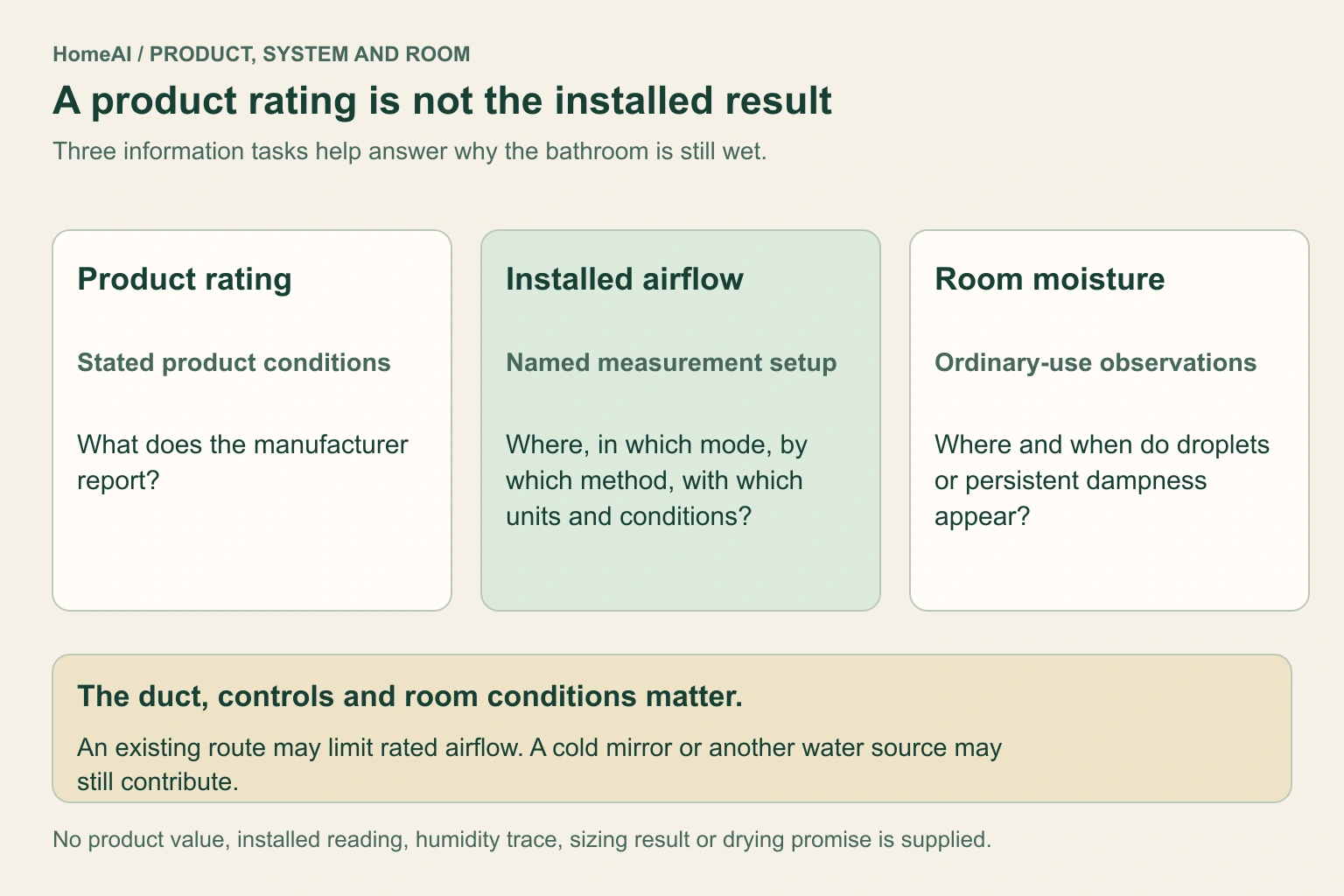
Three kinds of information answer different questions about the product, its installed performance and the room’s moisture pattern.
Numbers identify the parts explained below.
- Product rating
The manufacturer’s result under stated rating conditions describes the product.
- Installed airflow
The measured air volume moving over time at a named location and operating mode describes that test setup.
- Room moisture
The time and location of droplets or dampness describe an outcome that also depends on bathing, surfaces, weather and other water sources.
What does this illustration leave out?
No actual rating or measurement is supplied. A running fan and one observation cannot establish the entire installed route. Conceptual information comparison, not a fan-sizing calculation, owner test or compliance result.
Which part is a product rating, which is measured installed airflow, and which is an ordinary moisture observation?
Explore this with HomeAI ↗Opens an editable question. Nothing is sent until you choose to send it.Three pieces of information have different jobs.
The catalogue rating describes the fan under stated conditions. The installed airflow result describes a measurement in the actual arrangement. The moisture record describes what happens during ordinary room use. One does not replace the other two.
- Product rating
- The manufacturer’s result under stated rating conditions describes the product.
- Installed airflow
- The measured air volume moving over time at a named location and operating mode describes that test setup.
- Room moisture
- The time and location of droplets or dampness describe an outcome that also depends on bathing, surfaces, weather and other water sources.
The reviewed Broan example says existing ducts can prevent the fan from achieving its rated airflow. A measured result needs a location, mode, method, units and conditions. A cold mirror or another water source can still contribute to moisture while the fan runs. This diagram supplies no real product number, installed reading, humidity trace, sizing value or promised drying time.
Product rating, installed airflow and moisture each answer a question
- Product ratingWhat does the manufacturer report under its rating conditions? · It describes the product; it is not this room’s installed result.
- Installed airflowHow much air moved at the named location, mode and conditions? · Keep method, units and limits; a measurement is bounded by its setup.
- Room moistureWhere and when did droplets or persistent dampness appear? · Bathing, temperature, weather and other water sources still matter.
What do the timer and humidity sensor actually control?
A timer determines a period of operation. A humidity sensor can start or continue ventilation according to the actual model’s logic. Neither control measures whether every wet surface has dried. Learn the normal mode before interpreting an unexpected start or stop.
In the reviewed Broan Roomside/Flex example, the sensor responds to a humidity increase or a set-point, and manual operation can have timed shutoff. That is one model family’s example. Its switch sequence, internal settings and wiring are not instructions for another bathroom fan.
During normal use, note when ventilation begins and ends and whether the light stops separately. A central-system boost button may operate remote equipment. If the controls are unclear, request a demonstration of ordinary use and keep that explanation with the manual.
Health Canada advises exhaust during bathing and continued operation afterward. Follow the current guidance with the installed instructions; a generic run time does not prove effective room drying. Internal control adjustments, electrical work and uncertain maintenance access belong to the appropriate qualified person.
What should I record around an ordinary shower?
Use the household’s normal routine. Record shower start and finish, the fan mode, its start and stop times, ordinary door and window positions, and where moisture appears. Add the weather context and whether surfaces remain damp later. Do not prolong bathing to create an experiment.
If a room humidity and temperature instrument is already used, identify it and keep its location consistent and away from splash. Time-stamped readings can organize the pattern. Relative humidity also changes with temperature, so a rising or falling reading cannot by itself be converted into an exhaust rate.
Back-to-back showers, wet towels and changed room conditions give the professional useful context. A mirror, wall corner and fan grille are different locations. Record which one gets wet, when it happens and whether the same place is wet when the bathroom has not been used.
The log helps explain the complaint; it does not establish a national drying deadline, mould clearance or precise fan verdict. Ask which observations are useful for the planned assessment and keep its measured findings separate from your ordinary-use record.
Could a wet mirror or recurring patch have another explanation?
Yes. Water vapour can condense into droplets when room air reaches a sufficiently cold surface. A cold mirror can therefore fog while a fan runs. The fan removes moist air over time; it does not make every surface instantly warm or stop every moment of condensation.
A repeating damp patch can also involve plumbing leakage or water entering through the building enclosure. Health Canada identifies these as different moisture sources. They may coexist with a ventilation concern, which is why replacing the fan is not automatically the right repair for every wet area.
Compare timing and location from safe access. Does it follow showers, appear after rain, or persist without bathroom use? Those patterns help decide which questions need ventilation, plumbing or building-envelope expertise. A photo or stain alone cannot locate a hidden source.
Arrange appropriate assessment for recurring dampness, visible mould, suspected hidden moisture or persistent musty odours. Leave material disturbance and inaccessible investigation to the responsible professionals. Health concerns belong with a healthcare professional; this airflow guide cannot diagnose an occupant or identify mould risk from colour.
A wet mirror and a damp wall raise different questions
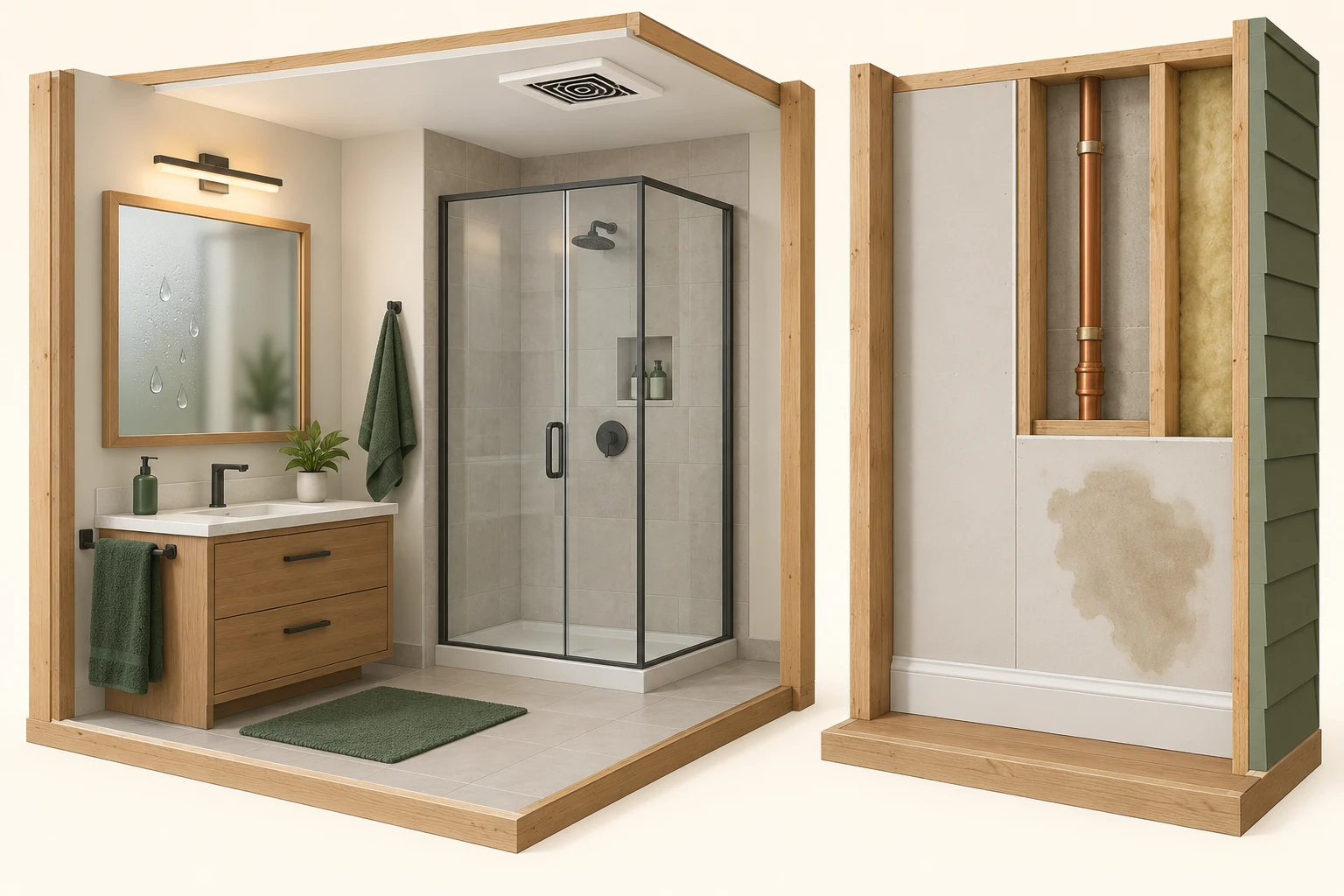
Mirror droplets and a damp patch elsewhere are different observed locations. Their timing and position help the professional choose what to investigate.
Numbers identify the parts explained below.
- Mirror droplets
Water on a mirror raises a surface-temperature and moisture question. Droplets alone do not establish the room’s humidity or fan performance.
- Other damp location
A recurring wall patch needs its own location and timing history. Keep possible plumbing or exterior-water explanations open.
- Intact pipe context
The pipe is visible, but no leak is drawn. Its proximity to a patch does not identify the water source.
What does this illustration leave out?
The patch has no identified source. The image measures no surface temperature or humidity and proves no condensation cause, plumbing leak, mould finding or fan-size problem. Do not open walls or reproduce wet conditions for this lesson. Avoid wet electrical equipment and arrange appropriate help for active water damage.
Where does the water appear, when does it return, and what assessment could distinguish condensation from other water sources?
Explore this with HomeAI ↗Opens an editable question. Nothing is sent until you choose to send it.How can the duct, outdoor hood and weather change the result?
The fan must move air against the resistance of its connected route. Duct restrictions, turns and an outdoor cap that does not open properly can affect the result. The relevant question is which parts of the actual route were assessed, rather than choosing a larger fan from room area alone.
Warm moist exhaust also meets colder parts of a duct. Condensation can be one explanation for droplets near the fan; water entering at an exterior detail is another. Ask about the actual route, colder-space conditions and weather timing before assigning the cause.
Photograph an identified accessible outdoor hood only from safe ground. Its appearance cannot establish hidden insulation, sealed joints or damper condition. Roof access, attic entry, duct changes and hood service at height are professional tasks in this learning workflow.
Season and outdoor conditions matter too. Bringing in humid summer air can add moisture, and outdoor smoke or other pollutants require relevant air-quality guidance. A winter observation cannot represent every season. Ask for a coordinated plan rather than blocking vents or disabling a ventilation system.
What should a qualified airflow assessment actually report?
Ask the professional to name the bathroom connection and fan or central unit, then record the operating mode and measurement location. An airflow value needs units, method, instrument and relevant conditions to be interpreted later. Litres per second and cubic feet per minute both describe air volume moved over time.
Include ordinary door and window positions, other system operation and the route extent examined. Ask what was inaccessible and which observations were reported rather than verified. This makes the result useful when someone later asks whether the fan, duct or control changed.
The professional should explain the project’s intended performance or applicable local target and why the method fits this arrangement. This guide gives no national fan size, duct diameter, door gap or compliance verdict. Building type, current local requirements, design and equipment determine the real comparison.
Fuel-burning equipment adds a household-air question. Exhaust removes air and can interact with some combustion arrangements. Ask whether qualified pressure or combustion review is needed after a change; do not deliberately challenge the house with competing fans. If a CO alarm sounds, leave immediately and call emergency services from outside.
Keep the system, measurement and finding together
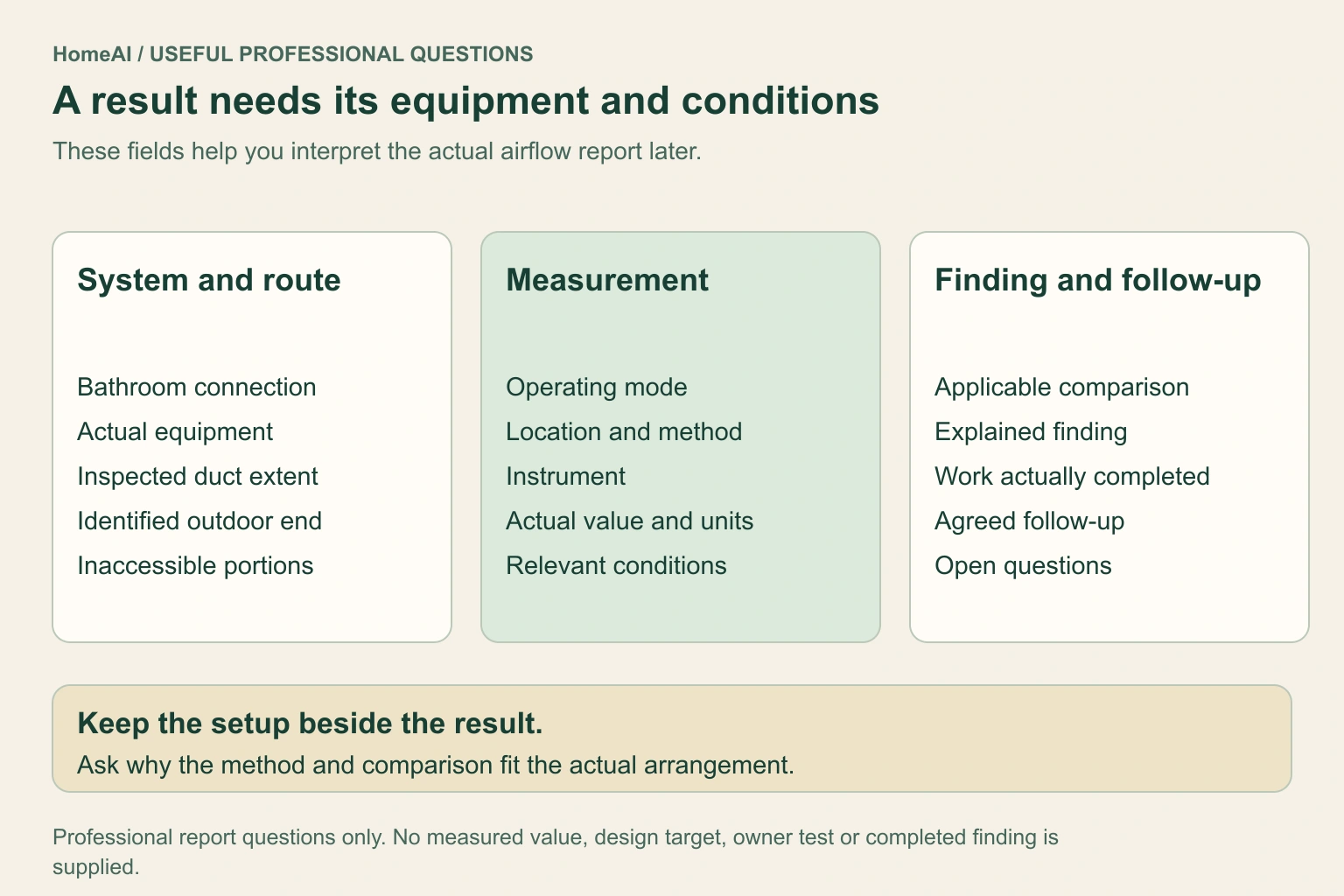
The field groups explain what is needed to interpret a professional result later, including inaccessible route limits and recorded operating conditions.
Numbers identify the parts explained below.
- System and route
Name the bathroom connection, actual equipment, inspected route and identified outdoor end. Retain what was inaccessible.
- Measurement
Retain mode, location, method, instrument, actual value, units and relevant conditions. A catalogue number is a different result.
- Finding and follow-up
Retain the applicable comparison, explained finding, completed work and agreed follow-up. A past result describes its recorded configuration.
What does this illustration leave out?
The diagram supplies no actual report, numerical target, approved design or completed work. Ask the professional to explain the real comparison and scope. Professional report questions, not directions to carry out an airflow or pressure test. Active CO alarms require leaving immediately.
What does the professional airflow result actually cover, and which questions remain open?
Explore this with HomeAI ↗Opens an editable question. Nothing is sent until you choose to send it.Keep the setup beside the result.
A result is easier to interpret when the record identifies the equipment, the route extent and how the measurement was made. These field groups are questions to ask the responsible professional, not an owner test procedure.
- System and route
- Name the bathroom connection, actual equipment, inspected route and identified outdoor end. Retain what was inaccessible.
- Measurement
- Retain mode, location, method, instrument, actual value, units and relevant conditions. A catalogue number is a different result.
- Finding and follow-up
- Retain the applicable comparison, explained finding, completed work and agreed follow-up. A past result describes its recorded configuration.
Airflow units describe air volume moved over time; keep the actual units rather than confusing a catalogue rating with a measured value. Ask the professional which project or local target applies and why the method fits the arrangement. No value, approved design, inspected finding or completed work is supplied here. Changes to equipment or the room can change what an old result describes.
Make the professional result useful later
- System and routeName the bathroom connection, equipment, inspected duct extent and outdoor end. · Identify what remains inaccessible or unverified.
- MeasurementRetain mode, location, method, instrument, value, units and relevant conditions. · Separate a catalogue number from the installed result.
- Finding and follow-upRetain the applicable comparison, explained finding, work scope and agreed follow-up. · A single result does not approve later changes or promise every surface stays dry.
How would a fictional quiet-fan upgrade be assessed?
Eli is a fictional owner who replaced a noisy fan with a quieter model. It runs, but the mirror still fogs after consecutive showers. The invoice identifies the replacement fan; it contains no airflow reading or verified route to the outdoor end. No defective-product finding has been made.
His ordinary-use notes describe the timer, door position and where moisture remains. He asks a ventilation contractor to identify the connected route, assess relevant restrictions and replacement air, and report airflow in the identified mode. A cold-surface or leak question can then receive its own suitable assessment.
If a restriction is later verified and corrected, the actual report should name that location, work and agreed follow-up. Eli keeps those findings alongside later room observations with bathing and weather context. The example invents no measured flow, price, compliance approval or guaranteed dry mirror.
The useful improvement is a clearer decision: retain the fan if its assessed role is suitable, address a verified route issue, or investigate a different moisture source. Those are possible outcomes to discuss with the professional, not conclusions supplied by this fictional story.
What should I maintain and retain after the assessment?
Keep the actual manual, control explanation, route findings, measured airflow and completed-work scope together. They explain how the system is meant to be used and what was actually checked. If dampness persists, follow the unresolved moisture question instead of repeatedly extending the timer without an explanation.
Follow the model’s maintenance instructions and safe access requirements. Visible grille soiling can be documented from ordinary room access and appropriate cleaning or service arranged. Do not stand on a bath edge, remove electrical covers, enter an attic or reach an outdoor hood at height for this lesson.
Shared-building fans and outdoor ends need the authorized owner, manager or service team. Health Canada’s ventilation publication principally discusses independently ventilated houses; its drawings cannot assign responsibility or approve changes in an apartment or other shared system.
Review the record after a fan, control, door, duct or wider ventilation change. A past result describes its recorded configuration. At a handover, explain which equipment serves the bathroom, how normal controls work and which findings or open questions the next occupant should retain.
Practice the distinction.
Eli asks why a quieter fan has not answered the moisture question
Fictional normal-use example: a quieter replacement fan runs, while mirror fogging continues and route/airflow records are unavailable.
Reported observations
- The replacement invoice identifies the fan.
- The mirror fogs after consecutive ordinary showers.
- The installed route and measured airflow have not been established.
Compare the explanations
Expand each possibility to see the evidence needed to distinguish it. Similar symptoms can have different mechanisms.
The connected exhaust arrangement needs assessment
The product rating may differ from installed performance because the actual route and replacement-air conditions matter.
A qualified route assessment and installed airflow report with mode, method, location, units and conditions.
A different moisture or cold-surface condition contributes
A cold mirror or another water source can coexist with a running fan.
The time and location pattern and a suitable ventilation, plumbing or building-envelope investigation.
A useful next question
Keep normal-use observations, identify the actual equipment and route, and request the scoped professional assessment before selecting another upgrade.
No actual flow reading, defect, price, national design value, health clearance or promised drying time is supplied.
Know what the words mean.
- Local exhaust
- A system that removes air near a source, such as a bathroom where bathing adds moisture.
- Installed airflow
- Air volume moving over time at a named measurement location, under the recorded operating conditions.
- Replacement air
- Air that reaches the room or home as exhausted air is removed. Its route affects performance and pressure.
- Termination
- The outdoor end of the connected exhaust route, such as its identified wall or roof hood.
Questions to bring
to the conversation.
- Which fan, central unit or HRV/ERV connection serves this bathroom?
- What records or assessment identify the actual route outdoors?
- Which normal mode operates, and what does the installed manual explain?
- Where does moisture appear, when, and under which ordinary bathing and weather conditions?
- What installed airflow was reported, with which location, mode, method, units and limits?
- Which professional finding and agreed follow-up address the actual complaint?
Separate a showing observation, an existing record and a new professional assessment. Unknown means a question remains; it does not automatically mean a defect.
Use the evidence planner ↗Go to the source.
Original HomeAI explanation informed by these public references. Sources support the underlying guidance; they have not reviewed or endorsed HomeAI. Diagrams are conceptual, and calculator outputs depend on your inputs.
References read for this refresh on October 5, 2026. Health Canada’s ventilation guide is a 2018 edition. The named Broan manual supports its applicable English models and instructions, not a national duct design or airflow target. Health Canada and NRCan provide federal education; Broan references describe their named product and operating context. Confirm the actual building arrangement and applicable local requirements.
Publication & source review
First published .
Sources reviewed .
- Health Canada · Ventilation and the indoor environment
- Health Canada · Guide to addressing moisture and mould indoors
- NRCan · Keeping the Heat In, section 9: operating your house
- NRCan · Certified ventilating fans
- NRCan · Humidity levels: cooling and ventilating equipment
- Broan-NuTone Canada · Bath and exhaust fan questions (manufacturer reference)
- Broan-NuTone · Roomside/Flex humidity-sensing fan manual (Canadian support; model-specific)
- Health Canada · Carbon monoxide: preventing exposure
Have a question about your home?
Start with the symptom, timing and what you have observed.
Ask HomeAI