- Capture rating, pressure drop and edge fit describe different properties; no one label establishes installed performance.
- Compare pressure-drop information at the stated airflow, size and loading condition before asking about equipment compatibility.
- Retain the actual filter/cabinet identity and qualified measurement context rather than diagnosing a restriction from noise or one cold room.
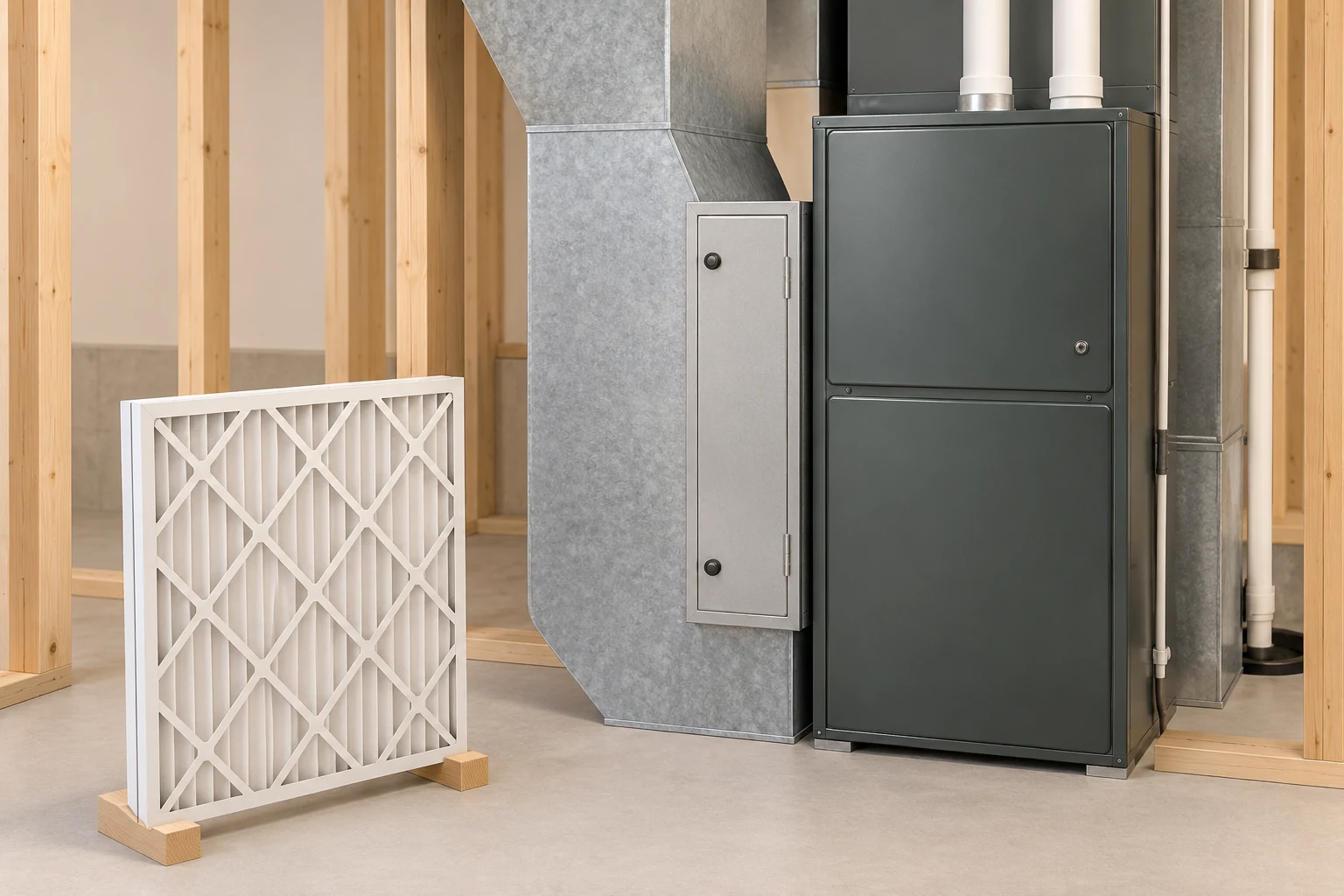
The filter sample is a freestanding teaching specimen. The nearby rack door and equipment covers remain closed.
About this illustration
Actual installed media, dimensions, rating, edge fit, fuel, complete routing, pressure drop, airflow and approved installation remain unknown. Visible pipes are specimens, not verified vent routes. This is a conceptual teaching model, not an assessment of your home.
2 picture lessons appear beside the questions in this guide. Use them to understand the explanation, then consider what it means for your home.
What does a capture rating tell me about the filter?
A particle filter intercepts some particles carried by air passing through its media. MERV, the minimum efficiency reporting value, describes tested particle-capture performance across specified particle-size ranges. It is useful information about the filter, rather than a measurement of how much air your home moves through it. The Public Health Agency of Canada separates filtration rating from fit and the forced-air system’s ability to handle resistance.
Ask what the intended improvement is: collecting ordinary dust, supporting a smoke-event plan or protecting a particular equipment arrangement. A higher capture rating can help with an appropriate particle task, but only air that reaches and passes through the media receives that treatment. Read a rating beside the actual part number and test information, rather than equating a larger printed number with better whole-home performance.
Particle capture also differs from removing every gas or solving a moisture source. Health Canada’s portable-cleaner guidance makes that distinction and explains that airflow and filter efficiency both matter. A furnace filter is not a carbon-monoxide alarm, a radon result or proof that room air is suitable for an individual’s health needs. Keep those questions in their own evidence files.
Which filter and cabinet does my home actually have?
Identify the equipment and separate filter cabinet through accessible labels, the supplied manual and service records. An illustrated pleated sample beside a closed cabinet is a teaching specimen; it does not reveal the media installed inside. Likewise, the dimensions printed on a spare filter do not establish that it is the correct replacement for the rack in front of you.
Record the installed part number, stated size and depth, cabinet model and date, where these can be established through authorised ordinary maintenance or a technician’s report. The reviewed Resideo F100/F200 guide lists replacement parts against specific sizes and models. That relationship illustrates why a similar-looking cartridge or a familiar brand name is insufficient identification.
Ask whether the rack, cover and filter arrangement were changed when heating or cooling equipment was replaced. Keep access clearance and permitted maintenance in the conversation: a filter that requires moving services or unsafe disassembly is a service-planning problem. Do not identify fuel, internal connections or correct installation from the cabinet’s colour, two white pipe specimens or a conceptual skeleton picture.
The sample is separate from the closed rack
The filter sample is a freestanding teaching specimen. The nearby rack door and equipment covers remain closed.
Numbers identify the parts explained below.
- Media sample
Pleats illustrate a media form. They do not identify the capture rating, resistance at a given flow or compatibility with your equipment.
- Closed rack
The actual rack and model instructions determine compatible dimensions and fit questions. This closed view cannot show an edge gap or measured bypass.
- Closed equipment
Fan behaviour and the installed system need scoped records and assessment. Keep hazardous machinery and covers closed.
What does this illustration leave out?
Actual installed media, dimensions, rating, edge fit, fuel, complete routing, pressure drop, airflow and approved installation remain unknown. Visible pipes are specimens, not verified vent routes. This illustration explains an idea. It is not an installation guide.
Which filter, cabinet instructions, fit evidence and qualified airflow or pressure-drop records apply to my actual system?
Explore this with HomeAI ↗Opens an editable question. Nothing is sent until you choose to send it.How are media resistance and edge fit different?
The media route and an edge-gap route answer different questions. Air passing through the porous filter experiences resistance as it moves among the fibres. An opening that lets air avoid the media creates a possible bypass route. Capture efficiency assigned to the media does not quantify what happens to air that never passes through it.
Imagine two otherwise similar teaching specimens: one has the media seated against an illustrative frame; the other adds a separate edge opening. The second route does not mean a measured fraction of air bypasses a real filter. Its share would depend on the actual openings, pressures and resistance. A drawing can explain the distinction without predicting a particle concentration or declaring a rack sealed.
Physical insertion is therefore only one part of fit. Ask a professional to establish whether the specified cartridge seats correctly and whether the relevant enclosure and joints prevent unintended routes. Do not stuff a gap with household foam, tape an access cover indiscriminately or alter the cabinet. The remedy must suit the identified installation, access requirements and equipment instructions.
Air that avoids the media is a separate question.
Explore two illustrative drawings. An edge route can bypass the media; its presence and flow at a real rack require their own evidence. Filter rating, media resistance and edge fit answer different questions. Neither model predicts airflow, leakage or capture efficiency.
Choose a drawing above. Neither model certifies actual rack fit or performance.
- Media route: resistance and filtration performance depend on the actual media, flow and equipment.
- Edge route: an illustrative path around the media explains a different fit question. The drawing provides no measured bypass fraction.
- Actual evidence: keep the cabinet closed; review compatible media dimensions and model instructions, and ask a qualified professional about safe fit and performance assessment.
Route marks are symbolic. Optional motion starts paused and follows reduced-motion and page-pause settings. No control operates real equipment or sends a request.
Why does a pressure-drop number need an airflow beside it?
Pressure drop is the pressure difference associated with air passing through the assessed component under stated conditions. It is commonly reported in pascals or inches of water column. Airflow is a different quantity, commonly litres per second or cubic feet per minute. A number with neither its units nor its test flow is incomplete comparison evidence.
Resideo’s named F100/F200 documentation plots initial filter pressure drop against airflow, with separate curves for different filter sizes. Those curves teach a relationship: the same identified product does not have one pressure-drop value for every operating flow. They are manufacturer data for the named equipment, not a field measurement at your home or a curve to assign to an unrelated filter.
When comparing alternatives, ask for the exact products’ data at a comparable airflow, size and condition. Keep initial clean-filter information separate from a later loaded-filter result. A conceptual upward curve can explain that resistance generally changes as more air is pushed through a specimen; without validated product data it cannot calculate your system’s operating point or provide a replacement threshold.
Why can the fan respond differently to the same added resistance?
Airflow results from the interaction between the blower, its control and the resistance of the installed air route. The filter is one part of that route alongside ducts, grilles and other equipment. Added resistance need not produce the same response in every system. The response also depends on the operating mode and the blower’s available capability.
NRCan describes electronically controlled motors that can compensate for restrictions while consuming more power to do so. This is different from promising that any variable-speed equipment maintains any requested flow. A technician must relate the actual model, control configuration and operating limits to the installed system. Loudness alone cannot reveal whether flow stayed constant, fell or changed for another reason.
Heating, cooling and ordinary fan modes may request different airflow. A filter assessment in one mode should state whether the conclusion extends to others. Room comfort adds another layer: distribution and room heat loss can still matter after filter compatibility is established. Keep the broader cold-room investigation in the heating-airflow guide instead of assuming every complaint began inside the rack.
A route is different from a tested system
Visible routes locate different system functions. Closed equipment keeps this a planning illustration.
Numbers identify the parts explained below.
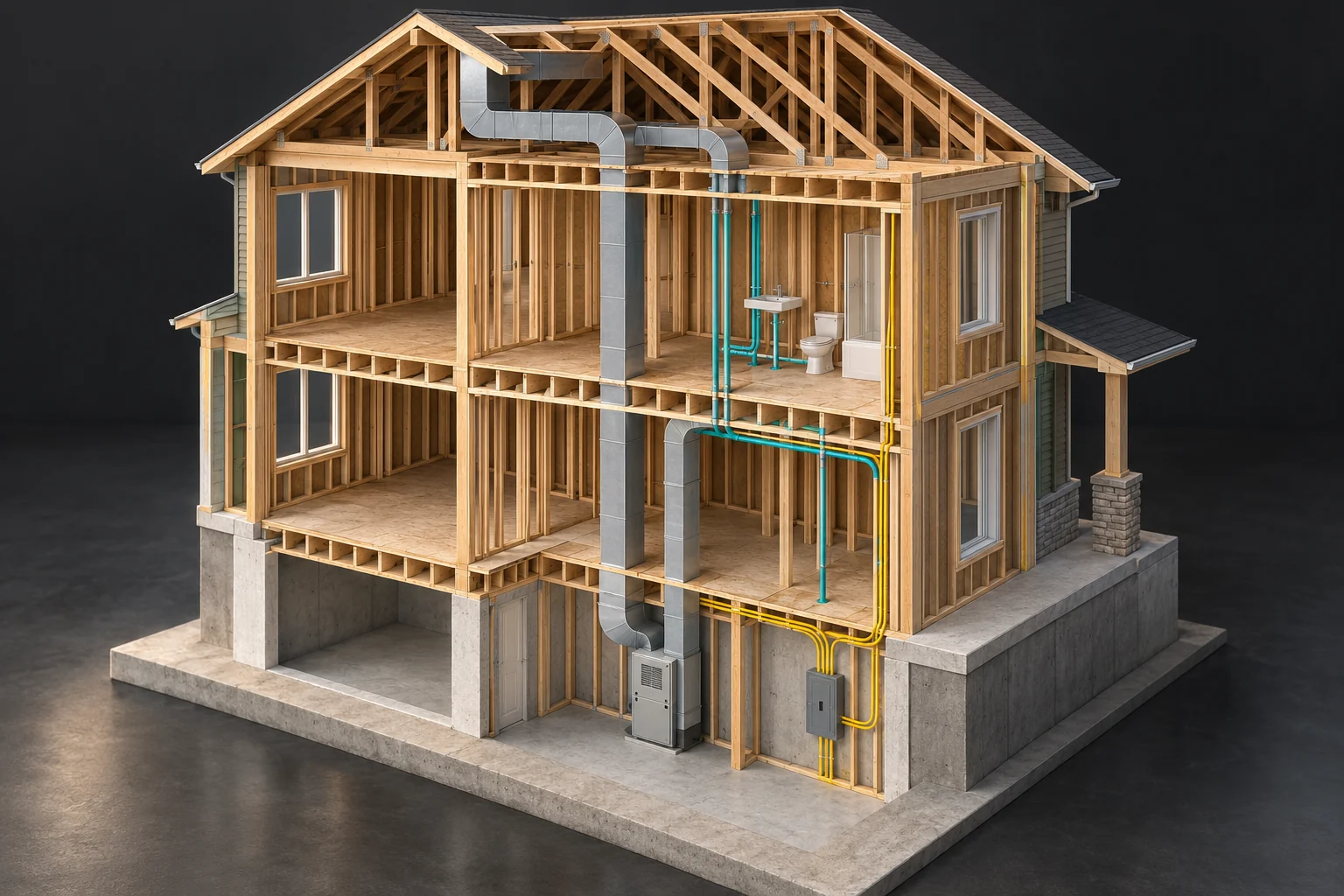
- Routes
Trace the question using records; colour is only this illustration’s key.
- Closed equipment
A professional defines access and measurements. Do not open a panel for this lesson.
- Room endpoint
A symptom at one room does not locate the fault.
What does this illustration leave out?
Capacity, continuity, hidden condition, electrical safety and actual delivered performance are not established. This illustration explains an idea. It is not an installation guide.
Which safe observations and specific professional measurements would resolve this system question?
Explore this with HomeAI ↗Opens an editable question. Nothing is sent until you choose to send it.Is a higher-rated or thicker filter always the better choice?
Select against the actual equipment requirements and the proposed task. Depth, media area, product construction, dimensions and installation can influence resistance; depth alone does not create a compatibility verdict. A deeper cartridge is not an invitation to cut a larger opening, stack filters or install a second unassessed filter along the same route.
The Resideo professional guide requires checking product suitability and trained installation, and identifies a return-side arrangement for its listed models. Use it as an example of specific documentation, not approval to install that cabinet on any home. Ask the qualified contractor how the equipment instructions, available space, proposed filter and system airflow were reconciled.
During wildfire smoke, Health Canada recommends filtration that the system can handle according to the manufacturer. That does not translate into one national MERV recommendation for every existing furnace or heat pump. A compatible central option, an appropriately selected portable cleaner and a plan to remain cool may serve complementary purposes. Keep current local smoke and heat advice attached to the plan.
What can I record safely after a filter change?
Preserve the old and new specifications, replacement date and any service explanation. From normal occupied-space use, note changes in noise, thermostat behaviour, room comfort or visible error messages. Identify the mode and whether several rooms share the pattern. A before-and-after chronology is useful even when it does not establish that the filter caused the change.
Follow the exact manual for routine accessible maintenance, including safe shutdown and closure where required. If the permitted access or procedure is unclear, arrange service. Do not run equipment with a cover removed, defeat a door interlock, reach a blower or drill pressure-test openings. A detached filter specimen in a picture is not a suggestion to operate a real system without its filter.
A dirty appearance, a whistle or air felt at a grille cannot quantify pressure drop or delivered flow. Document the observation rather than converting it into a clogged-filter diagnosis. Stop improvised experiments and seek prompt qualified help for abnormal equipment behaviour. A CO alarm or suspected gas escape requires leaving and contacting emergency services or the applicable utility from outside.
What should a qualified filter and airflow assessment report?
Ask the HVAC professional which measurements can answer the stated question. A pressure difference across the identified filter differs from a pressure assessment of a larger equipment or duct boundary. The report should name the measurement locations and included components so a filter result is not silently re-labelled total system pressure.
Useful context includes equipment and filter identity, filter condition, operating mode, relevant blower/control configuration, measurement method and instrument, result and units. If airflow was measured or derived, ask how and under which assumptions. The professional should identify the applicable manufacturer or design limit used for interpretation and explain whether the chosen method supports that comparison.
Keep a finding such as the cartridge did not seat against the assessed edge separate from a measured pressure result and a recommended modification. Ask what remains outside the assessment, including other modes or room distribution. This record is a request for accountable evidence; it supplies no drilling locations, universal static-pressure allowance or homeowner balancing procedure.
How would a fictional upgrade concern be resolved?
A fictional owner buys a more highly rated filter with the same printed face dimensions as the previous one. After replacement, the equipment sounds different and an upstairs room feels cooler. There is no confirmed cabinet model or qualified airflow record. The timing is real evidence within the example, but neither a restrictive product nor a failed furnace has been established.
The owner records both part numbers, the replacement date, heating mode and affected rooms, then asks a technician to assess compatibility and fit. Suppose the visit finds a mis-seated edge and also produces a pressure reading in one documented heating mode. Those findings need their own entries: correcting an observed seating issue is not proof that all other resistance or distribution questions were resolved.
The technician explains the accepted replacement and any further measurement needed in cooling. The owner retains that advice and a follow-up record of normal room behaviour. No invented pressure value, airflow percentage or repair price is needed to make the example useful. The improvement is a decision tied to specific evidence, with the remaining room-comfort question still visible.
How should I maintain a filter record without inventing an interval?
Keep the model instructions and the professional’s property-specific maintenance advice together. Calgary’s maintenance page discusses checking filters, while the named Resideo documents provide their own product guidance. These sources have different equipment and scope. Treat a generic calendar reminder as a prompt to review the relevant instructions, rather than proof that every filter lasts the same number of months.
Record each authorised inspection or replacement with date, part, observed condition and relevant events such as renovation dust or smoke. Visible loading is useful context but does not independently quantify remaining capture or resistance. Ask whether an unfamiliar change in condition calls for a service assessment, especially after the cabinet, blower settings or equipment have changed.
For a buyer, seller or new-home occupant, pass on the accepted replacement specification, access demonstration, manuals and any measured baseline. Keep old reports dated to their configuration. Your next evidence task is simple: identify the missing model or part information, then ask one named professional question about fit, resistance or airflow. Buying another filter is a later decision, supported by that answer.
Practice the distinction.
Same printed size, a different operating observation
Fictional learning scenario: an owner changes filter type, then hears different equipment noise and notices one cooler room.
Reported observations
- Old and new part numbers can be recorded.
- The cabinet and accepted replacement are not yet confirmed.
- The noise and room pattern changed after replacement.
- No field airflow or pressure result is available.
Compare the explanations
Expand each possibility to see the evidence needed to distinguish it. Similar symptoms can have different mechanisms.
Filter compatibility or fit needs assessment
Media resistance and an edge-seating question are distinct possibilities.
Identified equipment/part instructions and qualified fit, pressure and airflow assessment where appropriate.
Another distribution or operating factor contributes
Timing and one room’s response do not establish the source of a system change.
A scoped assessment of mode, control, delivered airflow and room conditions.
A useful next question
Recover model and filter identity, document normal-use conditions and ask for an assessment that separates fit from measured performance.
No universal MERV, replacement interval, pressure allowance, product diagnosis or running-open test is supplied.
Know what the words mean.
- MERV
- Minimum efficiency reporting value: a tested particle-capture rating, distinct from installed airflow or pressure drop.
- Media resistance
- Resistance encountered by air passing through the porous filter material under a stated condition.
- Bypass
- An unintended route that can allow air to avoid the assessed filter media; a real share requires evidence.
- Pressure drop
- Pressure difference across a specified assessed component or boundary, reported with units and operating context.
- Loaded filter
- A filter that has collected material during use; appearance alone does not quantify its resistance or remaining capture.
Questions to bring
to the conversation.
- Which equipment, cabinet and replacement filter part are actually identified?
- Does the exact model documentation explain permitted filters, maintenance access and operating limits?
- At which airflow, size and clean/loaded condition does the proposed product pressure figure apply?
- Who has assessed fit, bypass and airflow in the installed arrangement?
- What changed after replacement, and what qualified measurements would distinguish competing explanations?
Separate a showing observation, an existing record and a new professional assessment. Unknown means a question remains; it does not automatically mean a defect.
Use the evidence planner ↗Go to the source.
Original HomeAI explanation informed by these public references. Sources support the underlying guidance; they have not reviewed or endorsed HomeAI. Diagrams are conceptual, and calculator outputs depend on your inputs.
Publication & source review
First published .
Sources reviewed .
- Public Health Agency of Canada · Home ventilation and filtration
- Health Canada · Protecting indoor air during wildfire smoke
- Health Canada · Using a portable air cleaner
- Natural Resources Canada · Keeping the Heat In, section 9: operating your house
- City of Calgary · Home maintenance: furnace and filter questions
- Resideo · F100/F200 media air cleaners quick-start guide, revision 05-23
- Resideo · F100/F200 professional installation guide, revision 5-23
- Health Canada · Carbon monoxide: preventing exposure
- FortisBC · Gas leaks and odour
Have a question about your home?
Start with the symptom, timing and what you have observed.
Ask HomeAI