Jump to a question in this guide
- What are the three connected parts you are buying?
- Which source arrangement does the home actually have?
- How does the ground supply useful heat?
- Why do buried location records matter before yard changes?
- What can installation and commissioning records establish?
- How do replacement equipment and retained distribution change the enquiry?
- What can a showing, comfort history and bills add?
- Who can resolve the remaining purchase questions?
- What does a fictional older-loop purchase reveal?
- What belongs in the final source-system handover?
- Follow the source loop or water route, indoor heat pump and separate room delivery.
- Separate actual records, reported history, safe observations and professional findings.
- Keep unresolved scope and local-law or design limits with the decision.
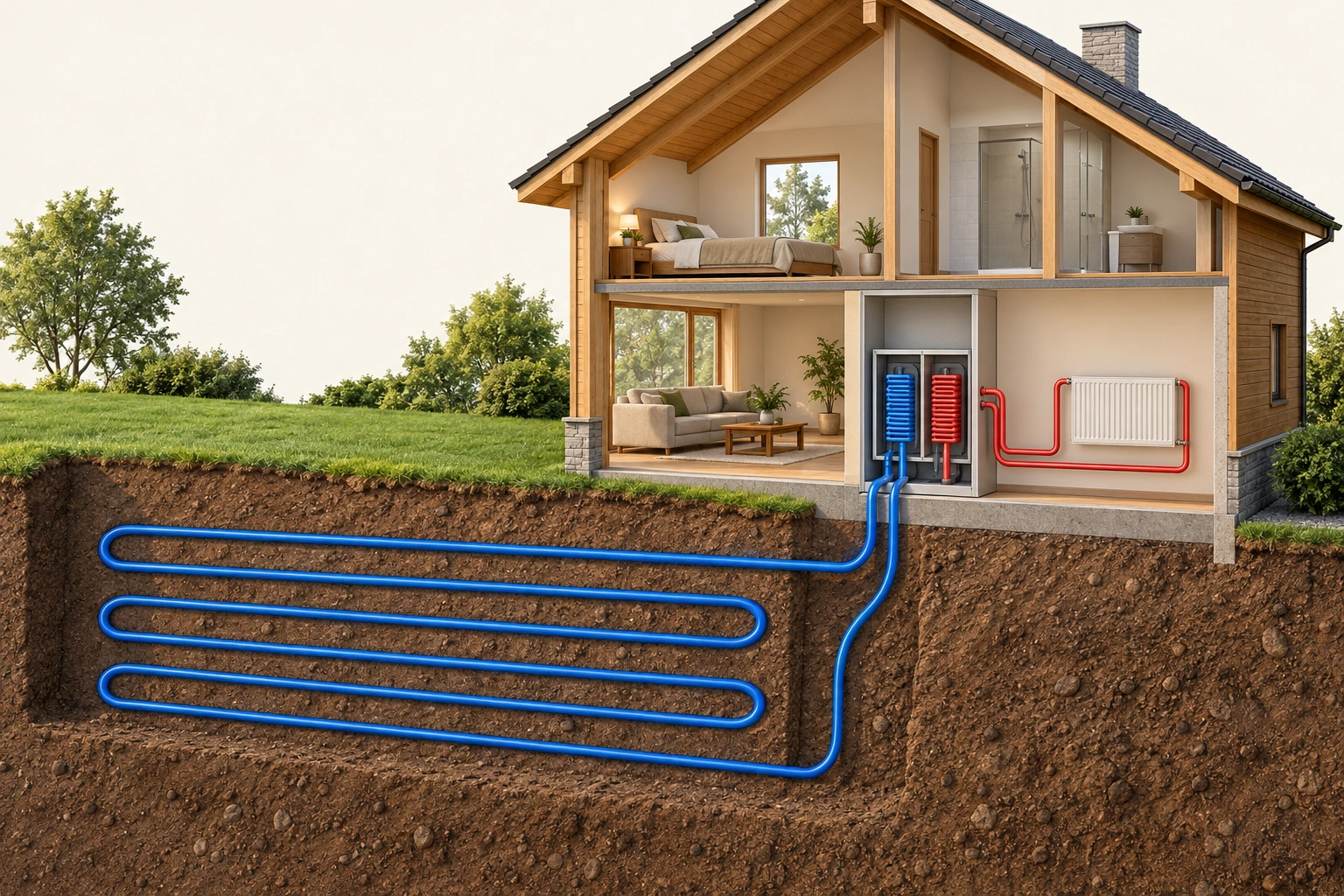
The blue buried route carries source-side fluid to and from the equipment; the red route connects the equipment with a room radiator. Heat moves between source and room delivery through the heat pump, but its refrigerant cycle and compression are not traced in this picture.
About this illustration
Cabinet coils are schematic. No complete refrigerant circuit, exchanger internals, loop depth, sizing, hydronic temperature compatibility or actual installation geometry is established. This is a conceptual teaching model, not an assessment of your home.
6 picture lessons appear beside the questions in this guide. Use them to understand the explanation, then consider what it means for your home.
What are the three connected parts you are buying?
A ground-source heat pump moves heat between the home and a ground or water arrangement. The buried or submerged source system exchanges heat with its surroundings. The heat pump uses electrical work and refrigerant to move that heat to a useful receiving temperature. The home's distribution then carries useful heat to the intended rooms. All three parts belong in the purchase enquiry.
In a common closed secondary-loop arrangement, one fluid circulates through the ground loop and returns to the equipment. Refrigerant follows a different circuit within the heat pump, with heat passing between the circuits at an exchanger. Room air or a separate water-based distribution receives the delivered heat. The fluids should not be imagined as one continuous pipe carrying garden water into bedroom radiators.
During heating, the source side supplies heat to the heat pump; in a reversible cooling arrangement the system can send heat from the home toward the ground. The actual installed design determines its functions. A ground-source label does not prove cooling, domestic-hot-water service or every room's coverage. Ask the qualified provider to identify what this particular installation is intended to do.
This guide owns the concealed source-system purchase question. The existing heat-pump cycle guide explains refrigerant and energy quantities, while the general purchase guide covers equipment identity, room coverage and handover. Here those connect to loop location, fluid identity, well or water routes, environmental context and later yard work. A new indoor cabinet is only part of that evidence chain.
Observe through ordinary authorized access, leaving cabinets and service components closed. Do not dig, open a chamber, release fluid, operate unfamiliar valves or stage unusual operation. The illustrations explain separate conceptual arrangements rather than a design for the property. Qualified mechanical, ground-loop or well specialists and the responsible authority answer the actual technical and permission questions.
Source heat and room delivery follow separate routes
The blue buried route carries source-side fluid to and from the equipment; the red route connects the equipment with a room radiator. Heat moves between source and room delivery through the heat pump, but its refrigerant cycle and compression are not traced in this picture.
Numbers identify the parts explained below.
- Blue ground route
Carries source-side heat-transfer fluid. Its conceptual path returns to the equipment.
- Equipment cabinet
Connects source heat with room delivery. Colored coils are schematic; refrigerant cycle and compression are omitted.
- Red room route
Carries useful heat toward a radiator. Actual emitter compatibility and room coverage need assessment.
- Heat-transfer relationship
Keeps the two fluid routes separate. The picture is a mechanism prompt, not an installed design.
What does this illustration leave out?
Cabinet coils are schematic. No complete refrigerant circuit, exchanger internals, loop depth, sizing, hydronic temperature compatibility or actual installation geometry is established. This illustration explains an idea. It is not an installation guide.
Which record and qualified scope establish the source route, equipment and room delivery?
Explore this with HomeAI ↗Opens an editable question. Nothing is sent until you choose to send it.Which source arrangement does the home actually have?
Ask the provider to identify the system from its records: closed secondary loop, open water arrangement or direct exchange. NRCan's Types—ground source heat pump page distinguishes those alternatives. They change which fluid moves below ground and which components belong to the specialist's scope. A listing using geothermal is insufficient to choose one, and it does not imply deep geothermal electricity generation.
A closed secondary loop recirculates a heat-transfer fluid through a continuous pipe arrangement. Heat passes between that fluid and the heat pump's refrigerant at an exchanger. The source pipe might follow horizontal ground routes, boreholes or a submerged arrangement. Those alternatives should remain distinct until the property's actual records identify the installation; an illustration of one cannot prove the others are absent.
An open system draws water through a source and discharge route. The water's availability, characteristics, pumping and receiving arrangement become part of the enquiry. Do not assume that an apparent well is the household drinking-water well or that another nearby well is a suitable receiving destination. The actual system drawing and qualified provider must identify their jobs.
In direct exchange, refrigerant itself circulates through the ground-side tubing, rather than transferring heat through the separate secondary fluid circuit described above. That distinction changes the qualified service and evidence questions. A buyer should not identify fluid by colour or pipe appearance, sample it or disconnect a fitting. Request the system and fluid identities from the responsible professional.
NRCan's short types page describes surface-water sources, while its longer Heating and cooling with a heat pump body warns against surface water in its open-system discussion. These descriptions cannot establish that a particular lake or well arrangement is suitable. Keep that difference explicit and obtain the actual design, equipment requirements and local environmental-authority answer. This guide selects no water source or discharge method.
Closed-loop, open-water and direct-exchange paths
The type determines which fluid travels below ground and which records and qualified scope matter.
Numbers identify the parts explained below.
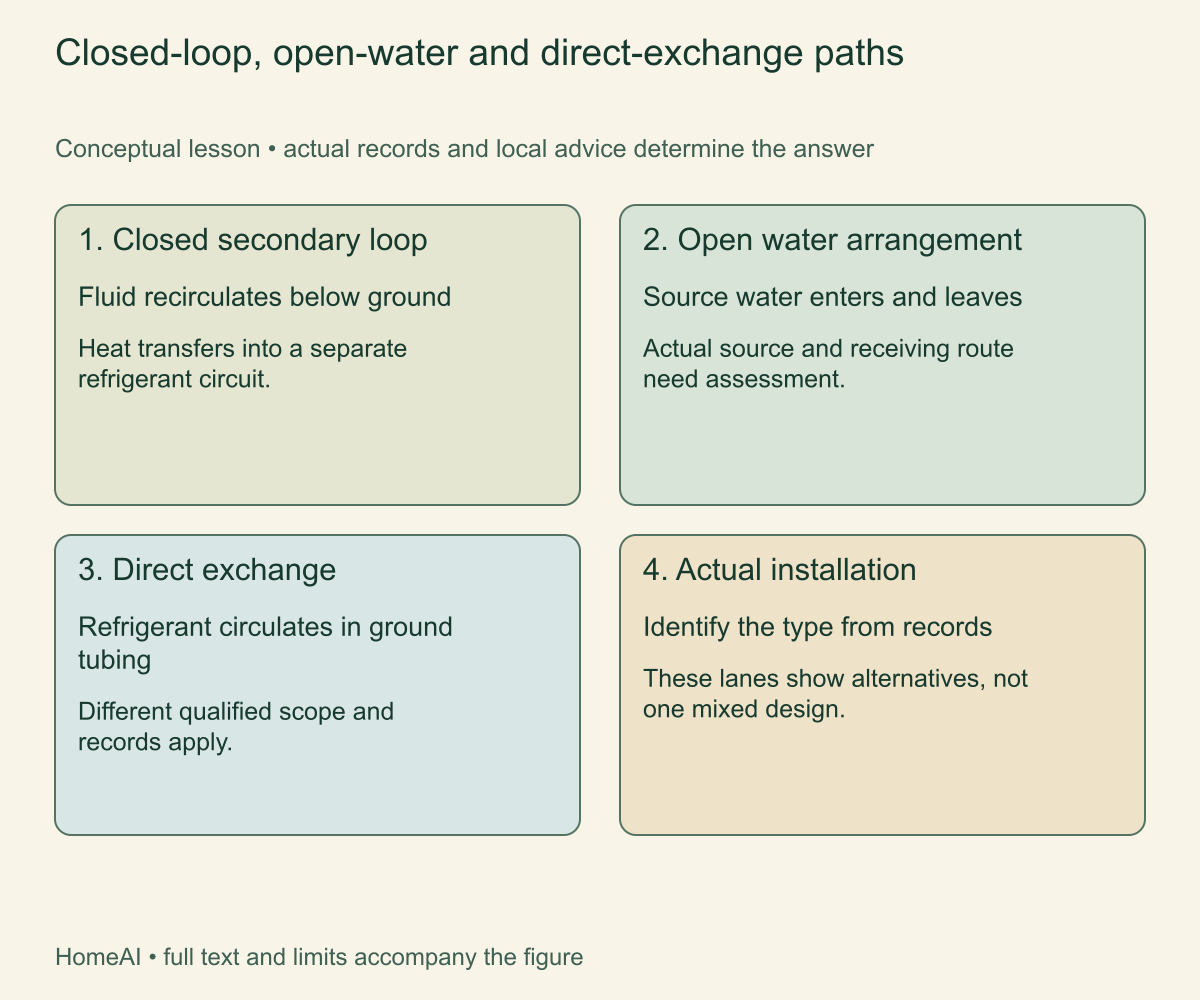
- Closed secondary loop
Fluid recirculates below ground. Heat transfers into a separate refrigerant circuit.
- Open water arrangement
Source water enters and leaves. Actual source and receiving route need assessment.
- Direct exchange
Refrigerant circulates in ground tubing. Different qualified scope and records apply.
- Actual installation
Identify the type from records. These lanes show alternatives, not one mixed design.
What does this illustration leave out?
No actual pipe route, loop sizing, fluid reading, equipment diagnosis or installation approval. This illustration explains an idea. It is not an installation guide.
Which record and qualified scope establish the source route, equipment and room delivery?
Explore this with HomeAI ↗Opens an editable question. Nothing is sent until you choose to send it.How does the ground supply useful heat?
Heat transfer needs a temperature difference and an appropriate exchange path. In heating, the source fluid absorbs heat from the surroundings under the system's operating conditions. At the heat pump, that energy is transferred into the refrigerant cycle. Compression raises the refrigerant's pressure and temperature so it can release useful heat on the receiving side. Electricity provides the work enabling the transfer.
The loop is therefore an exchanger, not fuel that is consumed and periodically replaced like an oil delivery. Its performance relates to the actual ground or water conditions, installation and heat-pump demand. NRCan's longer body discusses matching the ground exchanger and equipment and the balance of energy drawn and replenished over time. A buyer needs the professional design basis rather than a guessed adequate loop length.
Cooling, if provided, changes the heat-transfer direction and operating relationships under the installed design. Ask which functions were selected and commissioned. A thermostat offering a cooling label does not establish that every relevant part supports the intended service. Some designs and controls can differ from the simplified reversible example. Retain the actual manual and provider's explanation.
Stable ground conditions relative to outdoor air do not mean unlimited output, identical conditions all year or a guarantee of cheap heat. The building still has a heating requirement, and the installed system still has capacity and operating limits. Keep the source, equipment and room questions separate when a sales description turns a broad efficiency advantage into a promise about this home.
Have the specialist explain the source-side design assumptions and how they relate to the present building. A later addition, changed heated area or replacement heat pump can raise a new matching question. The existence of a long-established loop is useful history, but it cannot by itself establish suitability for an altered demand or a different indoor unit.
Why do buried location records matter before yard changes?
Ask for the actual source layout and the records describing installation. Horizontal routes, boreholes and connecting headers can occupy different portions of a site. A header joins loop branches to the equipment route; knowing a borehole location alone may leave its connecting piping unknown. An accessible pipe entering the wall does not reveal where that route travels outside.
Link plans to the actual property identifiers and revisions. Distinguish a design drawing from a record of installed locations, and ask the responsible provider how the latter was established. A neat seller sketch can help frame the enquiry while remaining an unverified account. A coloured plan is not automatically a measured location record or permission to excavate along its unmarked area.
Tell the advisers about planned landscaping, a pool, an addition, drainage work or another ground disturbance before assigning it a budget. The proposed activity may intersect source infrastructure or affect its access and supporting conditions. Have the relevant professionals and authority coordinate the actual enquiry. This guide gives no safe digging depth, offset, exclusion zone or method for locating pipes personally.
Alberta's current Groundwater—Management page identifies a regime for covered ground-source systems above the Base of Groundwater Protection, including a vertical closed-loop drilling context and reporting. Its listed subjects include siting, installation, fluids and reclamation. That is a named provincial example of why the ground installation has its own records and specialist responsibility. It is not an approval for another province or this property.
If source infrastructure is near a boundary or uses water or land beyond the apparent yard, ask the legal and technical advisers to establish the actual rights and routes. A fence does not supply those rights. Keep the title/survey enquiry connected without asking a mechanical provider to decide land interests or a legal adviser to certify concealed piping condition.
Boreholes and headers need their actual location records
The two blue U-shaped borehole loops connect toward equipment through near-surface routes. The orange outline marks a fictional proposed change, showing why both loop and header locations belong in a yard-work enquiry.
Numbers identify the parts explained below.

- Two U-shaped loops
Exchange heat through the source arrangement. Conceptual boreholes have no measured depth.
- Connecting routes
Lead source fluid toward equipment. Actual header and hidden connections require records.
- Orange outline
Marks a fictional proposed change. It is not a safe excavation area or clearance.
- Equipment area
Receives the conceptual source routes. Qualified and authority review precede actual work.
What does this illustration leave out?
No measured borehole depth, pipe route, safe clearance, excavation location, full hidden connection or approval is established. This illustration explains an idea. It is not an installation guide.
Which record and qualified scope establish the source route, equipment and room delivery?
Explore this with HomeAI ↗Opens an editable question. Nothing is sent until you choose to send it.What can installation and commissioning records establish?
Collect the exact heat-pump identity, source-system identity and distribution description. Request the applicable design, installation and commissioning records, relevant borehole or well records, fluid information and actual authority documents through authorized channels. The useful file identifies which records concern the indoor unit, which concern the source side and which concern delivery to rooms.
Commissioning is verification under a defined scope and recorded conditions. Ask what was checked, what findings were recorded and what was excluded. Source-side measurements, equipment operation and room delivery answer related but different questions. A general equipment start-up sheet should not silently become a report on every buried joint, every season or each room's comfort.
Where specialist readings are supplied, retain the method, units, operating conditions and interpretation with them. A number copied without context can look precise while answering little. The buyer should ask the author what conclusion the result supports and which question needs another scope. This guide supplies no target fluid pressure, flow, temperature difference or household test procedure.
Keep permission records separate from performance evidence. An applicable drilling or installation record concerns its actual administrative scope. A professionally recorded operating check concerns the task and date. A closed process does not guarantee unlimited future performance, while an apparently functioning unit does not establish that all relevant permissions and reporting were completed.
If a record is absent, ask who can reconstruct the appropriate information and what limitations would remain. Missing paperwork is a documentation question before it is a condition verdict. Some concealed details may not be recoverable without a separately authorized investigation. Keep that consequence visible instead of filling the file with a brochure for a similar-looking heat pump.
One commissioning folder, three scopes
A check of the indoor unit does not automatically verify the buried loop or every room.
Numbers identify the parts explained below.
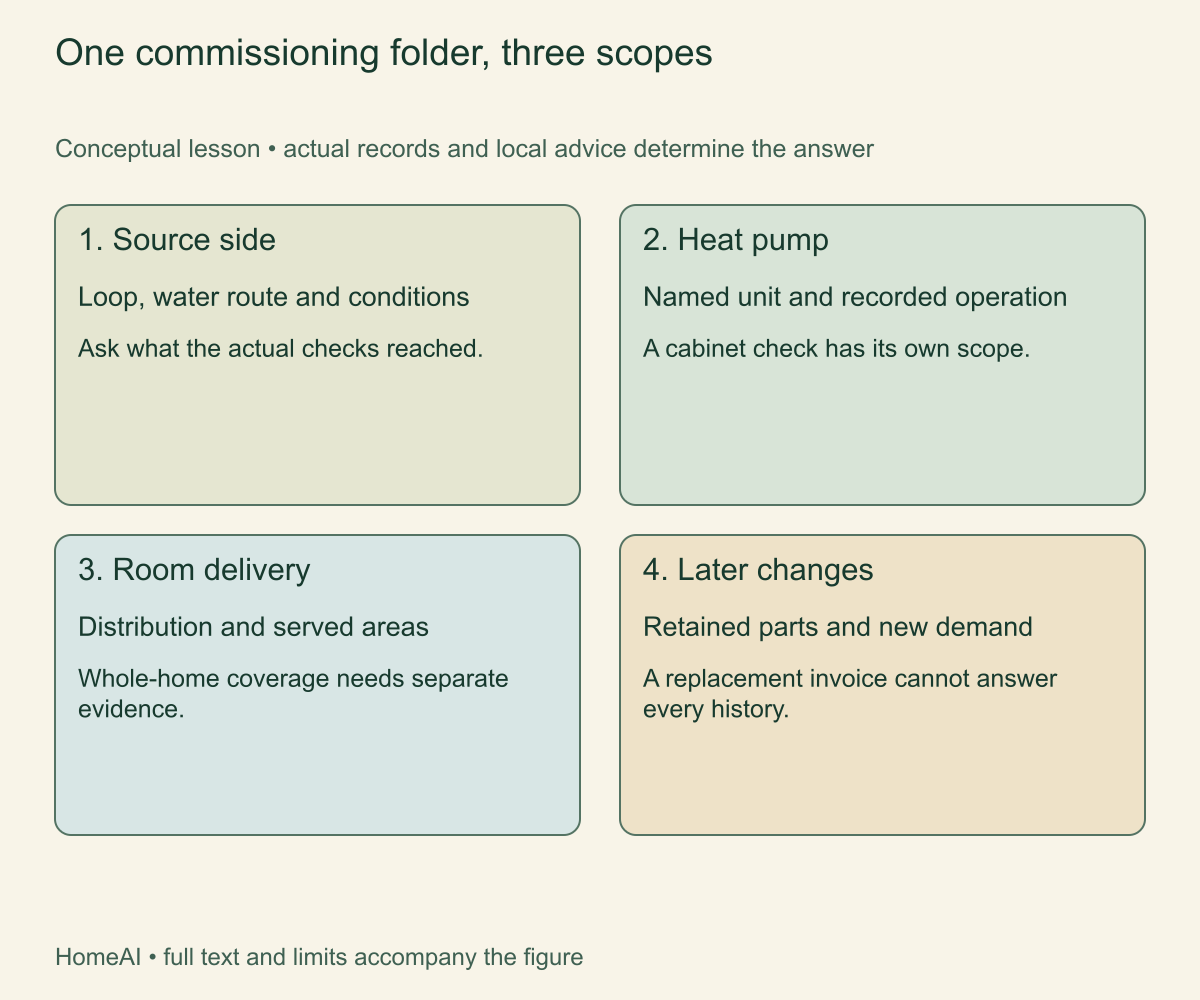
- Source side
Loop, water route and conditions. Ask what the actual checks reached.
- Heat pump
Named unit and recorded operation. A cabinet check has its own scope.
- Room delivery
Distribution and served areas. Whole-home coverage needs separate evidence.
- Later changes
Retained parts and new demand. A replacement invoice cannot answer every history.
What does this illustration leave out?
No actual pipe route, loop sizing, fluid reading, equipment diagnosis or installation approval. This illustration explains an idea. It is not an installation guide.
Which record and qualified scope establish the source route, equipment and room delivery?
Explore this with HomeAI ↗Opens an editable question. Nothing is sent until you choose to send it.How do replacement equipment and retained distribution change the enquiry?
A replacement indoor heat pump can retain an older ground installation and existing ducts or water-based emitters. The installation dates may therefore differ. Ask which components were replaced, retained, adapted or assessed. An invoice saying new geothermal system may need explanation if its actual scope covered only the cabinet and associated work inside the house.
The receiving side matters too. Ducts move conditioned air to intended spaces; a hydronic arrangement carries heat through water-based distribution and its emitters. Ask the mechanical provider to explain compatibility with the selected equipment and the building's assessed needs. This guide gives no operating water temperature, duct size or authority to alter an existing radiator system.
An extension or newly finished room can sit outside the original coverage record. Identify it explicitly rather than assuming every room in today's listing existed in the design. A room with a grille or a warm floor has an observable feature without an established delivery capacity. The appropriate professional should reconcile the current layout, distribution and design assumptions.
Supplementary heating has its own equipment and control sequence. Ask what it is intended to contribute and how the actual provider documented coordination. Do not import an air-source outdoor-temperature cutoff into a ground-source system. Nor should the presence of auxiliary equipment be treated as evidence of failure. Its intended role and actual operation need their own explanation.
Keep domestic-hot-water claims similarly specific. Some arrangements may contribute to water heating, but a nearby tank does not establish the connection or contribution. Ask which equipment does which job and what the actual records verify. A whole-home energy claim must not be built by counting the same delivered heat twice or assuming every tank is fully served by the heat pump.
What can a showing, comfort history and bills add?
An authorized showing provides observations under that visit's conditions. Record normal displayed information, reported operation and room differences without changing installer settings. Distinguish what the seller describes from what was observed and what a professional measured. A quiet cabinet, warm room or clean yard does not reveal the condition of every concealed source component.
Request relevant service and operating history through the appropriate representative. A recurring concern can involve source-side conditions, equipment, controls, distribution, building heat loss or changes in use. These are alternative enquiries rather than a diagnosis from one symptom. A qualified provider defines which checks can distinguish them safely and what remains outside that engagement.
Bills describe accumulated account use and charges. Weather, occupied area, household activity, other electrical loads, tariffs and supplementary heat can affect comparison. Use the existing energy-bill guide to separate quantity, period and charges. A seller's low total is neither a measured loop efficiency nor a forecast for another household's future consumption.
A product efficiency figure has a stated test condition and boundary. It should not be combined with an unrelated whole-house bill to calculate installed system performance. Ask for the actual provider's explanation when performance matters to the purchase. The guide offers no COP guarantee, savings percentage, payback period or standardized allowance for replacing a buried installation.
Do not simulate a fault or force extended operation to make a viewing more convincing. No buyer should release loop fluid, run an open-water system without proper oversight or interrupt occupied-home services as a test. A missing answer leads to an authorized scoped professional enquiry, not an improvised household experiment with pressure, water or refrigerant.
A higher bill has several possible contributors
A bill combines household use and system operation. It organizes questions without measuring a ground loop’s performance.
Numbers identify the parts explained below.
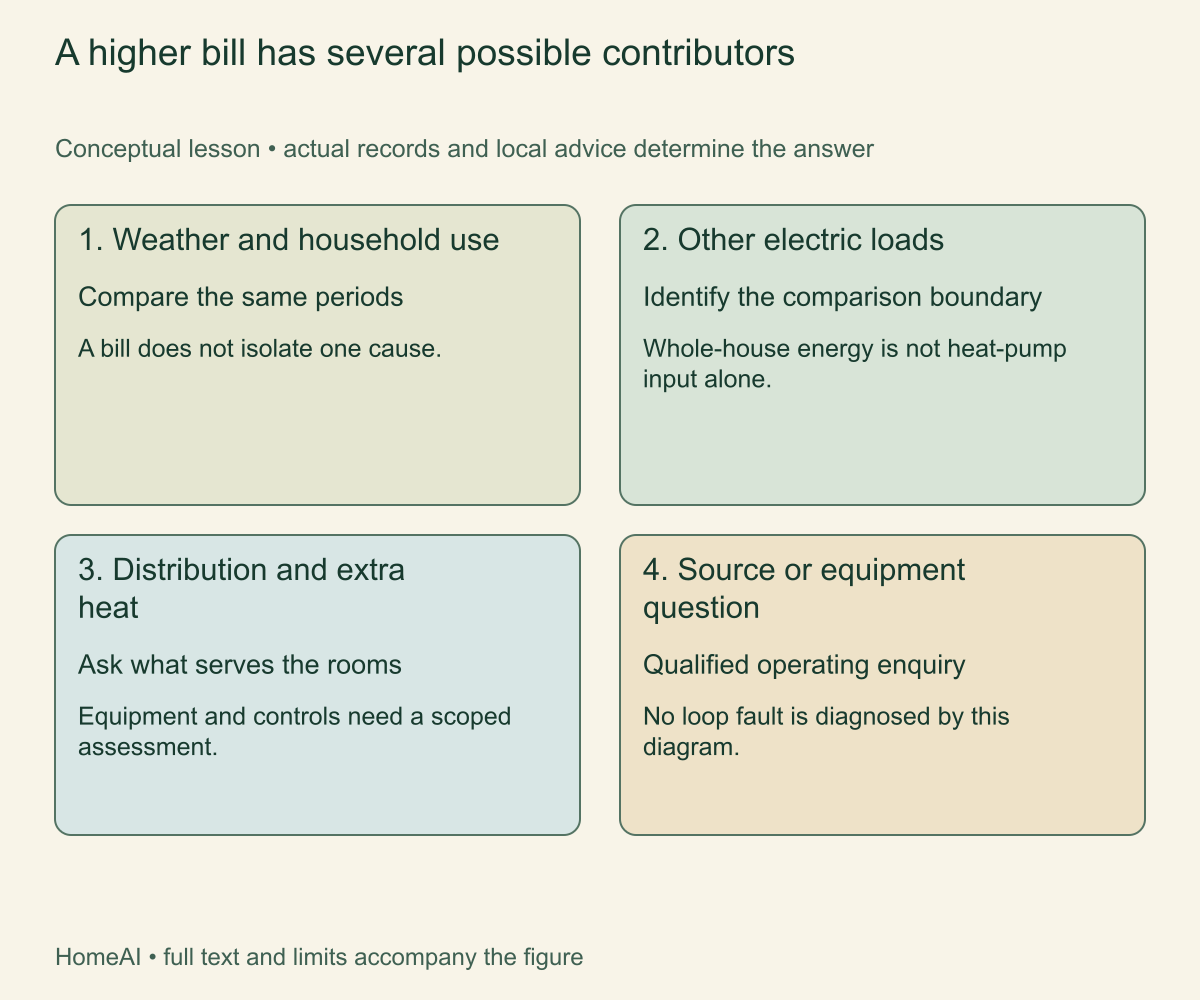
- Weather and household use
Compare the same periods. A bill does not isolate one cause.
- Other electric loads
Identify the comparison boundary. Whole-house energy is not heat-pump input alone.
- Distribution and extra heat
Ask what serves the rooms. Equipment and controls need a scoped assessment.
- Source or equipment question
Qualified operating enquiry. No loop fault is diagnosed by this diagram.
What does this illustration leave out?
No actual pipe route, loop sizing, fluid reading, equipment diagnosis or installation approval. This illustration explains an idea. It is not an installation guide.
Which record and qualified scope establish the source route, equipment and room delivery?
Explore this with HomeAI ↗Opens an editable question. Nothing is sent until you choose to send it.Who can resolve the remaining purchase questions?
Match the question to the actual competent provider. Heat-pump and distribution assessment need the relevant mechanical qualifications. Buried-loop, drilling or well questions may require additional specialist competence and jurisdiction-specific authorization. Environmental and local authorities determine their applicable processes. Ask each participant what their engagement covers rather than assuming a general HVAC title certifies every field.
The legal professional explains relevant land interests, rights, agreements and purchase terms. The transaction representative coordinates records and authorized access. The general inspector states the limits of their visual assessment and any referral. A lender or insurer assesses its own requirements from accurate facts. None of these responses should be presented as another provider's technical or legal conclusion.
If work may be needed, obtain a property-specific proposal that identifies assessment, design, access, relevant permissions, installation, restoration and verification. A price for an indoor unit alone cannot establish the cost or feasibility of buried work. Retain exclusions and uncertain concealed conditions instead of describing a partial equipment quotation as a complete solution.
Compare retaining, servicing, adapting or replacing components only after the relevant findings and feasible alternatives are established. This guide recommends none automatically. A functioning but poorly documented installation presents different decisions from an assessed fault or a proposed change in heated area. The evidence should explain which question the proposal answers and which existing parts remain.
Canadian geography and editions matter. NRCan's longer page is modified December 24, 2025; its generic ranges and installation suggestions are not adopted as current property design. The Alberta page's named standard reference is not a reading of every current applicable standard. Ask the authority and qualified designer which requirements apply to the actual location, history and proposed work.
What does a fictional older-loop purchase reveal?
Fictional buyers Devon and Lee view an invented home advertised with a recently replaced ground-source heat pump. The supplied invoice names a new indoor unit. A separate older drawing shows vertical source loops, while a current landscape sketch proposes a future addition. No actual property, fluid reading, borehole condition or professional result is represented in this example.
They ask the provider which source and distribution components the replacement work retained and what matching assessment was recorded. The invoice does not itself answer that question. Nor does the older drawing prove that the replacement is unsuitable. Devon and Lee keep the equipment date, source installation history and present building layout on separate rows until the records are reconciled.
The proposed addition creates a second enquiry. Its location and possible demand changes need technical and authority review. The buyers request the actual installed source layout and header route rather than assuming a clear space between drawn boreholes is available for excavation. They do not probe the lawn, lift a chamber or choose a safe footing location themselves.
A service report in the fictional file covers one equipment visit but does not address the whole proposed addition. The buyers retain that useful narrow result without expanding its scope. They arrange appropriate follow-up and ask advisers how unresolved feasibility affects the transaction. The example supplies no repair price, system failure, approval or negotiated outcome.
Their decision compares the actual supported arrangement with their intended use. A new cabinet can be valuable while leaving a different buried-system question open. The lesson is to connect the three systems and their histories, rather than treating either the replacement invoice or the older loop as a complete verdict about the home.
Fictional new cabinet, older loop
Replacing the indoor unit does not replace the buried installation. The fictional buyer asks what each dated file actually covers.
Numbers identify the parts explained below.
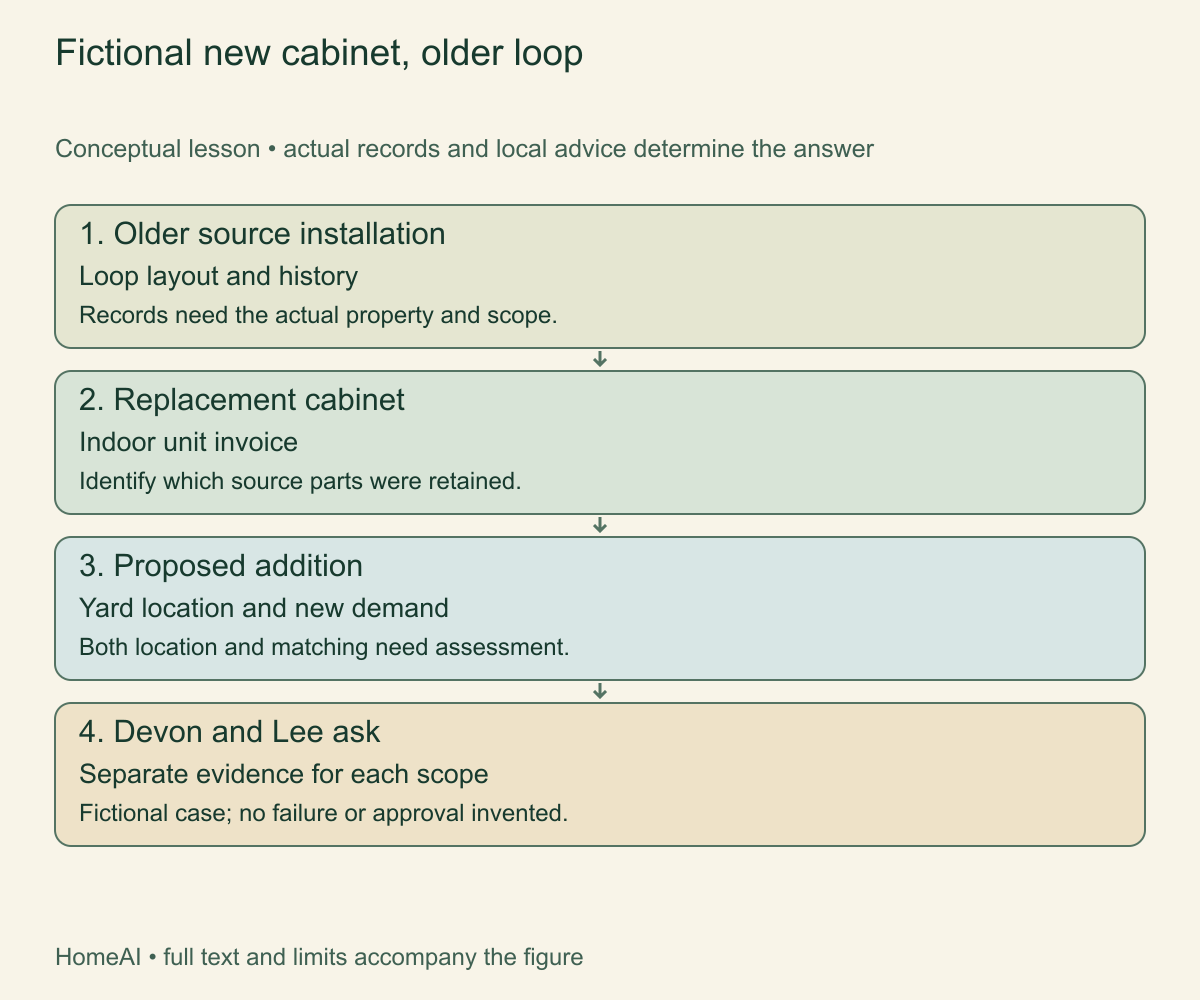
- Older source installation
Loop layout and history. Records need the actual property and scope.
- Replacement cabinet
Indoor unit invoice. Identify which source parts were retained.
- Proposed addition
Yard location and new demand. Both location and matching need assessment.
- Devon and Lee ask
Separate evidence for each scope. Fictional case; no failure or approval invented.
What does this illustration leave out?
No actual pipe route, loop sizing, fluid reading, equipment diagnosis or installation approval. This illustration explains an idea. It is not an installation guide.
Which record and qualified scope establish the source route, equipment and room delivery?
Explore this with HomeAI ↗Opens an editable question. Nothing is sent until you choose to send it.What belongs in the final source-system handover?
Preserve the identified system type, installed component schedule, actual source layout, relevant drilling or well records, fluid information, design explanation and applicable authority evidence. Link these to the equipment manuals, commissioning scope and dated service history. Identify the current version and who can explain discrepancies. Keep sensitive account information out of a general shareable property summary.
Retain an understandable room-service map and the provider's owner-control instructions for the actual equipment. Record what supplementary heating and any water-heating contribution do. Do not replace those instructions with generic settings from this guide. A household needs to recognize its own equipment and know when to contact a qualified provider without being invited to service refrigerant or buried components.
Give future yard and building projects a clear dependency note: consult the identified records, qualified providers and relevant authority before ground disturbance or demand changes. This note is not a locating clearance. It keeps the source system visible when later owners plan work that might otherwise treat the lawn as empty or the indoor cabinet as the entire installation.
The complete retained primary bodies were captured October 15, 2026, with source dates, geography and adopted reading extents recorded separately. Illustrations show explanatory alternatives, not measured depth, adequate loop capacity or a verified pipe route. The fictional case supplies no actual finding. Conflicting general water-source descriptions remain referred to the actual design and local authority.
A useful final answer names this source arrangement, this heat pump and this distribution; identifies what each dated record establishes; explains which professionals cover the remaining questions; and keeps proposed work distinct from completed evidence. That is the basis for understanding the installed home without inventing certainty about concealed ground or future operating cost.
Keep learning about the connected parts
- Buying a home with a heat pump: understand the installed system
- How a heat pump moves heat: the cycle, rooms and energy numbers
- Why is my energy bill higher? Read the quantity, dates and charges
Canadian context and authorities · Visual atlas · Learning labs
Practice the distinction.
What does a fictional older-loop purchase reveal?
Fictional buyers Devon and Lee view an invented home advertised with a recently replaced ground-source heat pump. The supplied invoice names a new indoor unit. A separate older drawing shows vertical source loops, while a current landscape sketch proposes a future addition. No actual property, fluid reading, borehole condition or professional result is represented in this example.
Reported observations
- They ask the provider which source and distribution components the replacement work retained and what matching assessment was recorded. The invoice does not itself answer that question. Nor does the older drawing prove that the replacement is unsuitable. Devon and Lee keep the equipment date, source installation history and present building layout on separate rows until the records are reconciled.
- The proposed addition creates a second enquiry. Its location and possible demand changes need technical and authority review. The buyers request the actual installed source layout and header route rather than assuming a clear space between drawn boreholes is available for excavation. They do not probe the lawn, lift a chamber or choose a safe footing location themselves.
Compare the explanations
Expand each possibility to see the evidence needed to distinguish it. Similar symptoms can have different mechanisms.
A useful next question
Know what the words mean.
- Source exchanger
- The ground or water arrangement transferring heat under the actual design.
- Secondary loop
- A separate fluid circuit exchanging heat with the heat pump’s refrigerant circuit.
- Refrigerant
- The working fluid carrying heat through the heat-pump cycle.
- Direct exchange
- An arrangement in which refrigerant circulates through the ground-side tubing.
- Open system
- A source-water arrangement with an incoming and receiving route needing actual assessment.
- Header
- Piping joining source-loop branches to the wider system route.
- Hydronic distribution
- A water-based arrangement delivering useful heat within the building.
- Commissioning
- Defined verification of an installed arrangement under recorded conditions and scope.
Questions to bring
to the conversation.
- Which source type, fluid and actual buried or water route do the records identify?
- What did source-side, heat-pump and room-delivery commissioning each check and exclude?
- How were retained loops, replacement equipment and any proposed yard or demand changes reconciled?
Separate a showing observation, an existing record and a new professional assessment. Unknown means a question remains; it does not automatically mean a defect.
Use the evidence planner ↗Go to the source.
Original HomeAI explanation informed by these public references. Sources support the underlying guidance; they have not reviewed or endorsed HomeAI. Diagrams are conceptual, and calculator outputs depend on your inputs.
Primary captures and adopted reading extents dated October 15, 2026. Alberta examples are provincial; CMHC 2018 editions are bounded organizational context, not updated law. NRCan source-water differences remain explicit. No actual property findings, legal/approval/financial outcome or future performance is established. Illustrations are conceptual and cases fictional.
Publication & source review
First published .
Sources reviewed .
Have a question about your home?
Start with the symptom, timing and what you have observed.
Ask HomeAI