- A pumping receipt and an assessment of the entire system have different scopes.
- Protect access and the dispersal area without opening tanks or disturbing components.
- Use the actual system and local authority to define maintenance, occupancy and change questions.
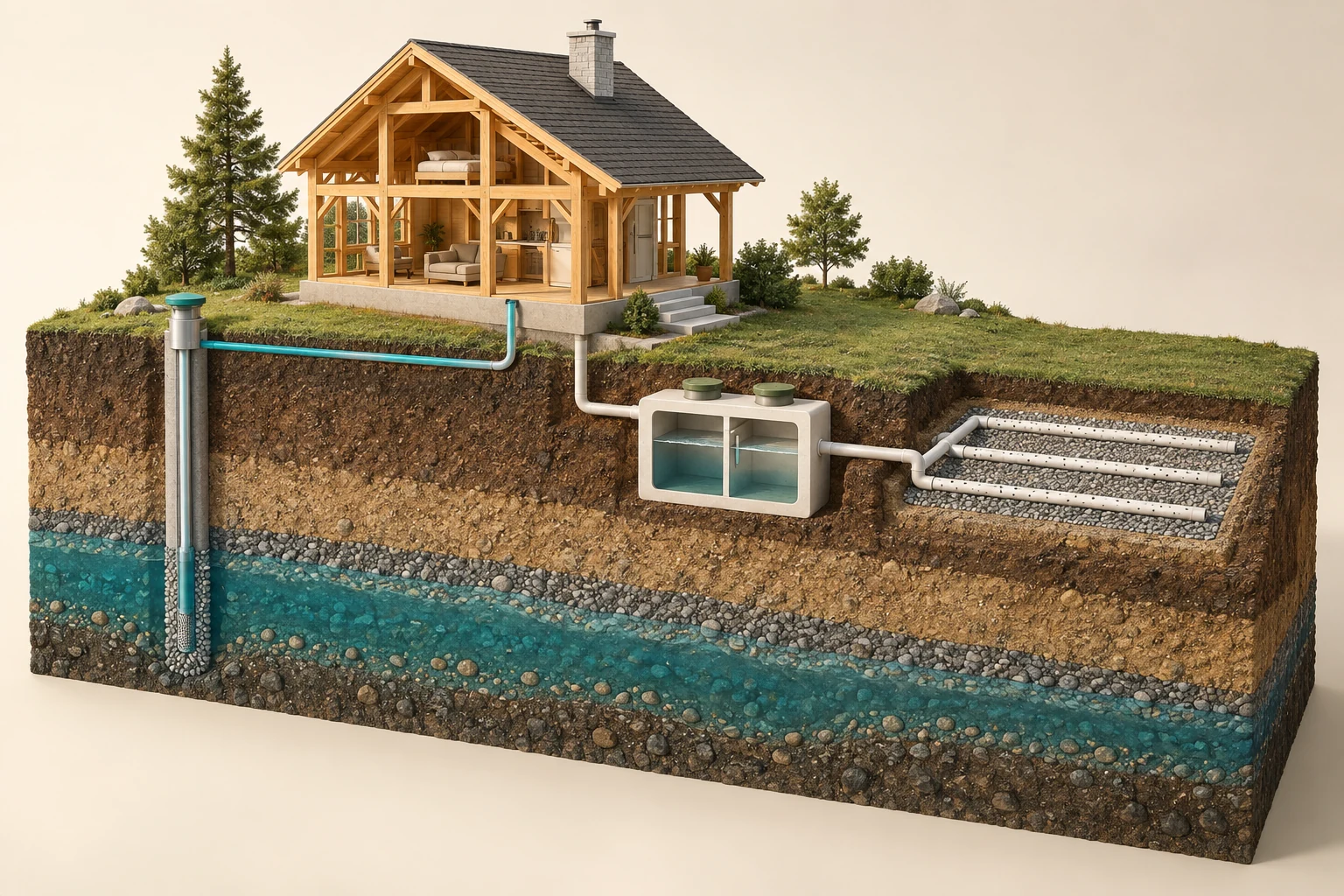
Conceptual architecture. Layout, sizes and routes are illustrative; the picture does not describe your home’s condition.
Explore this picture study ↗4 picture lessons appear beside the questions in this guide. Use them to understand the explanation, then consider what it means for your home.
Follow wastewater beyond the tank
An onsite system receives wastewater from the home, treats it through the installed components and releases the flow through its discharge arrangement. Approval and records remain local questions. In a common septic configuration, the tank separates material before liquid continues toward distribution and soil treatment. Other systems add pumps, treatment units or different dispersal arrangements. The teaching diagram illustrates the direction of a common route; it does not identify the system beneath a particular yard.
Start with the available plan, location record, installation or alteration documents, equipment manuals and maintenance history. Ask which components actually exist and whether their locations have been confirmed. An old sketch may be valuable, but its accuracy should not be assumed after landscaping, additions or undocumented changes. Mark an unconfirmed location as unconfirmed instead of using it as a precise excavation map.
The system's relationship with the household matters. A change in occupancy, fixtures or use can create a different operating question from the one addressed by an older record. This is a reason to discuss the existing approval and capacity with the responsible professional and jurisdiction, not a reason for HomeAI to calculate a new design from bedroom count.
Tank separation and receiving-ground treatment do different jobs
A house route reaches a sectioned tank with upper, middle and lower layers beneath closed green covers. A downstream display shows perforated-looking pipes in gravel above soil. The broad section is a fictional teaching layout.
Numbers identify the parts explained below.
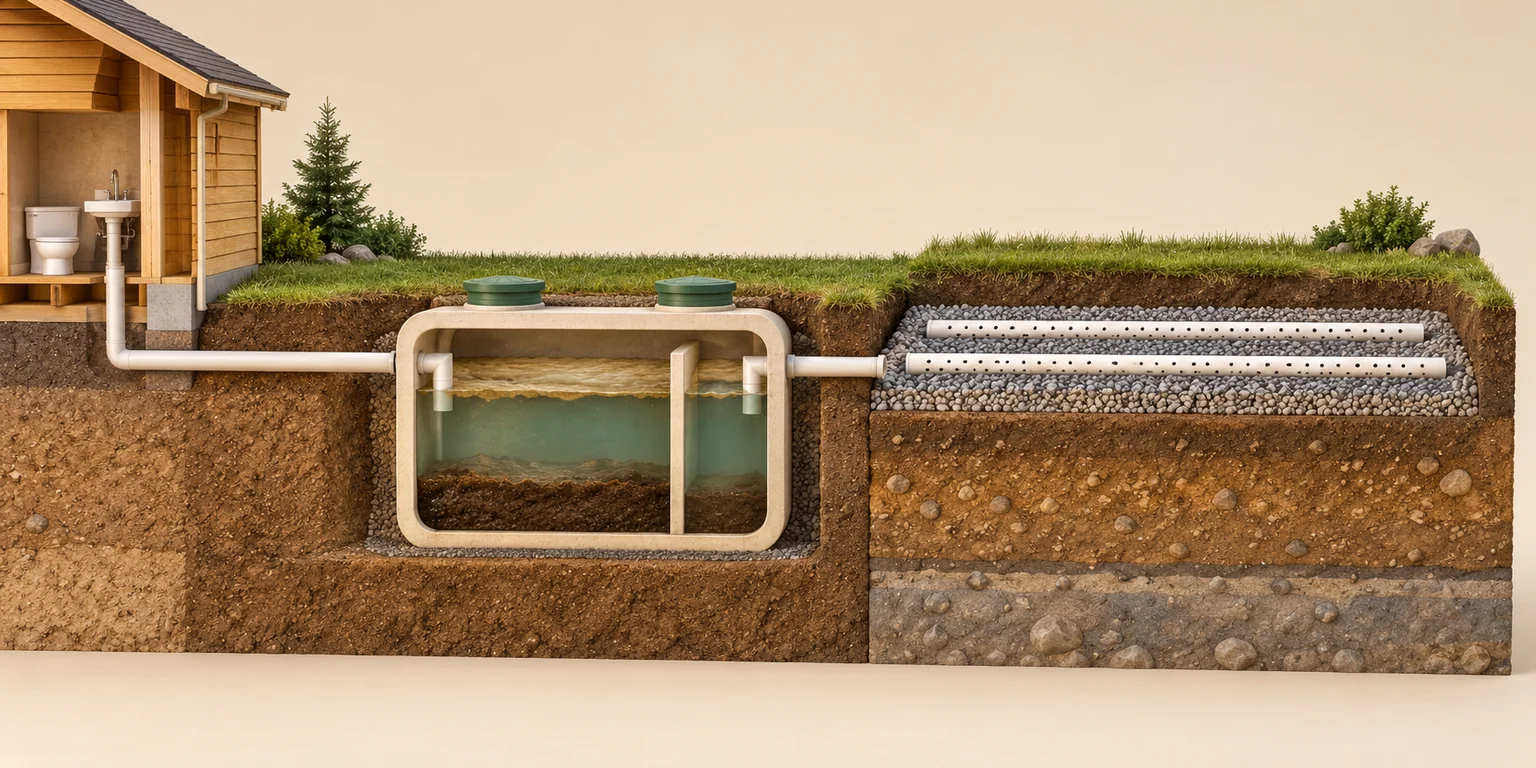
- Separation specimen
Floating and settled material introduce a tank function separate from the liquid leaving it. A clean-looking illustrated layer is no tested effluent or tank-condition finding.
- Distribution specimen
The downstream pipes introduce another component scope. Their displayed holes and spacing do not specify an installed distribution design or measured operation.
- Receiving-ground specimen
Further treatment in the receiving ground is a separate question. Soil appearance in this model supplies no site investigation, suitable design or performance result.
What does this illustration leave out?
The layers illustrate separation rather than measured contents or condition. No actual tank volume, pipe grade, working distribution, trench depth, soil profile, groundwater level, effluent quality, design approval or treatment performance is established. This conventional concept does not identify every Canadian arrangement. The virtual section is not permission to uncover, open or enter a real system. This illustration explains an idea. It is not an installation guide.
Which records and qualified findings address the tank, downstream distribution and receiving treatment area separately for this actual system?
Explore this with HomeAI ↗Opens an editable question. Nothing is sent until you choose to send it.Understand what solids management accomplishes
Material accumulates in a tank even when household drains appear normal. Pumping removes accumulated contents; it is not a replacement for all other maintenance or a universal proof of satisfactory downstream treatment. A receipt should say what was accessed and serviced. It may not document the condition of distribution components, a pump's controls or the soil receiving area.
Provincial guidance offers maintenance planning references, but pumping needs depend on the actual arrangement, use and observed accumulation. Ontario's SepticSmart and Nova Scotia's homeowner material distinguish assessment from removal of contents. British Columbia emphasises the system's maintenance plan and authorised-person context. Do not turn any one provincial interval into an every-home Canadian rule.
Ask the service provider how the next due action was determined and what their visit did not assess. A useful note might identify an observed condition, its relevance and a follow-up inspection; a date stamped on a generic receipt has less explanatory power. Preserve the difference between a recommendation made, a task booked and work completed.
A service task and a whole-system assessment have different scopes
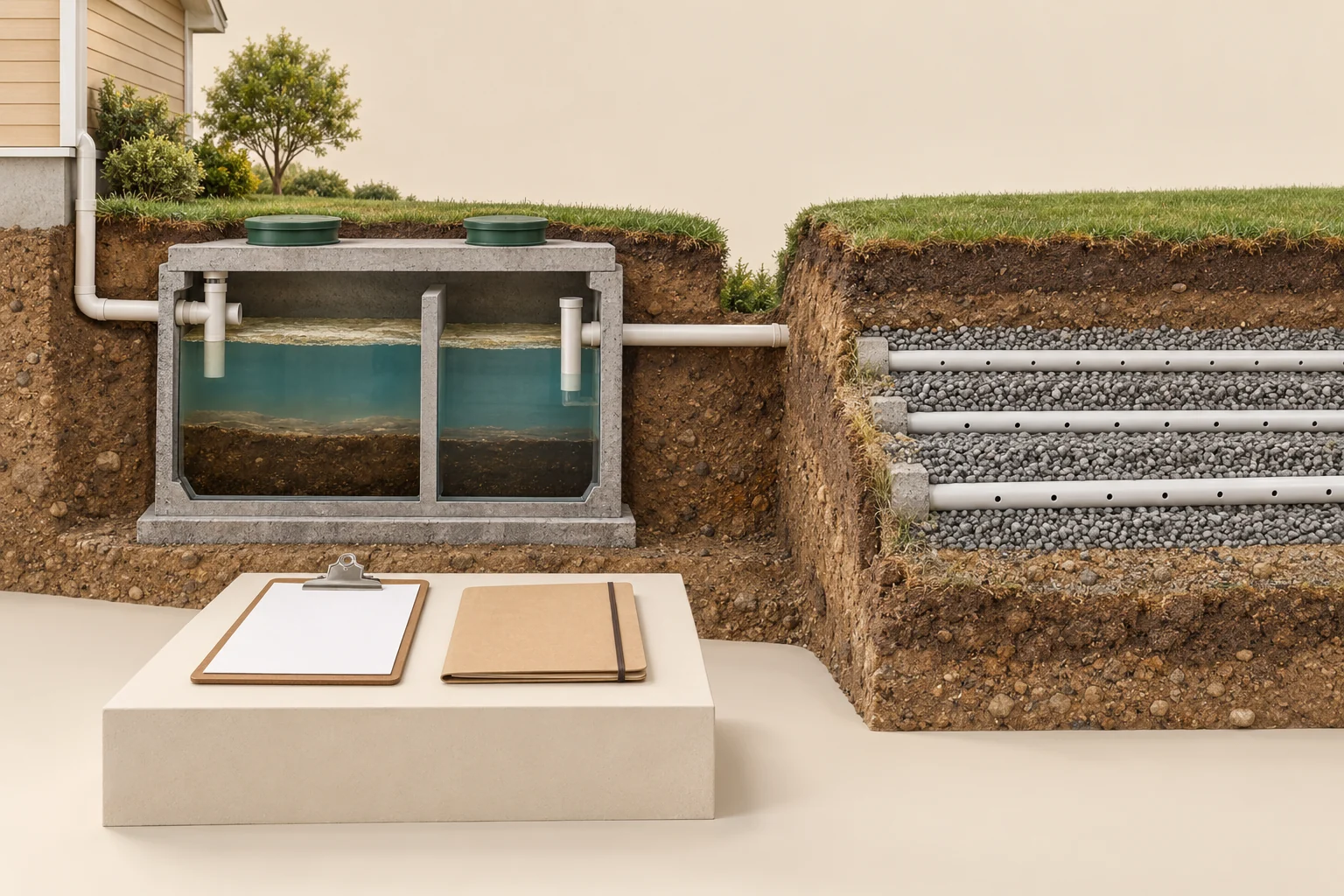
The tank section displays layers below closed green covers. Its outlet stops beside a gap separating the downstream pipe-and-gravel display. A blank clipboard and closed blank booklet sit in front.
Numbers identify the parts explained below.
- Tank-task landmark
A pumping or service record should name the actual component and task. Removing accumulated material answers a narrower question than assessing the complete downstream system.
- Separate downstream scope
The field specimen keeps distribution and receiving-ground questions visible. The display gap is not a defect finding; ask what downstream evidence the real engagement included.
- Blank service record
Keep the original task, date, provider, assessed reach, findings and exclusions. Blank pages cannot turn an invoice into a whole-system guarantee.
What does this illustration leave out?
The gap separates virtual display sections; it is not a depicted disconnected or damaged real pipe. No service has occurred and the blank paperwork proves no pumping, inspected reach, certification, removed quantity, condition, maintenance interval or assessed treatment-area performance. The cutaway is an illustration, not an access method or installation design. This illustration explains an idea. It is not an installation guide.
What task and components does this pumping or service record actually cover, and which downstream conditions or intended-use questions remain outside it?
Explore this with HomeAI ↗Opens an editable question. Nothing is sent until you choose to send it.Use household habits as load information
Wastewater management begins with what the house sends into the system. Provincial guidance discourages using drains as disposal routes for oils, solvents, wipes and other unsuitable materials. A toilet label or a product marketing phrase does not establish compatibility with the installed system. Keep the household's ordinary maintenance instructions accessible to everyone who uses the property.
Record meaningful changes in use: additional occupants, a long vacancy, extended laundry demand, an addition or a newly connected fixture. These facts can help a professional interpret an operating complaint. They are not evidence that a particular change caused a failure. A chronology should distinguish known dates from approximate recollections and avoid naming a culprit before the system has been assessed.
A water-use problem may also involve leaking fixtures or a supply issue in the home. Discuss confirmed leaks with a plumber instead of compensating through a guessed septic adjustment. The goal is to reduce avoidable load while allowing the onsite specialist to assess the installed treatment route. HomeAI does not prescribe additives, tank chemicals or improvised modifications.
Observe the surface without opening the system
From safe accessible ground, record recurrent wet areas, unusual odours, visible damaged covers or changes near the known dispersal area. Keep people and animals away from suspected sewage and unsecured openings. A patch of vigorous grass is an observation; it is not a diagnosis of tank leakage, a failed field or a safe place to dig.
Do not enter, open, lean into or try to rescue someone from a septic tank or pit. CCOHS identifies tanks and sewers as possible confined spaces with atmospheric and other serious hazards. A household fan, an open lid or absence of smell cannot clear them for entry. Component access, pumping and repair belong to qualified people with the appropriate controls.
If wastewater is backing up inside, stop adding unnecessary wastewater and contact the relevant professional or local authority promptly. Avoid contaminated areas and electrical hazards. Document from a safe position only; photographs are secondary to keeping the household away from the problem. An urgent service report should identify the immediate response and what remains to be investigated.
A wet patch needs context before it gets a cause
A wet-looking patch interrupts the foreground grass. A house downspout, two closed green covers and a shallow swale-like depression give separate surface landmarks. No buried route is exposed.
Numbers identify the parts explained below.

- Surface observation
From safe accessible ground, preserve the actual location and timing. Wet-looking grass alone cannot identify wastewater or the cause.
- Weather and drainage context
The downspout and right-hand depression prompt separate surface-water questions. This illustration traces no verified flow between them and the patch.
- Closed access landmarks
Keep real covers closed and record access limitations. A nearby cover does not establish which component or buried route relates to the observation.
What does this illustration leave out?
The scene identifies no sewage, actual connection, failed component, contamination, cause or safe contact. The downspout and depression are possible context rather than proven sources. Weather, occupancy, service history and qualified findings remain separate evidence. Do not touch or probe the patch, open covers, dig or stage a load test; keep people clear of actual contamination or insecure openings. This illustration explains an idea. It is not an installation guide.
Which ordinary weather, location and occupancy records would help a qualified provider distinguish explanations for this wet area without disturbing the system?
Explore this with HomeAI ↗Opens an editable question. Nothing is sent until you choose to send it.Protect the treatment area as an asset
The receiving area, including buried components, is part of the system rather than spare space waiting for a project. HealthLink BC guidance cautions against driving or placing unsuitable loads over dispersal areas and against introducing roof or perimeter-drain water into the sewage system. Before landscaping, building or changing drainage, ask the professional to locate and explain the actual system and local restrictions.
A surface photograph cannot show soil treatment capacity, buried distribution condition or compliance with an approved layout. Equally, a yard that looks ordinary does not establish that the system has failed. Use the records to define where a change may interact with the system, then request the appropriate assessment before work proceeds.
Consider access as well as the receiving area. Future maintenance can become more difficult when service points are buried by a deck or blocked by stored materials. Do not expose components yourself to solve that problem. Ask for a safe access plan and retain its location record so maintenance does not depend on one person's memory.
A site picture and actual service-location records answer different questions
The house and ground are virtual sections. A well-casing specimen appears at left; two green covers remain closed in the lawn. A right-hand gravel path and blank paper specimens sit apart from these service landmarks. No hidden wastewater pipe is visible.
Numbers identify the parts explained below.

- Closed system landmarks
Match actual system components and treatment-area locations to original records. The well specimen and green covers do not define an appropriate separation or concealed wastewater arrangement.
- Access and future-use question
The gravel path is not verified vehicle access. Ask how real service access and proposed yard work relate to documented buried components and treatment land.
- Blank location dossier
An original site record, as-built drawing, relevant survey and any sharing agreement answer different questions. These blank props supply none of those findings or rights.
What does this illustration leave out?
The layout supplies no actual locate, wastewater route, treatment-area extent, legal boundary, sharing right, access permission, reserve area, safe vehicle access, suitable addition or national separation distance. The well section reveals no actual construction or water result, and the blank sheet is no survey or as-built record. This is a site-question illustration, not an approved plan. This illustration explains an idea. It is not an installation guide.
Which original system-location, site and access records should the local specialist review before a driveway, deck, addition or other change around these buried services?
Explore this with HomeAI ↗Opens an editable question. Nothing is sent until you choose to send it.Specify the professional deliverable
Request a scope suited to the decision: routine planned maintenance, investigation of an operating complaint, confirmation of available records, or assessment before a proposed property change. These are different assignments. A specialist should explain what will be reviewed, what will require access, and which conclusions the chosen methods can support.
Ask for the identified system configuration, observed findings, relevant measurements or records, inaccessible components and follow-up actions. A tank-only service should remain described as tank-only service. If assessment of soil, distribution or approval records is outside the assignment, preserve that exclusion. The absence of a comment in a short receipt is not evidence that every component was evaluated.
Authorisation, filing and maintenance arrangements vary by province and local authority. Confirm who is permitted to perform the relevant work in the jurisdiction and what records should be retained. HomeAI can help you compare scopes, but cannot issue an approval, promise provider availability or determine that a transaction must proceed or stop.
Work through a fictional busy-season complaint
A fictional household has a pumping receipt from last year, a hand-drawn yard sketch and a wet patch noticed after a busy holiday week. Drains currently work. The observation could fit several questions, including surface weather effects or an onsite operating issue. The receipt shows a service occurred; it does not establish the condition of the wet patch or explain its cause.
The owner keeps everyone away from the area, records weather and use from memory as approximate, and asks an onsite professional to define an assessment of the surface concern and available records. They do not open a lid, add a treatment chemical or conclude that visitors overloaded the system. The specialist can decide which component access or measurements are needed.
If the professional later identifies a specific issue, the record should preserve the method, finding and limits. If the assessment remains inconclusive, that is still useful when it identifies the next evidence needed. The worked example rewards a purposeful question rather than a premature diagnosis. A future pumping action may be appropriate, but cannot be assumed to solve every plausible pathway.
Keep maintenance separate from guarantees
Build a file with the best available system plan, approval or installation records, component manuals, assessment findings, pumping and service receipts, and follow-up results. Keep proposed modifications in a separate section until they are actually completed. A record of requests shows diligence; it does not turn unavailable evidence into a verified condition.
Write tasks around the actual next step: obtain the maintenance plan, confirm a component location through a professional, clarify a receipt's scope or arrange a scoped investigation of a reported change. Ask what circumstances should prompt a call between planned visits. This creates a usable operating plan without pretending a universal calendar fits every onsite system.
For a property sale or purchase, describe the evidence with its dates and scope. A seller can provide genuine maintenance records, and a buyer can ask what remains unassessed. A realtor can help organise the questions and specialist collaboration; confirm their actual training and availability. The onsite professional and relevant authorities retain the technical and approval roles. Neither a recent pumping date nor a dry showing certifies future system performance.
Practice the distinction.
Recent pumping, unexplained wet ground
Fictional learning scenario: a tank was pumped last year and a wet surface patch has now been noticed.
Reported observations
- The pumping receipt does not describe a whole-system assessment.
- The component locations are only approximately sketched.
- The patch was observed after weather and a change in occupancy.
Compare the explanations
Expand each possibility to see the evidence needed to distinguish it. Similar symptoms can have different mechanisms.
Surface-water influence
Weather-related water remains a possible question until the route is investigated.
Safe dated observations and an appropriately scoped site assessment.
Onsite-system issue
A wastewater-related concern also remains possible; normal drains do not resolve it.
System records and qualified investigation of relevant components.
A useful next question
Keep clear of suspected contamination and ask an onsite professional to define the assessment scope.
No tank entry, repair instruction, failure diagnosis or nationally applicable service interval follows from this example.
Know what the words mean.
- Dispersal area
- The part of an onsite arrangement that distributes effluent into its receiving environment, as identified in the actual system records.
- Maintenance plan
- The system-specific description of service, monitoring and follow-up appropriate to its components and use.
- Scope exclusion
- A component or question that a professional assignment did not evaluate.
Questions to bring
to the conversation.
- What was actually observed?
- Which part was assessed, and what was inaccessible?
- What record supports the conclusion?
- Who can resolve the remaining technical question?
Separate a showing observation, an existing record and a new professional assessment. Unknown means a question remains; it does not automatically mean a defect.
Use the evidence planner ↗Go to the source.
Original HomeAI explanation informed by these public references. Sources support the underlying guidance; they have not reviewed or endorsed HomeAI. Diagrams are conceptual, and calculator outputs depend on your inputs.
Publication & source review
First published .
- Ontario · Septic systems
- Ontario · SepticSmart homeowner booklet
- HealthLink BC · Onsite sewage maintenance and operation
- Nova Scotia · Homeowner guide to septic systems
- CCOHS · Confined-space hazards
- Fraser Health · Onsite-system records and property-owner resources
Where this reference applies
Jurisdiction: Fraser Health region, British Columbia
Edition: Current resource page; no whole-page modification date shown
Source reviewed: 2026-10-05 · America/Edmonton
A regional system-file request route is separate from an actual property record, location or assessment. Linked forms have their own requirements; this resource page establishes no property approval or Canada-wide request process.
Have a question about your home?
Start with the symptom, timing and what you have observed.
Ask HomeAI