- Panels make electricity; inverter equipment and the installed configuration determine how the home uses it.
- Generation, self-use, utility export and bill credits describe different quantities. A solar installation also needs separate backup evidence.
- Confirm equipment ownership, the buyer’s utility arrangement and any generation-contract transfer with the actual responsible parties.
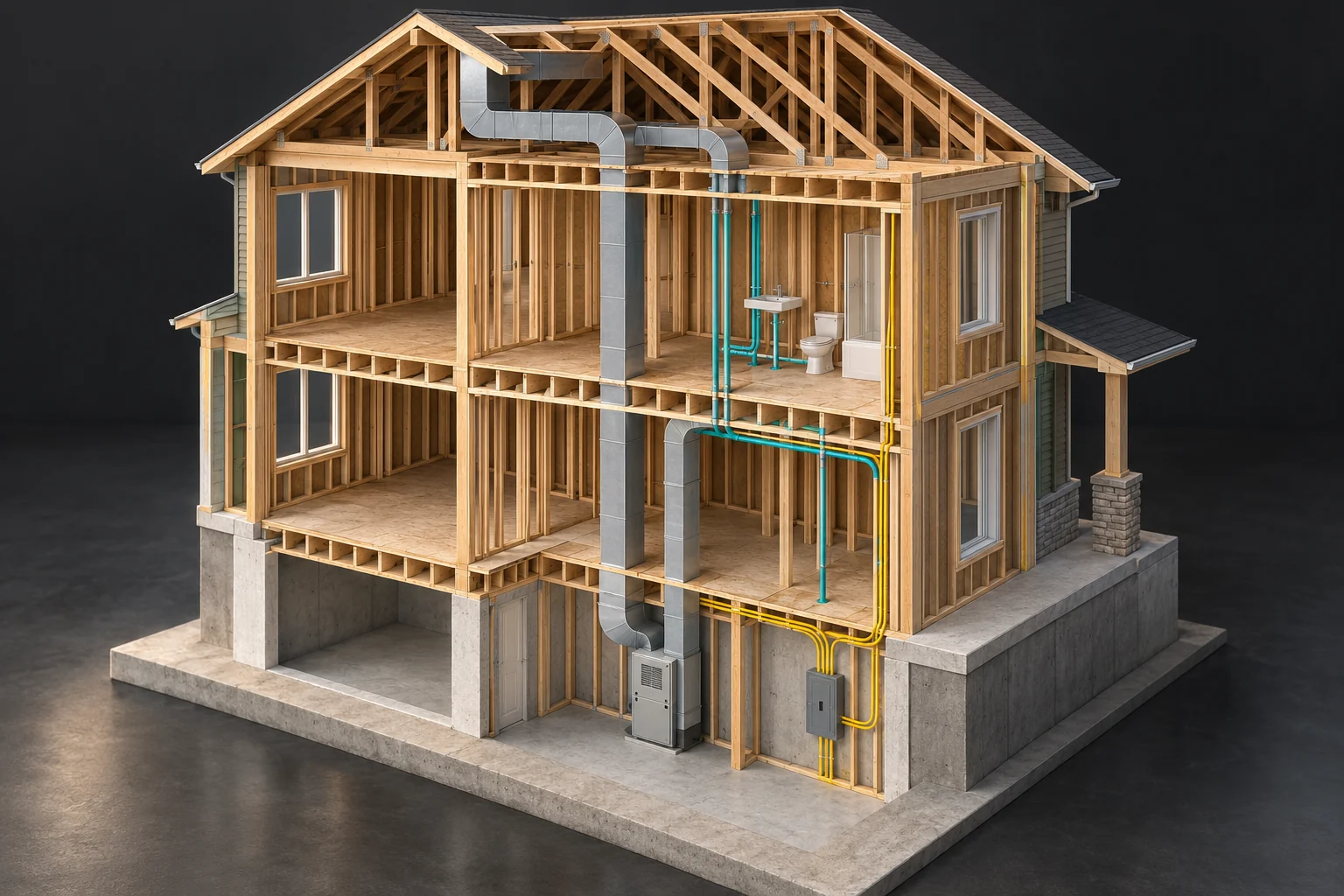
Conceptual architecture. Layout, sizes and routes are illustrative; the picture does not describe your home’s condition.
Explore this in the visual atlas ↗4 picture lessons appear beside the questions in this guide. Use them to understand the explanation, then consider what it means for your home.
What does the listing’s solar claim actually include?
Solar panels make electricity from sunlight. Inverter equipment changes that electricity into the form used by the home. The utility supplies electricity when the home needs it and can receive exports under the accepted arrangement. These useful functions sit behind a separate buying question: which equipment, rights and obligations would you actually receive?
Ask the seller for a list of panels, inverters, any battery, controls and monitoring equipment, with available model numbers and installation dates. Keep later changes on the same list. A photograph shows visible equipment at that visit. An invoice describes its stated job. Ask a qualified solar or electrical provider how those records match the present system.
For a new build, ask exactly what “solar-ready” includes. A reserved roof area, conduit or future equipment location may be preparation for another project. Request the builder’s package description and the work still needed before generation can operate. Keep proposed, installed and accepted work identified separately in the handover file.
How do panels, inverters and the electricity meter differ?
Photovoltaic, or PV, panels turn sunlight into direct current electricity, called DC. Inverters convert DC into alternating current, or AC, for the home’s relevant arrangement. Some products combine functions. BC Hydro explains these basic roles; the actual models and professional system drawing explain how they are arranged at this property.
Power describes a rate, usually in kilowatts (kW). Energy describes an accumulated amount, usually in kilowatt-hours (kWh). A panel’s DC capacity, an inverter’s AC output rating and a year of energy production answer different questions. Keep each number’s unit and stated conditions with it. NRCan’s 2020 planning guide explains this distinction; it is historical education, not today’s installation rules.
The utility meter records the electricity received from and sent to the grid under its configuration. A monitoring app may measure other locations, such as inverter production. Ask the installer where each reading is taken. Request an explanation of the installed system drawing, including later changes; it is a professional document rather than a homeowner wiring instruction.
Panels generate, an inverter converts, and a meter records at its boundary
The roof panels, middle cabinet and right-hand meter introduce three different jobs. Reading the production record and utility record separately helps make sense of a solar claim.
Numbers identify the parts explained below.
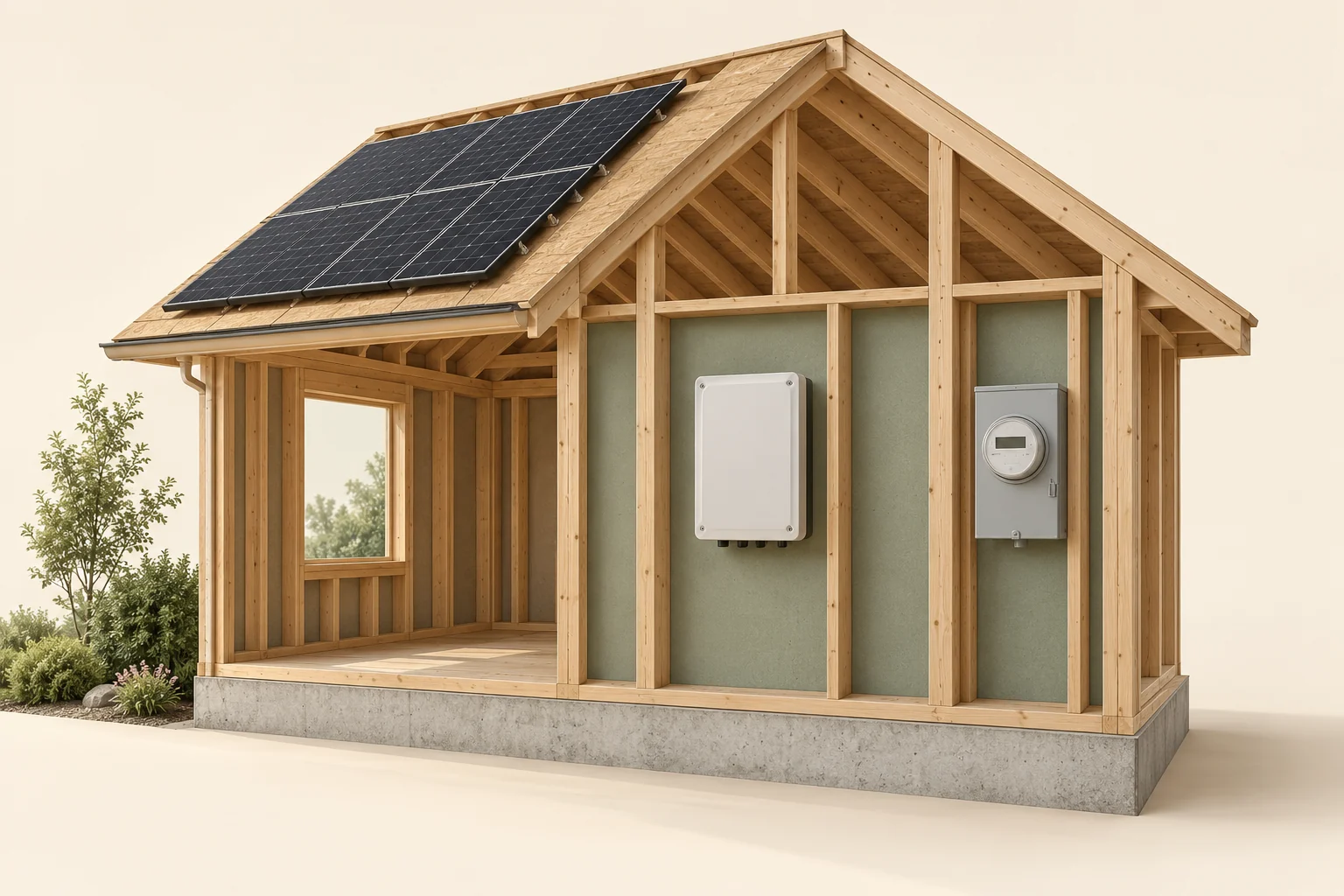
- Panel array
Panels convert sunlight into DC electricity. The panel shapes reveal no actual generation or equipment rating.
- Inverter
Converts DC to AC for the applicable arrangement. This closed cabinet represents the job without showing a connection.
- Utility meter
Records quantities at its installed boundary. Utility import and export are different questions from total solar production.
What does this illustration leave out?
No complete wiring route or working reading is shown. Appearance does not establish production, utility acceptance, ownership, outage operation or total household use. The guide’s native reading diagram explains the quantities; ask for the actual equipment and meter records. Use the installed model, current local authority and qualified provider for actual assessment. Keep electrical enclosures closed and stay clear of damaged equipment.
Which record measures solar production, which records utility import and export, and what does the actual configuration leave outside those readings?
Explore this with HomeAI ↗Opens an editable question. Nothing is sent until you choose to send it.What each part does
- PV panelsConvert sunlight into DC electricity. Identify the actual models and recorded capacity conditions.
- Inverter equipmentConverts DC into AC for the relevant arrangement. Its functions and output limits depend on the actual model and configuration.
- Utility meterRecords electricity received from and sent to the grid under its configured utility role. It does not necessarily report all on-site generation.
- Monitoring platformDisplays the quantities measured at its identified locations. Ask what each figure and missing interval actually represents.
Will the home still have power when the grid goes down?
Roof panels and outage backup do different jobs. BC Hydro says most self-generation systems shut down during an outage to prevent electricity flowing back to the grid. Panels can therefore produce useful daytime energy while leaving the home without supply when the grid is interrupted. The annual production total cannot answer the backup question.
For a backup claim, ask for the actual configuration, supported appliances or circuits and commissioning record. Commissioning means the checks used to verify the installed arrangement within an agreed scope. A battery cabinet alone does not establish what stays powered. The provider must explain the inverter, grid-separation equipment and controls for this particular system.
Ask whether solar can recharge the battery during an outage and under which conditions. Suitable configuration still needs available sunlight; it cannot promise a duration. Obtain the model instructions and a separate emergency plan. Do not interrupt the utility, bypass protection or request an improvised showing demonstration. The backup-battery guide explains power, energy and supported-load limits.
Who owns the equipment and who has the operating obligations?
Panels attached to a roof do not show who owns them. Ask for the purchase, lease, financing, service and electricity agreements that actually apply. Have your legal and transaction advisors establish what the sale includes and which obligations need separate consent or action. Keep an unanswered ownership question visible before relying on the listing description.
Ontario’s Energy Board describes one retailer arrangement with a power purchase agreement for electricity and an associated equipment agreement for the system. The utility’s net-metering agreement has another role. This Ontario example shows why several documents may matter; it does not establish which agreements govern a home elsewhere in Canada.
Ask your legal advisor about payment obligations, term, assignment or consent, maintenance, removal and other exit provisions in the actual documents. Ask the relevant parties who handles roof damage, equipment work and insurance questions. HomeAI helps prepare that discussion without deciding ownership, enforceability, financing discharge or a right to transfer an agreement.
Which utility and approval records describe the actual system?
Connection acceptance records the serving utility’s accepted equipment and operating arrangement. Request that record and the relevant agreement for this address. Read electrical and building records alongside them, keeping each job’s scope and status clear. Compare the records with later equipment changes. An application describes a request; it does not establish accepted or completed work.
Ontario’s ESA issues a Certificate of Acceptance once electrical work has been reviewed and passed. Ask for the actual certificate and the work it covers. ESA also explains checking a contractor’s applicable ECRA/ESA licence. Those are Ontario examples. Confirm the relevant authority, qualifications and completion records in the province and utility territory where you are buying.
In ENMAX Power’s service territory, the generation’s operating type and site circumstances affect the connection question. ENMAX treats utility isolation separately from backup transfer: a transfer switch is not its accepted means of disconnect. Let the qualified provider explain the actual records. For a shared roof or electrical system, also obtain the responsible parties’ permissions and agreements.
Can I inherit the seller’s rate, credits or generation contract?
Ask the actual utility and any contract counterparty what applies to your intended account after closing. Keep three questions separate: who receives the equipment, what utility service applies and what happens to any generation contract. The diagram below gives each question its own confirmation. A past seller bill cannot answer all three.
BC Hydro closed Rate Schedule 1289 to new customers and introduced Rate Schedule 2289 on July 1, 2026. Its current update describes legacy and rebate-related circumstances. Ask BC Hydro to confirm the arrangement for this property and buyer. An old bill does not establish inherited eligibility, and BC Hydro’s example does not describe every British Columbia utility.
EPCOR’s Collingwood-area guidance distinguishes a property sale from transfer of an existing IESO MicroFIT contract. Selling the home and equipment does not automatically transfer that contract. Ask the relevant parties to confirm the process and resulting effective arrangement. This named Ontario programme example provides no universal transfer rule or promise of approval.
Get three separate answers before closing
Separate equipment, meter/account and agreement drawings give each buying question its own confirmation.
Numbers identify the parts explained below.
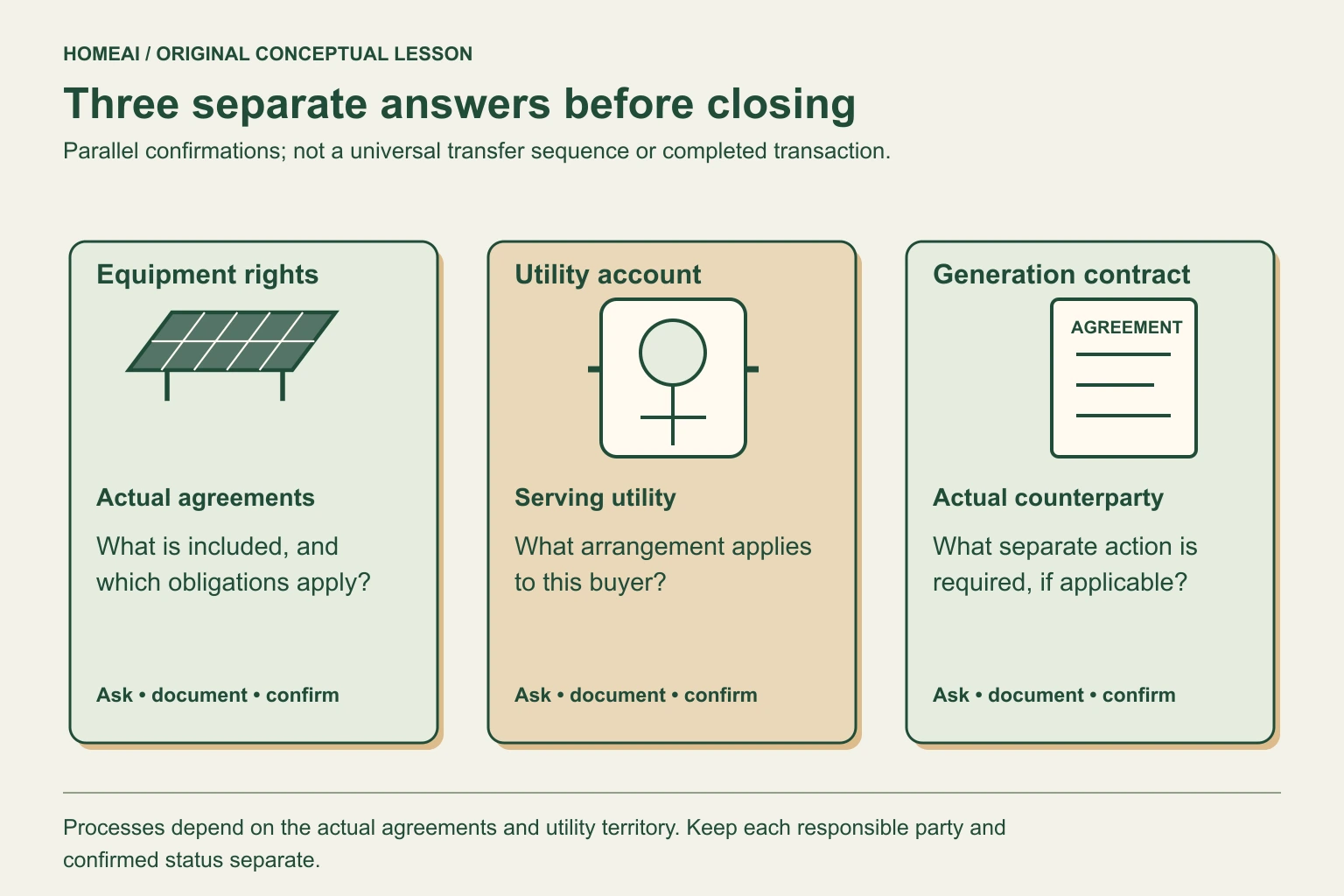
- Equipment rights
Legal review addresses the actual equipment agreements and included obligations.
- Utility account
The serving utility confirms this buyer’s arrangement for the actual system.
- Generation contract
The relevant counterparty confirms any applicable separate transfer or new arrangement.
What does this illustration leave out?
These are organizing examples, not this property’s legal or utility records. Not every home has a separate generation contract, and processes vary by agreement and territory. Ask the actual responsible parties what applies. Keep document identity, responsible party, action and confirmed effective status for each applicable question.
Which equipment, account and generation-contract questions are confirmed for the buyer, and which remain open?
Explore this with HomeAI ↗Opens an editable question. Nothing is sent until you choose to send it.Equipment, utility service and a contract need their own answers.
Keep the actual documents, responsible parties and confirmed actions separate. A completed equipment step does not automatically complete an account or generation-contract question.
- Equipment and obligations
- Its job: Identify included components and the purchase, lease, financing or service documents that actually apply.
- Next question: What rights and obligations will the buyer receive, and which consent or action does legal review identify?
- Utility arrangement
- Its job: Identify the serving utility’s system acceptance, account arrangement and applicable current rate treatment.
- Next question: What does the utility confirm for this buyer, address and installed system after closing?
- Separate generation contract
- Its job: Identify any applicable electricity-sale or generation contract and its responsible counterparty.
- Next question: Does it need a separate transfer or new arrangement, and what effective status is actually confirmed?
Three confirmations to keep separate before closing
- Equipment and obligationsObtain the actual ownership, lease, financing or service documents and legal review of required actions.
- Utility arrangementAsk the serving utility what acceptance, account and current rate arrangements apply to this buyer and system.
- Generation contractIf a separate contract exists, ask its counterparty about the actual transfer or new arrangement and confirmed effective status.
- Remaining questionKeep each responsible person, date and unanswered action on its own line; one completed step does not complete all three.
What does the production history actually measure?
Solar generation is electricity made by the system. Self-use is generated electricity used on site. Export is electricity sent to the grid; import is electricity received from it. A bill credit describes the account treatment of the relevant energy. These quantities can differ even when the records are accurate. The diagram below separates the reading locations and questions.
Request an exportable history with the site and equipment identity, units, start and end dates, and the location each reading represents. A lifetime total needs its start date and system-change history. Keep a forecast labelled as a forecast with its author and assumptions. A summer screenshot and a winter bill describe different periods and may describe different quantities.
Ask the provider about gaps, interruptions and configuration changes before comparing periods. Missing monitoring data may reflect connectivity or a monitoring issue; it does not establish whether generation worked. A new home may have no operating history yet. Keep that limit clear and ask what commissioning, later monitoring and authorized access will provide after closing.
Follow what each solar reading measures
A solar-generation route branches toward the home and grid. A separate route shows electricity received from the grid, and a separate bill box names account treatment.
Numbers identify the parts explained below.
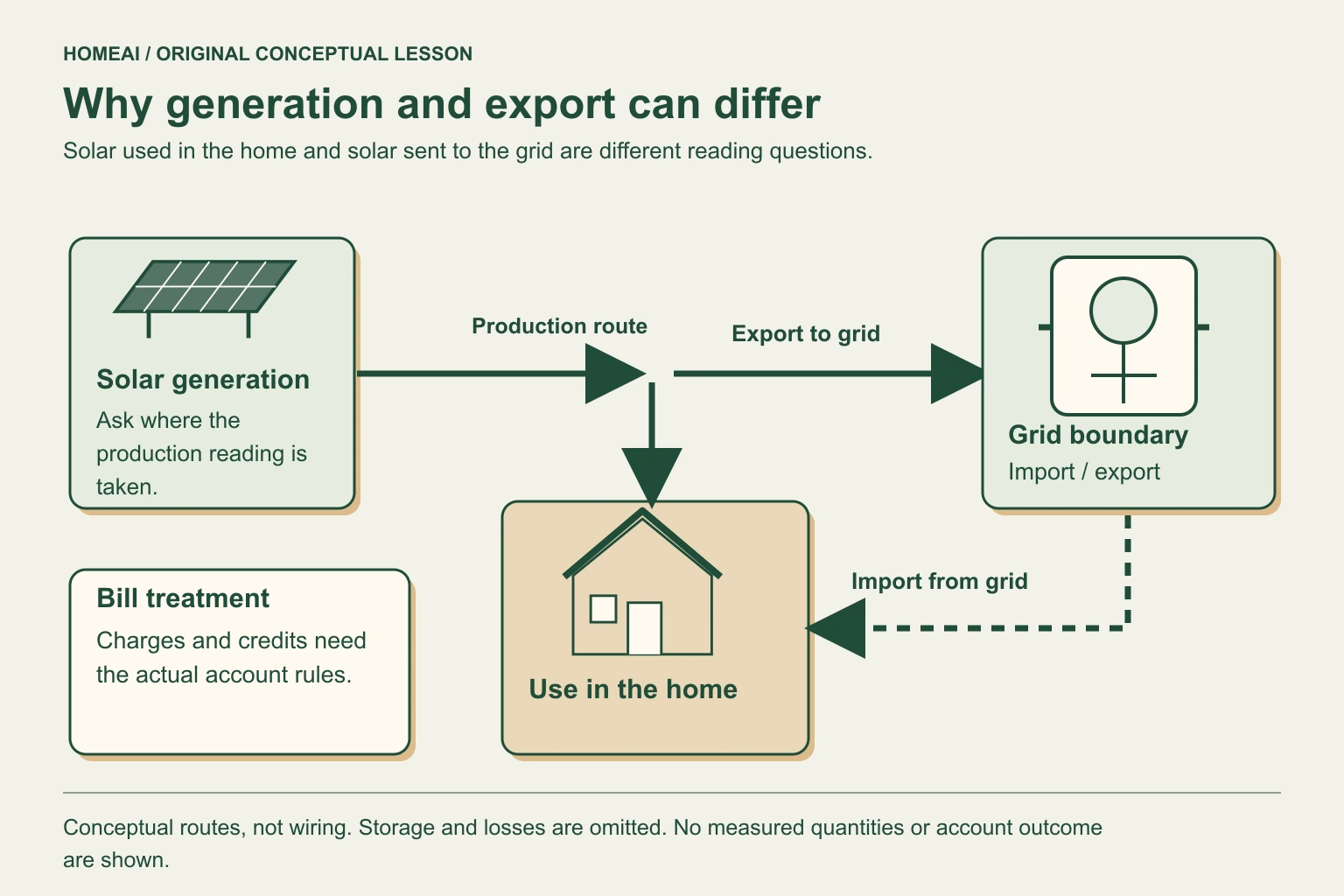
- Production reading
Records generation at its identified location. Ask which equipment and period the history represents.
- Home use
Generated energy used on site can make total production different from utility export.
- Utility readings
Import and export describe the grid boundary; the account’s credit treatment needs its own explanation.
What does this illustration leave out?
The illustration is a reading aid, not the installed wiring or meter layout. Storage, losses and other details are omitted. Ask the provider what each actual reading measures before comparing quantities. Conceptual relationships only. Identify the actual equipment, reading location, units, period and utility arrangement.
Does this number describe solar generation, on-site use, grid import/export or an account credit?
Explore this with HomeAI ↗Opens an editable question. Nothing is sent until you choose to send it.Production and export answer different questions.
Generated electricity can be used in the home before any export. Utility import and export have their own readings, and charges or credits depend on the actual account arrangement.
- Generation
- Its job: Electricity made by the solar system, measured at the location identified by the provider.
- Next question: Which equipment and reading location does the production history represent?
- Self-use
- Its job: Generated electricity used on site instead of being exported at that time.
- Next question: Does the record actually measure self-use, or is the platform deriving it from other readings?
- Grid import and export
- Its job: Electricity received from and sent to the utility grid under the meter’s configuration.
- Next question: Which direction, period and units does each utility entry describe?
- Bill treatment
- Its job: The account’s charges and credits under its applicable arrangement, rather than total solar generation.
- Next question: Which current utility and agreement rules apply to the buyer’s intended account?
Why do the roof and attachment records belong in solar due diligence?
The roof carries the mounted equipment and continues to manage rain and snow. Attachments connect the array to the roof assembly. NRCan’s 2020 guide discusses concentrated loads, uplift at anchoring points and potential moisture entry where attachments penetrate the covering. These explain why the roof belongs in the assessment; they do not diagnose a leak or establish adequate support from a photograph.
Request the roof type, documented condition, mounting design and relevant structural and roofing records. Add later roof or equipment work. A roofing professional and solar or electrical provider may need to coordinate their scopes, including areas beneath the array that were inaccessible. A completed electrical job does not necessarily assess every roof or attachment question.
Ask what future roof work would involve: who can disconnect, remove and reinstall equipment, which permissions apply and what completion records follow? Obtain the actual agreement and warranty explanations. Keep observations to safe ground-level access. Do not climb, lift panels or inspect concealed fasteners yourself. The roof-coverings guide explains the wider roof-assembly questions.
A solar array belongs in the roof discussion
The model separates the panel array above the roof, the shingle surface and the timber beneath. Each part raises a different condition and records question for a buyer.
Numbers identify the parts explained below.
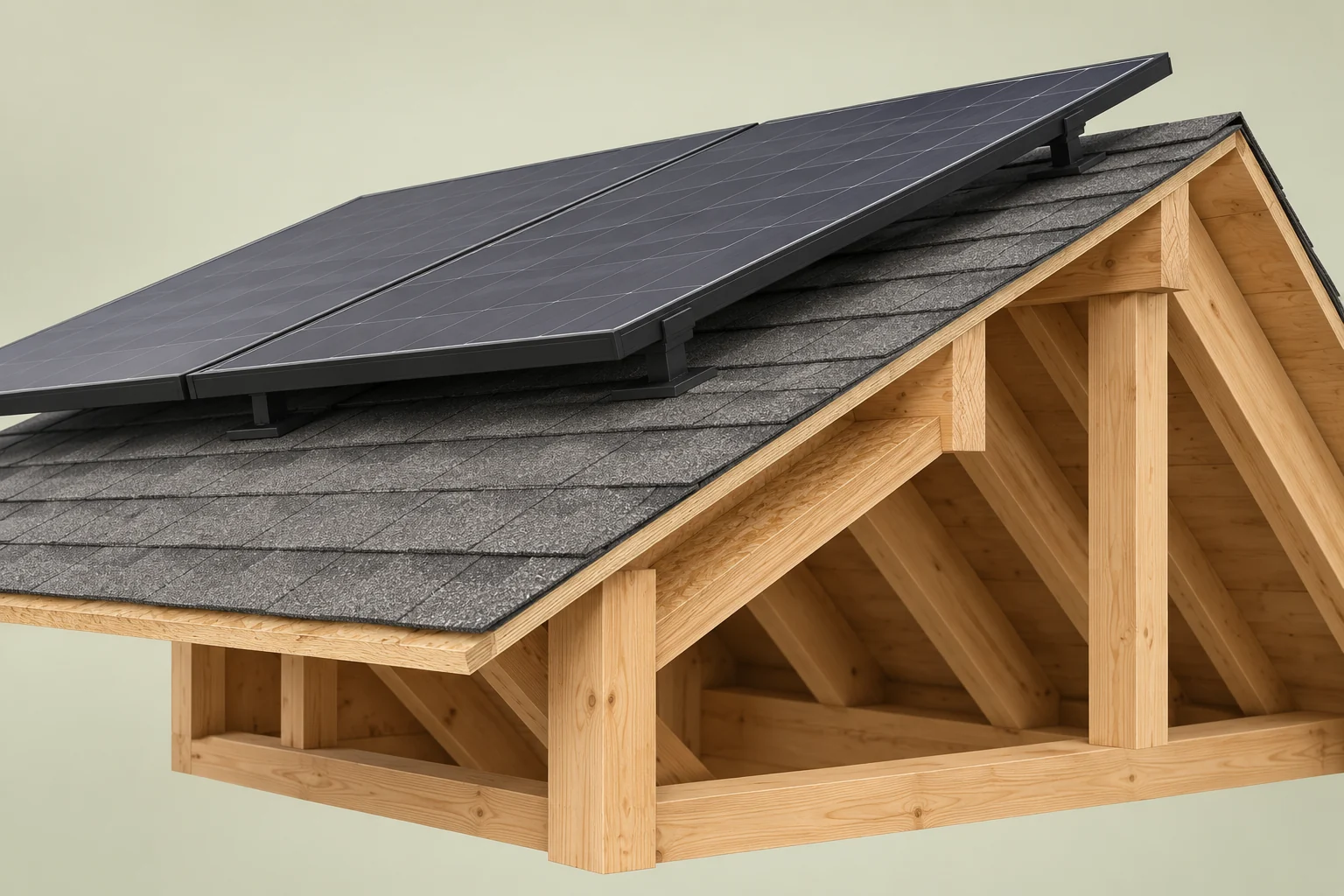
- Panels and supports
Ask for equipment, attachment and removal or reinstatement records. The visible supports provide no approved fastening design.
- Roof covering
Ask about current roof condition and any roof work affected by the array. No leak or successful weatherproofing is demonstrated.
- Timber support
Ask which professional records address the actual support and relevant work. The pictured timber provides no load rating.
What does this illustration leave out?
Mount fastening, penetrations, flashing and weatherproofing details are not shown. This is no installation detail, structural assessment or proof of roof condition. Buyers should use accessible records and appropriately scoped professional advice, without climbing onto the roof. Keep observation at a safe accessible position. Roof and electrical work require the appropriate qualified providers.
What do the actual roof, support and solar-attachment records explain, and who will coordinate any future roof work?
Explore this with HomeAI ↗Opens an editable question. Nothing is sent until you choose to send it.How could my use of the home change the solar claim?
Your electricity needs may differ from the seller’s. An EV, electric heating, different cooking or water-heating equipment, and changed occupancy can alter demand. Tell the appropriate provider what you intend to use before treating an earlier bill reduction as your expected result. The electrical-readiness guide addresses whether the home can support proposed added loads.
Ask for any proposed energy scenario to state its assumptions: when electricity is needed, the tariff, export treatment and storage, if present. An annual energy total does not establish supply at every moment. Keep the installed system, recorded history and proposed household use together so the professional can explain which comparisons are meaningful.
Ask about exposure changes when relevant. The OEB notes that a new tree or building can change solar production through shading. A qualified solar professional can assess whether the original study still addresses current conditions. A listing photograph does not measure a shading effect or promise what future development will do.
How would a fictional buyer use this file before closing?
Fictional example: Jules sees a listing saying “owned solar, lower bills and backup included.” The supplied invoice names an installation job; one app screenshot reports a quantity for its displayed period; one bill records past account charges. Jules keeps those useful records while identifying separate ownership, backup and future-account questions.
Jules’s agent coordinates authorized requests and specialist access. The solar or electrical provider receives the configuration and backup question. A roofing provider receives the defined roof-and-attachment question. A legal advisor receives the agreements. This coordination helps the buyer understand the home while leaving technical findings and contract interpretation with the relevant professionals.
In the invented file, identified generation records are available, but a full-year production history and transfer confirmation remain missing. Jules records those gaps and discusses them with the team before deciding. This example establishes no actual defect, lost credit, approved transfer or price premium; it shows how different records support different purchase questions.
What should a seller or builder hand over to the next household?
Prepare an equipment list, matching manuals, relevant design or as-built records, connection and completion records, monitoring history and service findings. As-built records describe the documented installed arrangement. Include actual agreements and confirmed transfer or new-account actions. Label original quotes, intended work and completed records so the next household can tell them apart.
Arrange monitoring access through the provider’s authorized process and the receiving household’s permission. Keep seller credentials and unrelated private account information out of the package. Ask who supplies service, updates equipment records and explains permitted owner actions. Keep any warranty, roof coverage, insurance and account questions attached to their own confirmation.
Finish with open questions, the responsible person and the next action. If a realtor is described as HAUSE-trained, ask what training they completed and how it relates to this question. Confirm actual licensing where required, specialist scope, referral relationships and current availability. Training cannot replace an electrical, roofing or legal assessment of the home.
Keep learning about the connected parts
Practice the distinction.
Jules separates the solar claim into useful questions
Fictional example: Jules receives an installation invoice, one production screenshot and a utility bill for a listing claiming owned solar, lower bills and backup.
Reported observations
- The invoice describes its named installation job.
- The screenshot and bill cover their own displayed quantities and periods.
- A full-year history and confirmed transfer arrangement are not supplied.
Compare the explanations
Expand each possibility to see the evidence needed to distinguish it. Similar symptoms can have different mechanisms.
The installed generation can have a useful record
Equipment and accepted-connection records may explain the actual arrangement, while qualified assessments address the defined condition questions.
The equipment list, system explanation, connection records and scoped findings.
The wider listing claim needs separate answers
The supplied items leave ownership, backup and the future utility or contract arrangement unresolved.
The actual agreements, backup configuration, commissioning scope and responsible parties’ confirmation.
A useful next question
Jules’s agent coordinates authorized requests; the solar/electrical, roofing and legal professionals each receive their own clearly stated question.
This invented example establishes no defect, generation loss, approved transfer, credit eligibility or property-value outcome.
Know what the words mean.
- Solar equipment schedule
- A list of the home’s panels, inverters, storage, controls and monitoring equipment, with available model numbers and dates.
- Generation boundary
- The place and quantity a production reading measures. Ask whether it represents generation, import, export, storage or another quantity.
- Connection acceptance
- The utility’s recorded acceptance of the described equipment and operating arrangement. Read its scope alongside later changes.
- Power purchase agreement
- An agreement to purchase generated electricity. Ask the legal advisor about the actual obligations and transfer provisions.
- Associated equipment agreement
- The separate system-equipment agreement in the Ontario retailer example. Read its own terms with the associated electricity agreement.
- Solar-ready provision
- Documented preparation for a future solar project. Ask what was supplied and what work remains before accepted generation can operate.
Questions to bring
to the conversation.
- Which equipment, model records and later changes are included in the proposed sale?
- Where is each generation, import or export reading taken, and which period and units does it cover?
- Which actual configuration and commissioning records support a backup claim?
- Which roof and mounting questions need coordinated professional assessment?
- Who confirms equipment rights, utility service, contracts and authorized monitoring access after closing?
Separate a showing observation, an existing record and a new professional assessment. Unknown means a question remains; it does not automatically mean a defect.
Use the evidence planner ↗Go to the source.
Original HomeAI explanation informed by these public references. Sources support the underlying guidance; they have not reviewed or endorsed HomeAI. Diagrams are conceptual, and calculator outputs depend on your inputs.
Chapter references reviewed for this refresh on October 5, 2026. The NRCan planning reference is a 2020 edition, not a statement of current code or tariffs. BC Hydro, ENMAX, Ontario and EPCOR examples have distinct jurisdictions and arrangements. Confirm the actual equipment, serving utility and contract-specific transfer process.
Publication & source review
First published .
Sources reviewed .
- Natural Resources Canada · Planning and Decision Guide for Solar PV Systems (2020)
- BC Hydro · Solar panels: equipment, roof condition and professional assessment
- BC Hydro · Self-generation and power outages
- BC Hydro · Self-generation
- BC Hydro · Customer-generation service-rate updates, effective July 1, 2026
- ENMAX Power · Start a project and distributed-energy-resource information
- Electrical Safety Authority · Certificate of Acceptance
- Electrical Safety Authority · Hire a Licensed Electrical Contractor
- Ontario Energy Board · Net metering and associated agreements
- EPCOR Collingwood · MicroFIT contract transfer
- Tesla Canada · Powerwall system design
Have a question about your home?
Start with the symptom, timing and what you have observed.
Ask HomeAI