- Describe the changed equipment and circuits before interpreting an approval or invoice.
- Confirm the exact address, work scope, review process, status and date behind an electrical record.
- Historic completion evidence and the present system’s suitability for future equipment are separate enquiries.
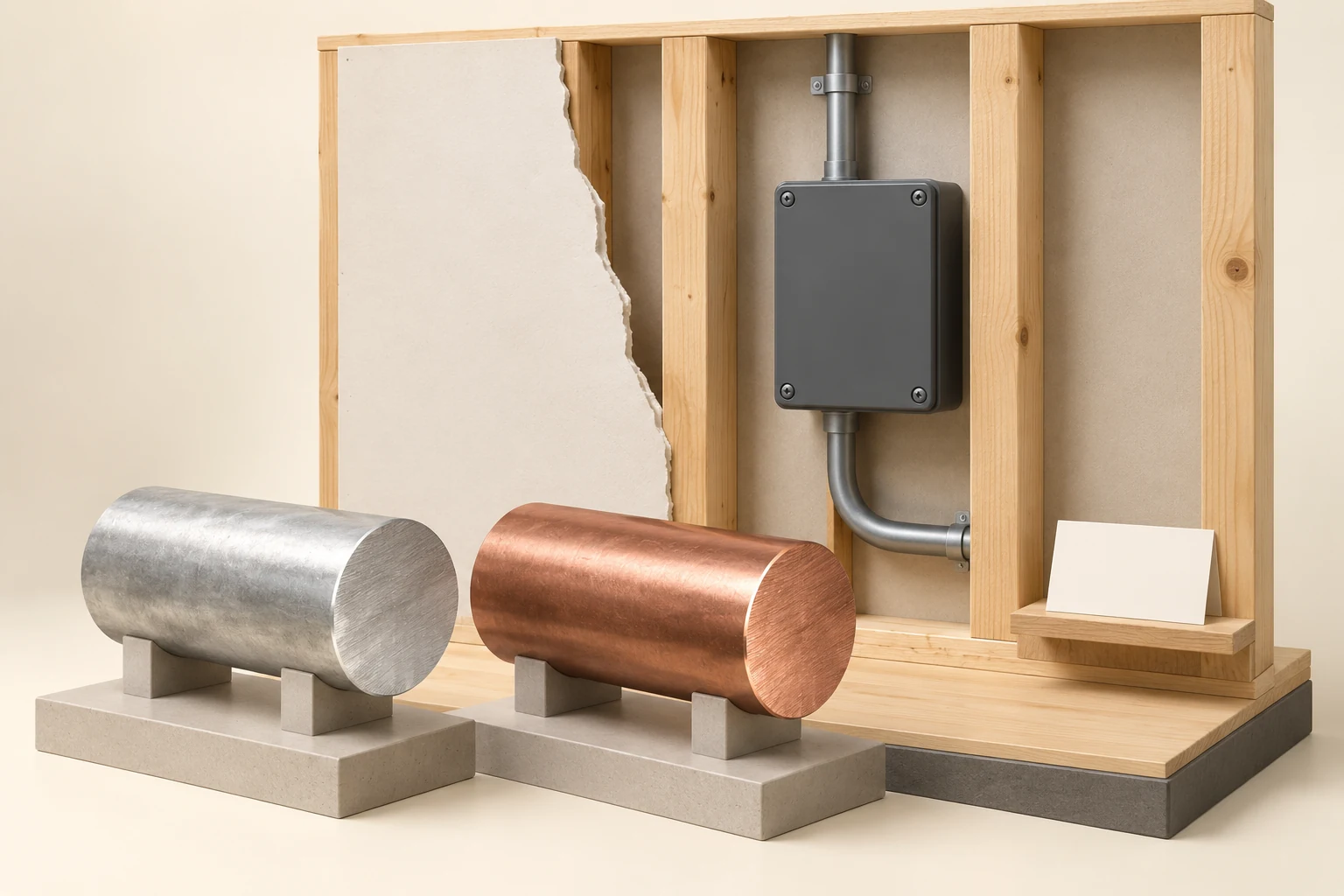
Two independent enlarged metal samples, a closed enclosure and a blank card are visible. The specimens are unconnected and do not depict live wiring.
About this illustration
Colour cannot identify field conductors, alloy, connector compatibility, torque, concealed work, approval or current condition. The closed enclosure shows no joints; the blank card carries no actual evidence. This is a conceptual teaching model, not an assessment of your home.
3 picture lessons appear beside the questions in this guide. Use them to understand the explanation, then consider what it means for your home.
What should “electrical updated” mean to a buyer?
Ask for the physical change behind the phrase. It could describe replacement lighting, a new distribution panel, new circuits for a kitchen, an enlarged service, or work connected with an added dwelling area. Those changes involve different parts of the system. A seller can accurately report one completed project while older circuits remain elsewhere. The purchase question is whether the documented project answers the concern you actually have.
Write a short scope in ordinary words: location, intended use, equipment changed and known dates. Attribute a seller’s account rather than treating it as an inspection finding. Ask the responsible electrical professional to explain unfamiliar terminology and the retained equipment. An invoice, authority record and current assessment can then be compared against the same question. Payment for an upgrade does not define everything that was assessed, and the price cannot establish the unseen extent.
What physically changes when wiring is altered?
A circuit supplies equipment through conductors and connections forming an electrical path. A renovation can change where that path runs, where connections occur and what equipment it serves. Behind a new finish there may be retained wiring, new wiring and an interface between them. A working fixture shows an observed function; it does not describe every connection or the protection of the concealed route.
Ask the electrician which routes and connection locations were within the work and how its boundaries were documented. Request a description of any relevant existing portion that remained. Connections, conductor condition, device compatibility and enclosure arrangements are technical questions for that professional. A drawing may describe the intended layout without recording every as-built change. Do not open electrical boxes or remove covers at a showing to reconstruct the route. Have access and any investigation agreed and performed safely by the appropriate professional.
Think of the alteration boundary as an interface within a continuing system. Moving a fixture can involve retained portions as well as a new location; adding a circuit can leave adjacent circuits untouched. The important enquiry is how the new work relates to what remains, including any relevant limitations the provider identified. A room-based invoice and a circuit-based assessment might describe overlapping but different extents. Ask the author to reconcile them. Neither the number of new devices nor a new room finish establishes that every electrical path through the area was replaced or assessed.
The material specimen and the connection are different questions
Two independent enlarged metal samples, a closed enclosure and a blank card are visible. The specimens are unconnected and do not depict live wiring.
Numbers identify the parts explained below.
- Metal specimens
The enlarged specimens introduce material differences. A qualified assessment of actual wiring uses appropriate evidence, not a colour match to this illustration.
- Closed enclosure
Connection compatibility and workmanship need their own evidence. Keep covers closed; this picture contains no repair procedure or verified connector.
- Blank record
A record must match the address, circuit or work scope, date, responsible party and outstanding items. A permit status and current condition answer different questions.
What does this illustration leave out?
Colour cannot identify field conductors, alloy, connector compatibility, torque, concealed work, approval or current condition. The closed enclosure shows no joints; the blank card carries no actual evidence. This illustration explains an idea. It is not an installation guide.
What actual electrical work, conductor and connection assessment, local verification records and unresolved scope should a buyer ask a qualified professional to explain?
Explore this with HomeAI ↗Opens an editable question. Nothing is sent until you choose to send it.Does a new panel mean the whole home was rewired?
The service bringing power to the dwelling, equipment distributing it and individual circuits serving rooms are distinct parts. Replacing a panel does not, by that description alone, mean every branch circuit was replaced. Nor does it establish that utility supply capacity changed. A new enclosure can be connected to a mixture of retained circuits and new work. A listing photograph cannot settle the physical or approval scope.
Request the project description and ask which parts of the supply path and distribution were changed. If the buyer plans electric heating, charging or another substantial addition, supply those plans separately for a load assessment. The seller’s completed project concerned its specified equipment and assumptions. Calgary’s contractor guidance, for example, treats electrification planning and utility coordination as relevant tasks. Use the current local process for the address; do not turn the appearance or rating of one component into a conclusion about the complete system.
A route is different from a tested system
Visible routes locate different system functions. Closed equipment keeps this a planning illustration.
Numbers identify the parts explained below.
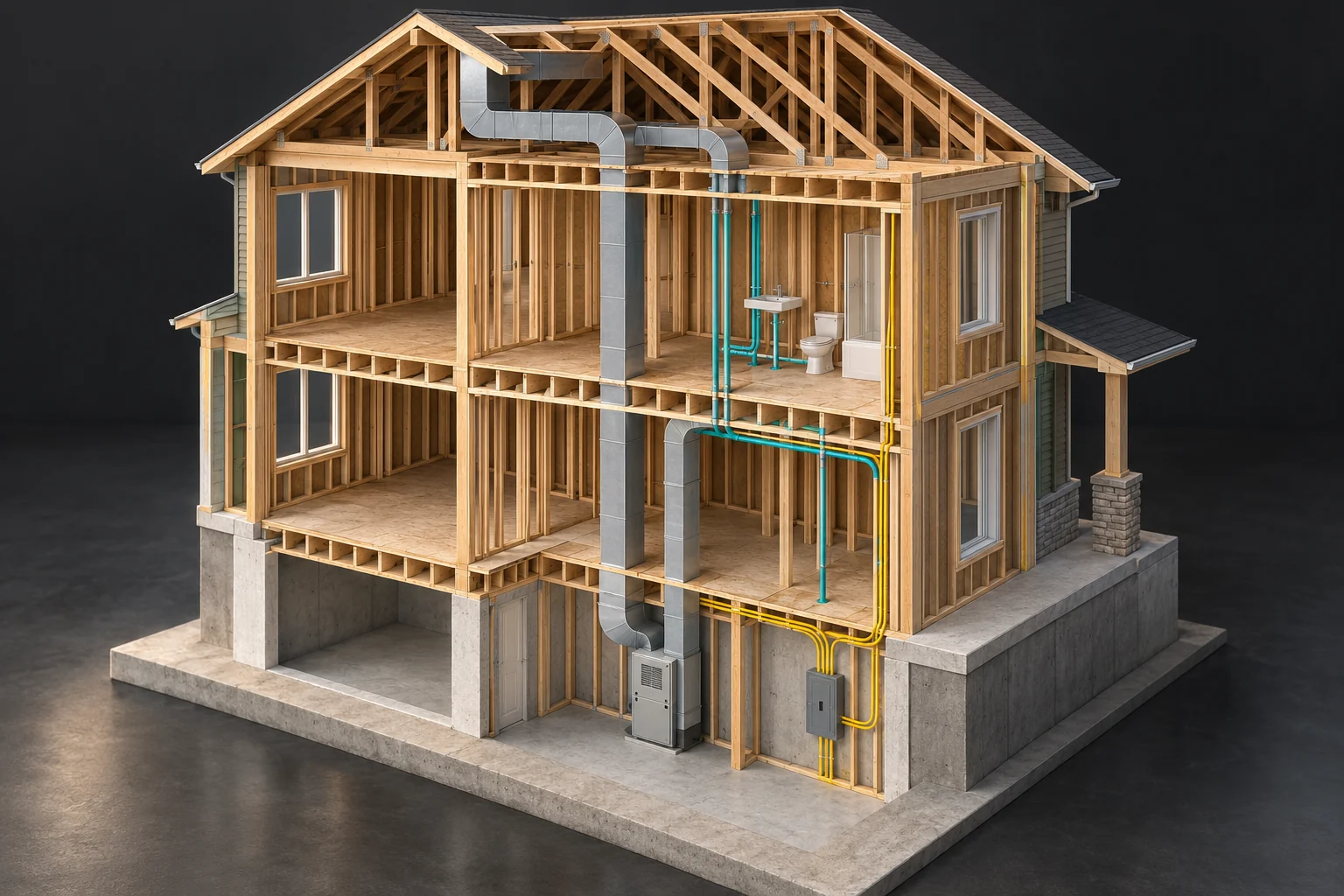
- Routes
Trace the question using records; colour is only this illustration’s key.
- Closed equipment
A professional defines access and measurements. Do not open a panel for this lesson.
- Room endpoint
A symptom at one room does not locate the fault.
What does this illustration leave out?
Capacity, continuity, hidden condition, electrical safety and actual delivered performance are not established. This illustration explains an idea. It is not an installation guide.
Which safe observations and specific professional measurements would resolve this system question?
Explore this with HomeAI ↗Opens an editable question. Nothing is sent until you choose to send it.Why does ordinary operation leave technical questions open?
Equipment functioning during a visit is a limited observation under the conditions then present. Electrical connections can have local problems even when the equipment operates. In an investigated Delta hot tub incident, Technical Safety BC described unsuitable conductor connections developing high resistance and heat. That specific incident illustrates why compatibility matters; it does not establish a defect in another house or imply every aluminum installation fails.
Ask what question the proposed assessment and methods can answer. A brief observation of a light, a seller’s statement that breakers do not trip, or a photograph of a modern switch cannot replace a defined electrical assessment. Preserve any reported intermittent behaviour with its location and circumstances. Do not reproduce symptoms, load circuits deliberately, probe sockets or request exposed energized photographs. Electrical smoke, sparks, a burning smell or water contacting electrical equipment call for immediate safety action, not continued transaction troubleshooting; keep clear and contact emergency help when danger is present.
Which document links the alteration to the right property?
Compare the full address, unit or building identity, relevant dates and work description. The contractor invoice describes its commercial deliverable. A permit or notification identifies regulated work under an authority’s process. A completion or closure record describes the outcome of that process. These documents belong together, but a reference number on an invoice is not itself the final outcome.
ASCA’s electrical application guidance asks for the project location and a full description of the work. It also describes owner communications and a permit services report when a permit closes. Those are Alberta pathway examples; another authority may use different documents. Have the actual issuer explain ambiguous scope or status. If the record covers a garage and the questioned work is a basement, identify that mismatch rather than assuming the number covers both. Preserve the original documents so the scope stays attached to a later summary.
What do rough, service and final records establish?
Different project stages expose different evidence. Ontario’s ESA describes service, rough-in and final stages, while explaining that the review or inspection process varies. Its risk based oversight uses the nature of work and other factors to select site visits. An acceptance document should therefore be read with its scope and process; it is not evidence that an inspector personally examined every connection.
Technical Safety BC distinguishes contractor declaration acceptance from physical or remote inspection. Accepted contractor declarations receive confirmation without an inspection or Certificate of Inspection; physical and remote inspections issue certificates. Its homeowner permit process is separately described. Do not merge those pathways or interpret absence of one document title as automatic failure. Ask the relevant authority which process applied, what final record should exist and whether unresolved items remain. A new-build possession date, utility connection or building inspection record is not a substitute for identifying the electrical record that covers the actual work.
See what finishes can conceal
Open framing, insulation specimens, closed equipment and an illustrative buried sanitary route are exposed.
Numbers identify the parts explained below.
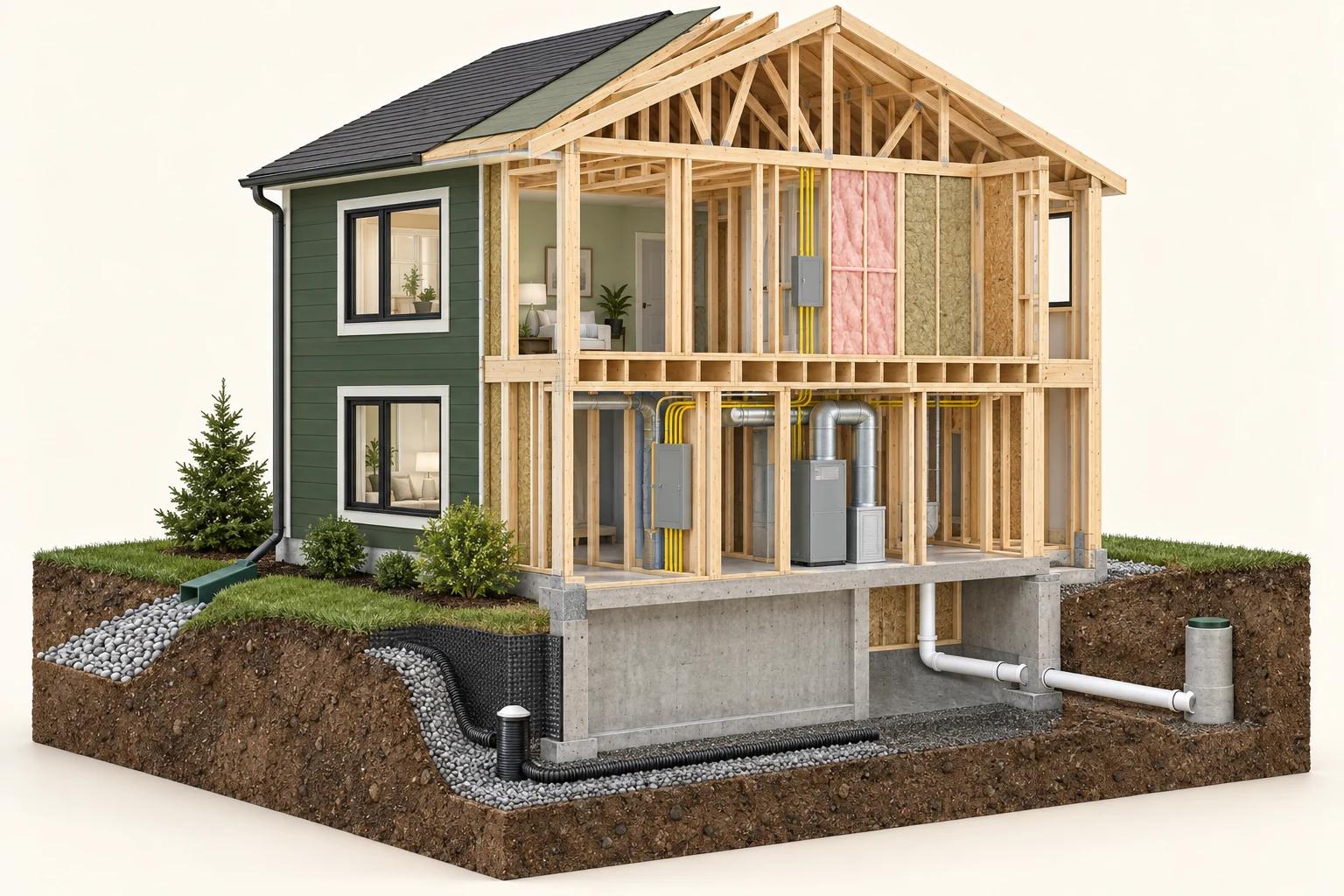
- Exposed stage
Stage records can document specific work before it disappears behind finishes.
- Closed services
Ask for installation, inspection and commissioning records; keep hazardous equipment closed.
- Buried routes
The white sanitary route and dark foundation-drainage context are separate. Gaps are cutaway simplifications, not a defect finding.
What does this illustration leave out?
Member capacity, connections, assembly continuity, commissioned performance and pipe support are not certified by this model. This illustration explains an idea. It is not an installation guide.
Which new-build stages and commissioning records should I review, and what remains outside each inspection scope?
Explore this with HomeAI ↗Opens an editable question. Nothing is sent until you choose to send it.Does a product approval mark certify its installation?
A product’s approval information concerns the product under its assessed scope. Installation also concerns the actual combination of equipment, conductors, protective arrangements and use. ESA’s Ontario approval-mark guidance distinguishes complete-product approval from component recognition. It also explains that a panel-only evaluation does not cover equipment later added or connected to that panel. The label’s scope matters.
Ask the qualified electrical professional to identify relevant product documentation and installation requirements for the actual altered system. Retain the equipment identity and applicable instructions with the completion record. A catalogue photograph or unfamiliar mark is a prompt for verification, not confirmation that the installed item is approved or suitable. HomeAI cannot authenticate a label from an image or approve the combination. Avoid using a product certificate as a summary of all electrical work in the home.
How can later work change the meaning of an older record?
Keep a chronology of subsequent equipment replacement, added circuits, room changes and known damage or repair. An earlier record may accurately describe the work at its date while leaving a later alteration outside its scope. A new appliance can introduce a different connection requirement; a later renovation can change locations or equipment. These are reasons to ask a new question, not proof that the original work was defective.
Compare the dated documents with the described present arrangement through a qualified assessment. Ask which later changes require separate records or authority clarification. Do not infer that older acceptance automatically extends to a later kitchen, suite or electrical accessory. Sellers should state the specific project they can support. New-build buyers can similarly distinguish original construction evidence from extras, post-possession upgrades and later repairs. Keep unresolved dates or scopes explicit rather than inventing a continuous inspection history.
What if the electrical records are missing or unclear?
Start with the relevant authority and an authorized, property-specific request. ESA’s Ontario buyer guidance distinguishes Search of Records and Access to Information and says its records date back to 2000. That range alone leaves important limits for older work. An unsuccessful search is missing evidence; it is not automatically proof that all work was unreported or that no alteration occurred.
Ask the issuer to clarify the correct property identifier, available record range, status and process for uncertain past work. Have a qualified electrical professional define any present assessment needed. Record what each enquiry could and could not resolve. Do not conceal uncertainty with a blanket “passed” statement or assume that collecting more photographs will settle inaccessible condition. Obtain transaction and access advice from the relevant advisers while the question remains open.
How would this work in a fictional renovated basement?
Fictional case: a listing calls an invented basement “electrical updated.” The seller supplies an invoice describing a panel replacement and a related completion document. A separate statement says later basement lighting was added. The buyer plans different heating equipment. No actual property, inspection finding, defect or approval outcome is represented.
The buyer first maps the supplied documents to the panel project. They ask for the later lighting scope and the applicable electrical record, without assuming it was included or unreported. They give the electrician the future heating plan as a separate capacity question. If the authority clarifies a record or the electrician supplies findings, each stays attached to its date and assessed work. The example ends with distinct enquiries about historic alteration, present condition and future suitability, not a predicted repair bill or purchase recommendation.
What should the electrical professional and transaction team answer?
Before commissioning work, identify the decision, property, altered locations, available records and intended future equipment. Ask the electrical professional what will be assessed, what access is needed, which relevant existing portions are included and what will remain unknown. Request findings and their implications in writing. Ask who will coordinate any required authority and utility steps if work is proposed.
Your agent can help coordinate permitted access and document requests; the technical professional supplies the electrical findings. Your legal adviser addresses the actual agreement and unresolved obligations. Confirm current authorization and relevant experience under the local pathway instead of assuming one Canadian licensing label. Sellers can preserve accurate records for handover, and buyers can carry the assessment into their Home Plan. Keep the project-specific answer intact: understanding what was checked is more useful than an unsupported whole-house assurance.
Keep learning about the connected parts
- Buying a home with a standby generator: engine, switching and handover
- Power bars, surge protection and UPS: understand the different jobs
- How home internet works: follow the service, router and room connection
- Hiring a repair contractor: carry evidence into scope, changes and completion
- Buying a house with knob-and-tube wiring
Practice the distinction.
Fictional basement: three electrical questions
An invented panel-project invoice and completion document coexist with an attributed later-lighting alteration and a buyer’s proposed heating change.
Reported observations
- The supplied records describe the fictional panel project.
- The later lighting is reported separately, with its approval scope unresolved.
- The buyer’s proposed heating is outside the described past project.
Compare the explanations
Expand each possibility to see the evidence needed to distinguish it. Similar symptoms can have different mechanisms.
The original records may be accurate within their scope
A panel replacement can be documented without establishing the later work’s status.
Issuer clarification and the complete address-specific record.
Another assessment may be needed for the buyer’s plans
Future equipment needs its own defined suitability and load enquiry.
Qualified assessment using the actual proposed equipment and supply arrangement.
A useful next question
Resolve the scope of each alteration, commission the relevant current assessment and obtain transaction advice on remaining uncertainty.
This fictional example supplies no defect, code-compliance verdict, load capacity, legal remedy or buying recommendation.
Know what the words mean.
- Alteration scope
- The identified equipment, locations and work included in a particular electrical change.
- Electrical notification
- A record initiating the applicable authority process for stated electrical work; terminology and requirements depend on the jurisdiction.
- Branch circuit
- A circuit distributing electricity to specified equipment or outlets downstream of its protection.
- Acceptance record
- The applicable authority’s documented process outcome for a defined scope; its name and assessment method must be confirmed.
- Product approval scope
- The product or component and conditions addressed by its approval or evaluation, distinct from the complete installation.
- As-built information
- Information describing the completed arrangement, with its author, date and verification limits.
Questions to bring
to the conversation.
- Which service, panel, circuit, device or equipment connection was actually altered?
- Which electrical authority administered that scope, and what does its actual completion record mean?
- What existing wiring remained and which later changes are documented?
- What must a qualified electrical assessment answer before the property decision or proposed work?
Separate a showing observation, an existing record and a new professional assessment. Unknown means a question remains; it does not automatically mean a defect.
Use the evidence planner ↗Go to the source.
Original HomeAI explanation informed by these public references. Sources support the underlying guidance; they have not reviewed or endorsed HomeAI. Diagrams are conceptual, and calculator outputs depend on your inputs.
Publication & source review
First published .
Sources reviewed .
- Electrical Safety Authority — buying a renovated home
- Electrical Safety Authority — notifications and inspections
- Electrical Safety Authority — risk based oversight
- Electrical Safety Authority — recognized approval marks
- Technical Safety BC — electrical assessments
- Alberta Safety Codes Authority — electrical permit application guidelines
- City of Calgary — electrical permits for contractors
- Canadian Centre for Occupational Health and Safety — electrical safety basics
- Technical Safety BC — hot tub conductor incompatibility incident
- CAHPI — 2024 National Standards of Practice
Have a question about your home?
Start with the symptom, timing and what you have observed.
Ask HomeAI