- Radiant, induction and gas categories create cooking heat differently. A hot-pan contact can still heat an induction surface.
- Cavity convection, appliance cooling and kitchen exhaust are separate air-moving jobs. A sound alone does not identify the running component or prove performance.
- A selected mode, temperature target, timer and finished result are different evidence. Useful records identify the exact appliance, existing context and scope of service.
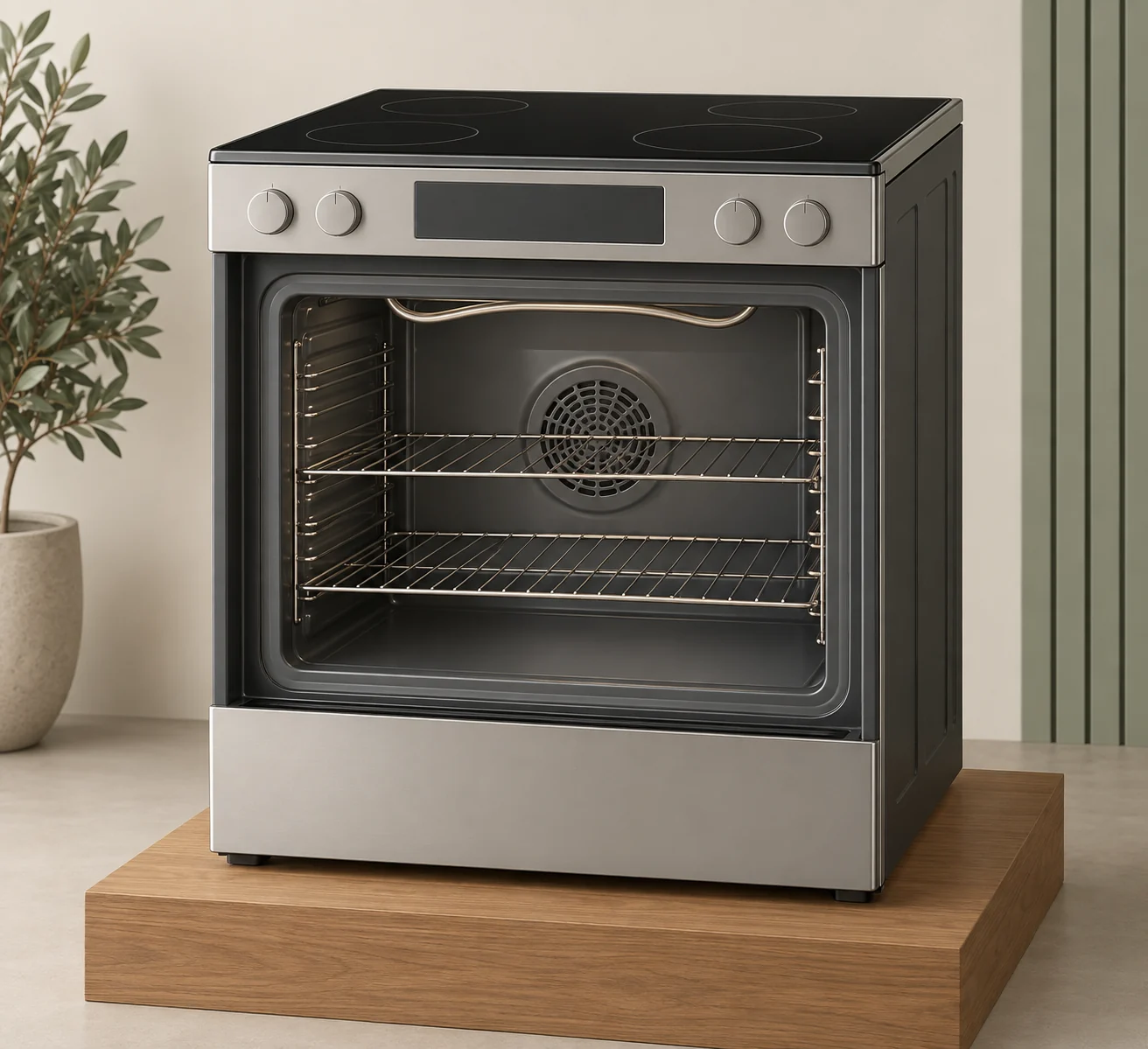
The front-cutaway cavity contains two empty racks, side rack supports, a curved upper metal form and a circular grille at the rear. The lower cavity floor is covered and shows no exposed lower element. Four circle outlines appear on the dark cooktop; the fascia display is blank. There is no food, flame, glowing part or operating reading.
About this illustration
No exact product, radiant or induction identity, energized state, heat-source output, temperature, hidden lower element, fan behind the grille, airflow, calibration, rack suitability, cooking result, installation or safe service access is established. The open front is a display cutaway rather than an instruction to remove a door or reach inside. Cooktop circles and metallic forms do not establish an operating mechanism. This is a conceptual teaching model, not an assessment of your home.
4 picture lessons appear beside the questions in this guide. Use them to understand the explanation, then consider what it means for your home.
What jobs does a range combine?
A range combines a cooking surface and an oven, but the two do not perform one undifferentiated job. The surface supplies heat to cookware. The cavity surrounds food with its selected heating and circulation conditions. Controls request particular functions, and separate components manage appliance heat. An owner can understand those roles without knowing an internal wiring diagram. Start by asking which part of the cooking process changed: a surface zone, a cavity result, a control meaning or an air-moving sound.
This guide uses the Bosch HEI8056C/08 Canadian support-linked electric-range manual as its detailed example. The document also covers a US model and includes jurisdiction-specific material; those sections are not converted into Canadian rules. Canadian Whirlpool explanations supply only family-level radiant, induction and gas distinctions. Neither a product family nor a similar fascia proves which features your appliance has. Existing model and variant records, matched instructions and a responsible service provider should establish that identity before interpreting a control or service note.
How do radiant and induction surfaces create cooking heat?
In the named Bosch radiant example, an electrically heated source supplies cooking heat through the cooking surface to cookware. Its manual describes zones cycling during operation and different heating sections within some zones. A remembered glow or interval is therefore not a complete measure of delivered heat or a diagnosis of a failed control. Keep the identified zone, already-known selection and ordinary-use account separate from any inference about hidden components.
Whirlpool Canada describes induction as a magnetic field interacting with compatible cookware, which becomes a source of cooking heat. The appliance-and-pan relationship differs from heating a radiant source beneath the surface. It does not make the surface safe to touch: the same article explains that heat from cookware can warm it. Compatibility belongs to the exact appliance instructions, not a staged live-pan or magnet test in this guide. Gas is a separate category in which flame provides cooking heat. That category label supplies no burner, valve, ignition, combustion or repair instructions here. The useful comparison teaches heat-source roles while withholding efficiency predictions, output numbers and safety clearances.
Separate ways to create cooking heat
Separate the job, the evidence and the question that remains.
- RadiantAn electrically heated source transfers heat through the cooking surface to cookware.
- InductionA magnetic field interacts with compatible cookware; hot cookware can still heat the surface.
- Gas categoryFlame supplies cooking heat; this page gives no gas-component or service procedure.
Category meanings, not live compatibility testing, efficiency, installation or touch clearance.
Bosch · Electric Slide-In Ranges Use and Care Manual — HEI8056C / HEI8056U and named families; Whirlpool Canada · What is induction cooking?; Whirlpool Canada · How to buy a cooktop. Reviewed October 5, 2026. Named equipment and Canadian jurisdiction limits remain in the full reference panel. Qualitative comparison; no measured quantity, test result or property approval.
How does the oven cavity receive and distribute heat?
The named Bosch manual describes Bake as cooking with heated air and identifies an upper broiling heat source. Convection modes add a fan that circulates heated air within the cavity. A selected mode changes the intended heating and air-moving function; it is not merely a different name for the same process. The representative component figure identifies racks, an upper heat source and a rear convection-fan landmark. It does not authorize access to the hardware behind those surfaces.
An empty cavity picture can help connect the terms rack, upper heat and circulation, but it cannot establish an exact hidden arrangement or actual temperature. The accompanying skeleton study is conceptual and unpowered. In ordinary records, preserve which mode was already selected and which rack and pan arrangement applied. An observed browned top or pale bottom does not uniquely identify the heat source responsible. Food, placement, cookware and selected function can all matter, while a component or control problem remains a separate possibility for qualified assessment. Ask for the applicable mode explanation and documented findings rather than turning a food result into a parts diagnosis.
Separate the cavity, racks and documented heat sources
The front-cutaway cavity contains two empty racks, side rack supports, a curved upper metal form and a circular grille at the rear. The lower cavity floor is covered and shows no exposed lower element. Four circle outlines appear on the dark cooktop; the fascia display is blank. There is no food, flame, glowing part or operating reading.
Numbers identify the parts explained below.
- Upper heat-form landmark
The curved metal form locates an upper heat-source question. Match the actual model and selected mode; this still proves no energized state, output or temperature.
- Rear grille landmark
A circular grille is visible behind the racks. A visible grille does not establish a hidden fan, its state or a measured cavity-air path.
- Racks and covered floor
Two empty racks and a covered lower floor are visible. Actual rack use and any concealed heat source depend on the model instructions; no lower exposed element is pictured.
What does this illustration leave out?
No exact product, radiant or induction identity, energized state, heat-source output, temperature, hidden lower element, fan behind the grille, airflow, calibration, rack suitability, cooking result, installation or safe service access is established. The open front is a display cutaway rather than an instruction to remove a door or reach inside. Cooktop circles and metallic forms do not establish an operating mechanism. This illustration explains an idea. It is not an installation guide.
Which heat sources and circulation roles does the exact model document for the selected mode, and what remains hidden behind its covers?
Explore this with HomeAI ↗Opens an editable question. Nothing is sent until you choose to send it.Why are convection, cooling and kitchen exhaust separate fans?
The Bosch example distinguishes its convection fan from a separate cooling fan. Convection circulates air within the oven cavity for the named modes. The cooling fan manages appliance heat and can run during cooking and continue afterward. Its exterior vent is another appliance landmark, not the kitchen hood. A fan-like sound can therefore have different meanings depending on the identified component and operating context. Hearing it does not measure cavity circulation or establish that a cooling path is clear.
The kitchen hood handles a different question: cooking-source air in the room and its actual recirculation or exterior-discharge route. Health Canada describes cooking particles and moisture, with gas combustion adding another source context. A cavity fan cannot be treated as room-air removal. The two kitchen studies illustrate separate hood-route concepts; their arrows are not measured capture or adequate replacement air. Use the kitchen-exhaust guide for that system. When service concerns a fan, ask which component was identified and what function was assessed. The detached fan specimens here teach separate roles without claiming to reconstruct either appliance air path.
Cavity circulation and appliance cooling are separate questions
The central range has a closed glass-front door, two visible racks behind it, a narrow dark opening above the door and a blank fascia. At left, an independent empty cavity and a round grille-faced fan specimen occupy separate plinths. At right, an enclosed circular fan-like specimen with a rectangular outlet-like form sits on its own plinth. All specimens remain unconnected.
Numbers identify the parts explained below.
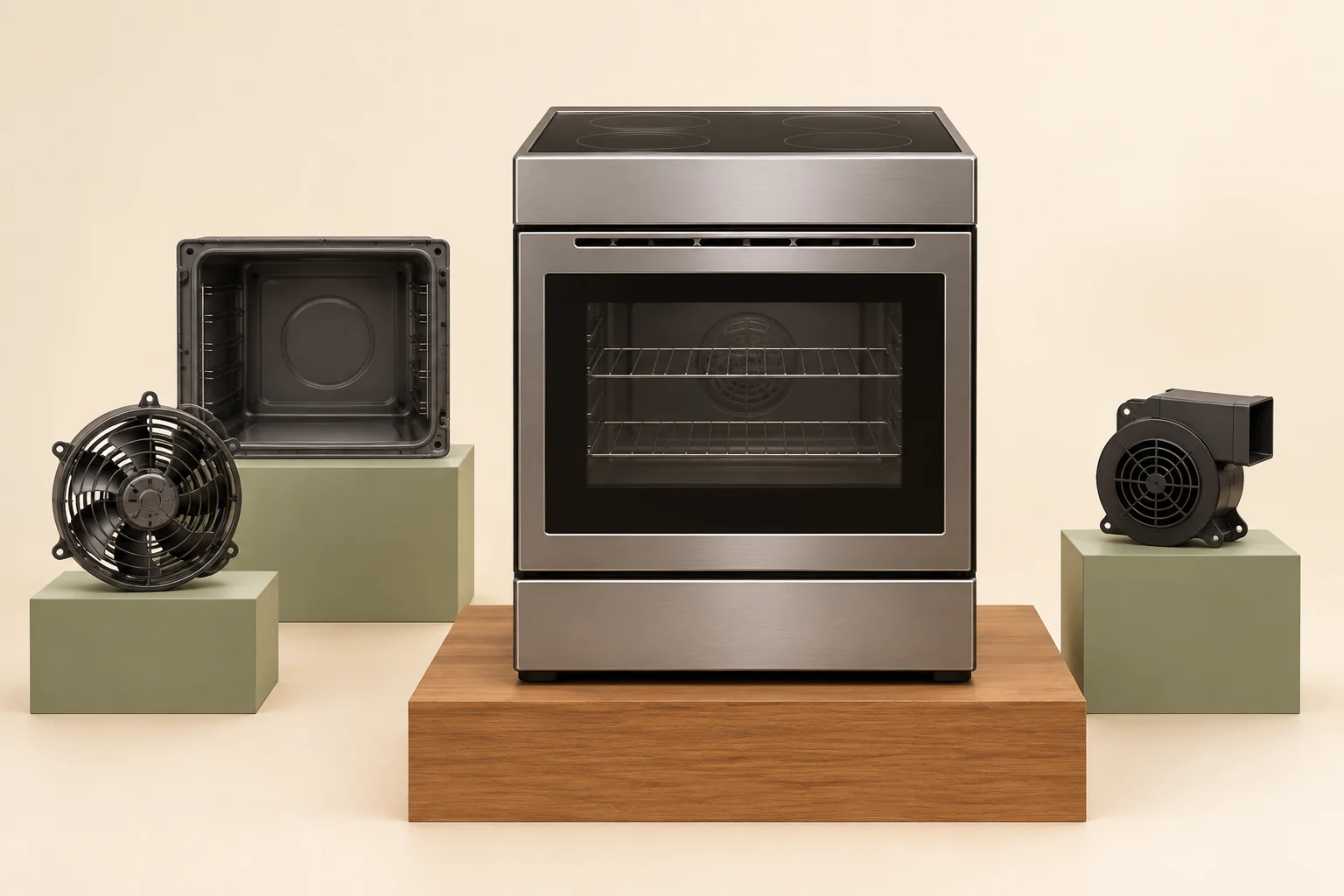
- Cavity and fan specimens
The independent cavity and round fan locate the circulation-role question. They are detached shapes, not an approved part pair or a reconstruction of this range.
- Closed appliance and opening landmark
The central appliance remains closed. Its narrow upper opening proves no airflow, operating cooling arrangement or safe temperature.
- Separate cooling-role specimen
The enclosed fan-like form illustrates a different possible role. Its outlet-like shape proves neither installed connection nor air direction or operating state.
What does this illustration leave out?
No detached specimen is identified as the actual appliance part. The display establishes no internal mounting, duct or wiring path, air direction, rotation, cooling circuit, temperature, safe-to-touch state, operating time, exact model or fault. The narrow opening is a landmark, not a proven discharge path. No kitchen hood is pictured; room exhaust needs the separate room-source explanation. This illustration explains an idea. It is not an installation guide.
Does the actual documented fan serve the oven cavity, appliance cooling or room-source exhaust, and which of those roles was assessed?
Explore this with HomeAI ↗Opens an editable question. Nothing is sent until you choose to send it.Keep kitchen-source exhaust separate from appliance fans
The left kitchen shows a hood with upward and room-return arrows. The separate right kitchen shows a hood, a drawn bent duct and exterior terminal with an outward arrow. A blue arrow appears near the right-hand window. Cooking-vapour effects, cabinets and range-like appliances supply room context.
Numbers identify the parts explained below.
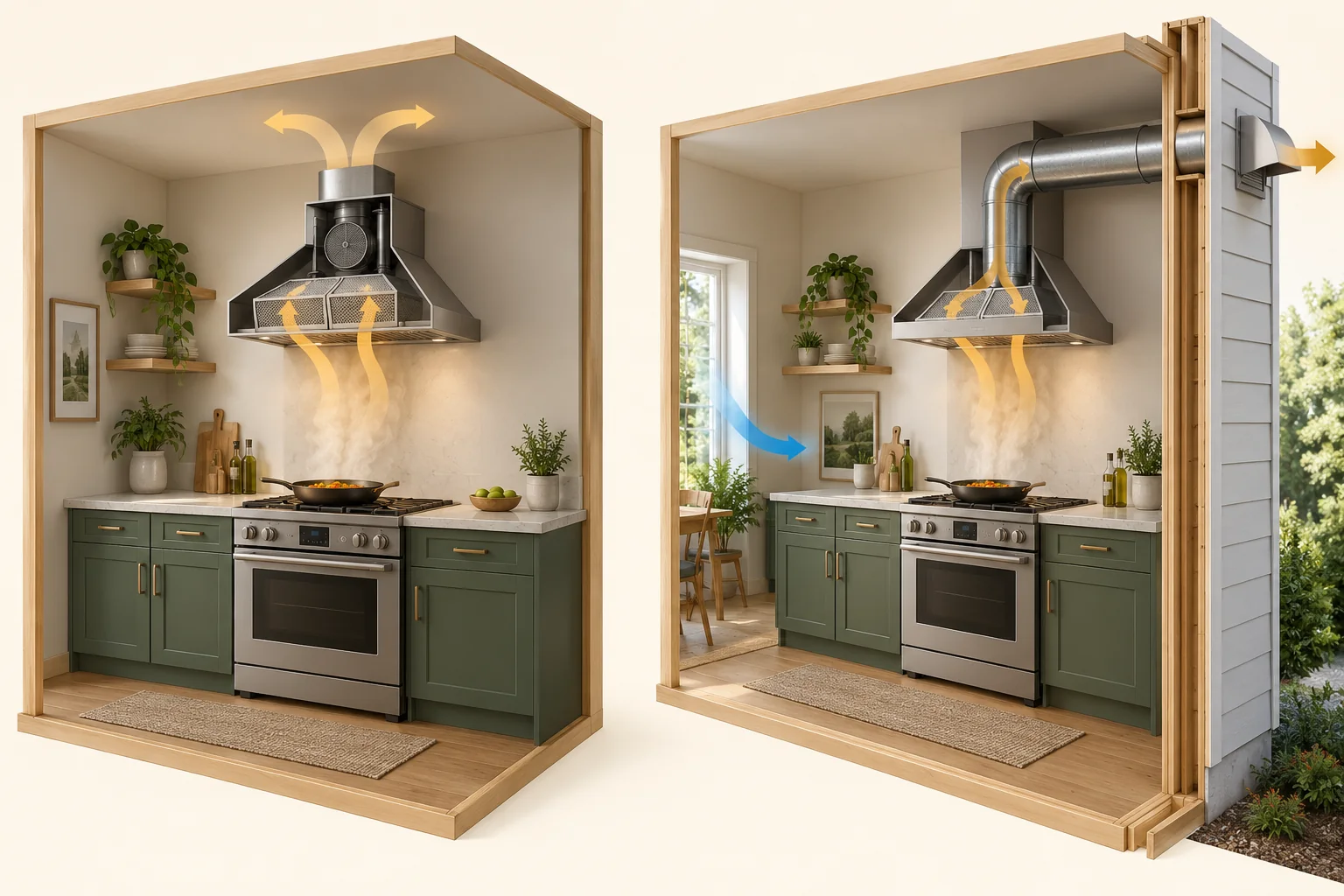
- Room-return concept
The left arrows illustrate a room-return role only; no removal efficiency or measured air path is pictured.
- Exterior-route concept
The right drawn duct and terminal illustrate a separate destination question. Verify the actual model and route; the art proves no installation or capture result.
- Room-air context
The blue arrow locates a room-air question without specifying a permitted air-supply arrangement, rate or operating procedure.
What does this illustration leave out?
All arrows and vapour are conceptual. No capture efficiency, airflow rate, humidity, pollutant result, installed routing, permitted replacement-air arrangement or operating hood is established. The depicted cooktop and range do not identify the electric model discussed in the chapter or any cavity/cooling fan. An open-window arrow is not a universal replacement-air recommendation. This illustration explains an idea. It is not an installation guide.
Which kitchen-source system and destination are documented, and how do those differ from the oven cavity and appliance-cooling roles?
Explore this with HomeAI ↗Opens an editable question. Nothing is sent until you choose to send it.Three air-moving jobs
Separate the job, the evidence and the question that remains.
- ConvectionCirculates air within the identified oven cavity.
- CoolingA separate named appliance fan manages appliance heat and can continue after cooking.
- Kitchen exhaustA separate hood system handles cooking-source room air according to its actual route.
No reconstruction of hidden routes, measured capture, sound diagnosis or performance guarantee.
Bosch · Electric Slide-In Ranges Use and Care Manual — HEI8056C / HEI8056U and named families; Health Canada · Improve indoor air quality in your home. Reviewed October 5, 2026. Named equipment and Canadian jurisdiction limits remain in the full reference panel. Qualitative comparison; no measured quantity, test result or property approval.
What do a mode, a temperature and a timer actually mean?
A mode identifies the requested heating and circulation function. A selected temperature is a control target, not proof that every part of the cavity has reached or stays at that value. A timer represents a time-related function whose effect depends on the actual control. These meanings should be preserved separately in a service account. A display photograph without its already-known context may not explain which value was shown or what the appliance had been asked to do.
The Bosch manual makes one distinction explicit: its kitchen timer counts down without controlling oven heating, while its oven timer ends the cooking mode in the supported modes. The manual lists exceptions. That is a named-model example, not a universal promise that any timer stops any heat source. The document also describes an automatic convection conversion and a temperature-offset setting. Their existence is useful context when comparing an ordinary-use account, but this guide supplies no numerical conversion or calibration procedure. Ask which settings were applicable and how the service assessment accounted for them. Do not change a mode, offset or timer to stage a diagnosis.
Read control meanings separately
Separate the job, the evidence and the question that remains.
- ModeRequested heating and circulation function.
- TemperatureSelected target, not a verified cavity measurement.
- Kitchen timerThe named Bosch countdown does not control heat.
- Oven timerThe named Bosch control ends supported cooking modes, with documented exceptions.
Named model example; no button sequence, calibration, timing prescription or universal timer behaviour.
Bosch · Electric Slide-In Ranges Use and Care Manual — HEI8056C / HEI8056U and named families. Reviewed October 5, 2026. Named equipment and Canadian jurisdiction limits remain in the full reference panel. Qualitative comparison; no measured quantity, test result or property approval.
Why do pans, racks and preheating change the result?
The named manual explains that pan material and arrangement influence browning and heat circulation. Rack position changes where food sits within the cavity’s heating context. It also notes that preheating depends on circumstances such as the selected target and rack arrangement. A different result after a different pan, position or mode is therefore not automatically a changed appliance. The record needs the ordinary cooking context before a comparison can be interpreted.
This does not mean every poor result is a cookware issue. It means several explanations remain open. An existing account can identify the food, pan, rack position, mode and already-known preheat sequence without repeating the cook or measuring a live cavity. A meaningful service question describes what changed and what stayed comparable, leaving missing details unresolved. The provider can decide whether a model-matched assessment is needed and what it must cover. This guide supplies no recipe temperature, preheat duration, rack spacing, food-safety threshold or thermometer-testing method.
Why can residual heat and a running fan outlast cooking?
Turning a requested cooking function off does not instantly remove heat already held by cookware, the cooking surface and cavity materials. The Bosch manual warns that a surface can remain hot when it no longer appears to glow and identifies a residual-heat indication for its zones. It also describes cooling-fan operation continuing after cooking. A dark surface or an ended timer therefore cannot be treated as permission to touch equipment.
Continued fan sound, vent warmth or moisture still needs the actual context. The manual notes warm air and steam at the oven vent and describes condensation associated with food moisture and cooler surfaces. Those descriptions explain possible functions, not a blanket clearance for an unusual smell, damaged surface or changed behaviour. Do not touch, block a vent or reproduce an event to distinguish causes. Preserve an existing account and ask the appropriate provider to identify the source and its limits. The guide gives no cooldown interval or universal normality test.
What does a self-clean feature change about the service question?
The named Bosch manual describes a high-heat self-clean function, with its own door-locking and operating conditions. It treats that function separately from cooking. A record saying “cleaned” is therefore ambiguous: it may describe ordinary surface care, a named appliance cycle or work by a service provider. The exact task and instructions matter when interpreting what happened before a changed result.
This guide does not recommend starting a cycle, defeating or resetting a lock, applying a cleaning product or opening any assembly. The complete manual includes important safety and material restrictions that cannot be reduced to a generic shortcut. Ask which model-specific care instruction applied, what work was actually recorded and whether a service assessment addressed the subsequent concern. A feature’s presence establishes neither that it was used correctly nor that it is suitable for the present equipment condition. An unclear care record remains unclear until identified.
How can changed results be documented without a test?
Separate a result from an interpretation. “The top browned sooner than in the previous account” describes a comparison. “The upper element is defective” names a cause that the food alone does not establish. Similarly, “a fan sound continued after the display changed” preserves sequence but does not identify the fan. Useful existing notes distinguish food, pan, rack, selected mode, already-known temperature target and timer context. They also identify which comparison was actually made, rather than implying controlled conditions that were never recorded.
Keep observation safe and retrospective. Use existing records and already-visible information from an ordinary safe position; do not move or tip the appliance, touch a cooking surface, remove a panel or reproduce a heating event for evidence. A cracked or damaged cooking surface is a stop-use and service concern in the named manual. Immediate safety concerns take priority over a worksheet. Missing details are acceptable: a responsible provider can identify the appropriate assessment rather than asking an owner to supply a staged electrical, temperature or cooking test.
What can service records establish, and what stays unknown?
The Bosch manual identifies model and production information for service. A useful record connects that exact unit with the dated concern, work, findings and verification scope. An invoice may establish that a component was replaced or a particular task was performed. It does not automatically establish all zone functions, every cavity mode, appliance cooling, kitchen-air removal or the suitability of the installation. Ask what was actually assessed and which questions remained outside the visit.
A qualified appliance service provider can interpret the matched controls and define component or operating assessment. Electrical, gas, installation or building-air questions may require other appropriate professionals and local requirements. Canadian equipment variants and local responsibilities differ; this page supplies no national credential, code-compliance, warranty or property approval conclusion. A general home inspection also needs its stated scope and exclusions. The useful handover is a truthful record of identity, observations and verified work, with limits attached—not a promise that an attractive appliance or a recent invoice settles every function.
Changed outcome and evidence scope
Separate the job, the evidence and the question that remains.
- Existing cooking accountFood, pan, rack, mode and ordinary-use sequence.
- Already-visible stateContext identifies the meaning of a displayed value.
- Service recordExact unit, work, findings, verification scope and unresolved limits.
- UnknownBrowning or sound does not establish hidden operation or appliance safety.
No staged heating, live electrical test, thermometer procedure or property approval.
Bosch Canada · HEI8056C/08 support; Bosch · Electric Slide-In Ranges Use and Care Manual — HEI8056C / HEI8056U and named families. Reviewed October 5, 2026. Named equipment and Canadian jurisdiction limits remain in the full reference panel. Qualitative comparison; no measured quantity, test result or property approval.
A fictional owner separates a changed bake from a fan sound
Explicitly fictional Canadian owner case: an owner reports that one baked dish browned differently from an earlier cook. An existing note identifies a changed pan but leaves the selected mode unclear. Separately, the owner recalls a fan sound after cooking ended. The prior service invoice names the range but gives no assessment of cavity modes or fan functions. No temperature measurement, failed component, completed test or repair outcome is invented.
The owner preserves two questions. The baking account needs its existing pan, rack and control context. The sound needs identification of the actual fan and the operating sequence already known. The responsible provider is asked to interpret both against the exact model and define any necessary assessment. A changed pan is context, not a proved explanation; the named cooling-fan behaviour is a possible function, not proof that this sound was normal. The fictional record narrows the enquiry while leaving the cause, safety and service result unresolved.
A useful range and oven handover worksheet
Prepare five fields from available records: exact appliance and variant; the changed result or sound in the owner’s words; already-known food, pan, rack and control context; dated care/service work with findings and exclusions; and the remaining question for the responsible provider. Attach existing photographs only when safely obtained and identified. A blank field is better than a guessed mode, inferred measurement or claimed test. The abstract papers-and-binder picture illustrates record scope only; its unconnected cabinet is not a range and its blank device is not an oven instrument.
For an owner, this worksheet makes the service request more specific. A buyer can use it to understand which appliance is included and what records actually transfer with it. A seller can disclose known work and unresolved concerns without turning an invoice into whole-appliance proof. Keep the separate kitchen-exhaust path attached when the question concerns cooking air. A useful answer states the exact unit, function, findings, conditions and limits; this guide teaches how to ask for that answer, with no invented property result.
Tie the range handover question to the actual dated file
A timber room cutaway and a separate closed generic dark cabinet form the rear display. Two blank sheets, a small tabletop device with a blank face and a green binder of blank pages sit separately in front. No range, oven, cooking process, completed record or reading is visible.
Numbers identify the parts explained below.
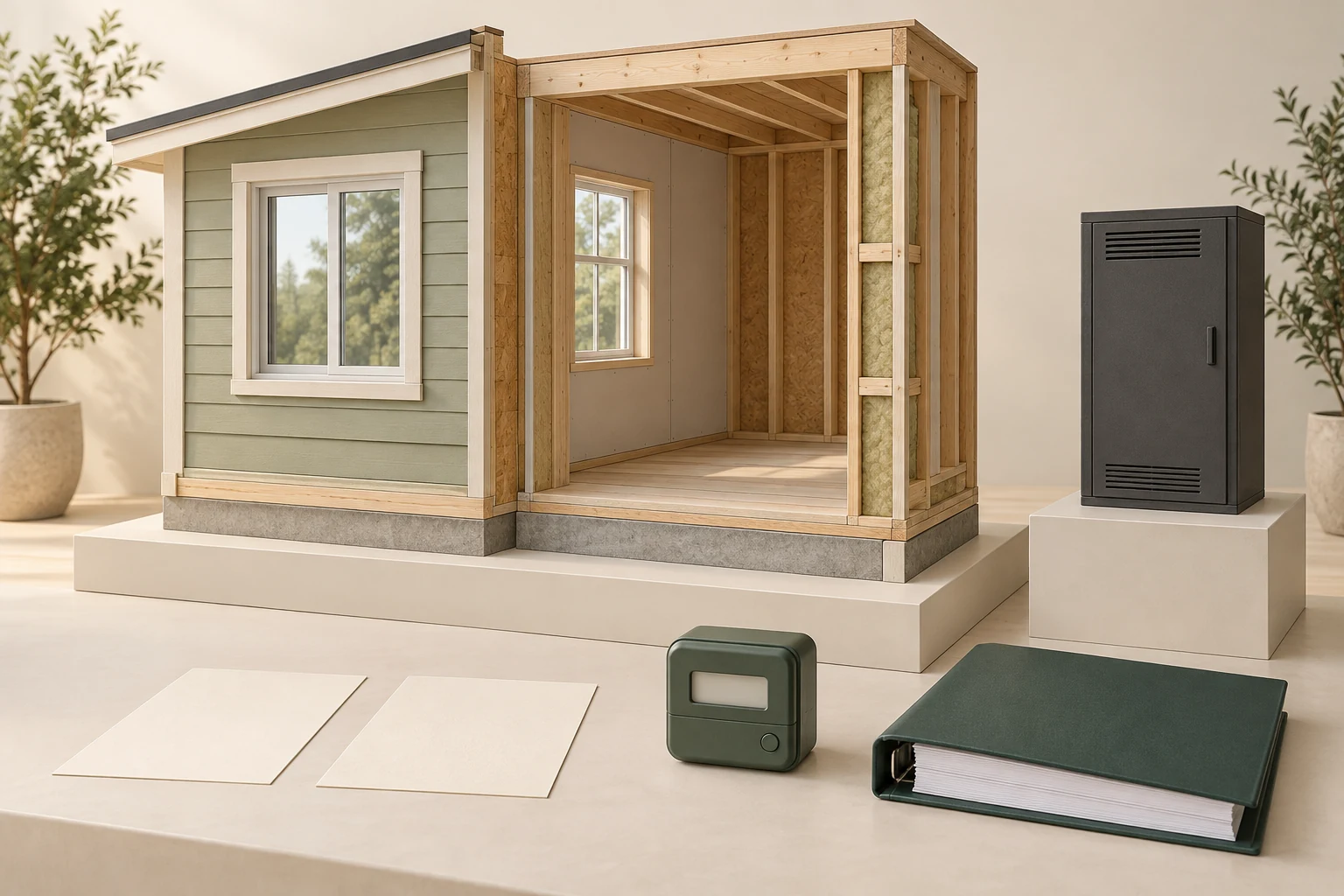
- Generic cabinet context
The closed cabinet is an abstract equipment landmark, not a range or oven. It supplies no model identity or internal condition.
- Blank record props
The sheets and binder introduce an actual-file question. Their blank content establishes no manual, service, approval or result.
- Blank device landmark
The small device has no reading and is not an oven instrument. Record actual controls and reported results in the file, without a new test.
What does this illustration leave out?
The cabinet is not a pictured range or oven, and the small device is not a pictured oven instrument. Blank papers and binder establish no exact model, manual version, warranty, service findings, work approval, calibration, operating result or handover completion. The room supplies no installation or energy assessment. Actual dated records must answer the named range question. This illustration explains an idea. It is not an installation guide.
Which model-matched manual, dated observations, service findings and remaining questions belong in the actual range handover file?
Explore this with HomeAI ↗Opens an editable question. Nothing is sent until you choose to send it.Keep learning about the connected parts
Practice the distinction.
Changed browning and a separate fan account
Explicitly fictional Canadian owner with existing cooking notes and an unclear service invoice; no staged test or verified fault.
Reported observations
- A baked dish reportedly browned differently from an earlier cook.
- The existing account names a changed pan but leaves the mode unclear.
- A separate account describes fan sound after cooking ended.
- The prior invoice does not establish cavity-mode or fan verification.
Compare the explanations
Expand each possibility to see the evidence needed to distinguish it. Similar symptoms can have different mechanisms.
Cooking context may differ
Pan, rack and selected mode can affect the result, but an incomplete account proves no single cause.
Existing ordinary-use context and appropriately scoped model-matched assessment.
The fan role requires identification
The manual distinguishes convection and cooling; remembered sound alone does not identify either or establish safe operation.
Exact model documentation and a qualified finding identifying the component and assessed function.
A useful next question
Preserve the cooking and fan accounts separately and request exact-model interpretation with explicit scope and remaining limits.
No actual property, measured temperature, live test, failed part, recommended setting, food-safety determination, normality clearance, installation approval or repair outcome.
Know what the words mean.
- Radiant cooking surface
- A category using an electrically heated source to transfer cooking heat through the surface to cookware.
- Induction cooking
- A category using a magnetic field with compatible cookware to create cooking heat; hot cookware can still heat the surface.
- Oven mode
- The identified requested heating and circulation function, separate from its selected target or a measured result.
- Cavity convection
- Fan-driven circulation within the named oven cavity, separate from appliance cooling and kitchen exhaust.
- Appliance cooling fan
- A separately identified fan managing appliance heat; the named Bosch example can continue after cooking.
- Residual cooking heat
- Heat remaining in cooking surfaces, cookware or cavity materials after a requested heating function ends.
- Kitchen versus oven timer
- In the named manual, a kitchen countdown does not control heat; the oven timer ends supported cooking modes, with documented exceptions.
- Appliance service scope
- The exact unit, concern, functions, conditions, findings and exclusions addressed by a dated service assessment.
Questions to bring
to the conversation.
- Which existing record identifies the exact range or oven model and variant?
- Does the account distinguish surface heat, cavity result, control meaning and fan sound?
- Which pan, rack, mode, target and timer context was already known, and which details remain missing?
- What functions and findings does the dated care or service record actually cover?
- Which qualified provider can define the assessment while keeping appliance cooling and kitchen exhaust separate?
Separate a showing observation, an existing record and a new professional assessment. Unknown means a question remains; it does not automatically mean a defect.
Use the evidence planner ↗Go to the source.
Original HomeAI explanation informed by these public references. Sources support the underlying guidance; they have not reviewed or endorsed HomeAI. Diagrams are conceptual, and calculator outputs depend on your inputs.
Publication & source review
First published .
Sources reviewed .
- Bosch Canada · HEI8056C electric slide-in range
Where this reference applies
Jurisdiction: Canadian manufacturer product portal; named electric range family
Edition: No substantive publication/update date established; current price, stock and marketing claims unused.
Source reviewed: 2026-10-05 · UTC
Reading scope: Complete substantive current English product body.
Canadian model identity, not installed variant, feature equivalence, present availability or suitability.
- Bosch Canada · HEI8056C/08 support
Where this reference applies
Jurisdiction: Canadian manufacturer support; exact HEI8056C/08 route
Edition: No publication/update date established in substantive support body.
Source reviewed: 2026-10-05 · UTC
Reading scope: Complete substantive English support body and embedded current manual-link data.
Binds the current Use and Care document 8001290367_A.pdf to this exact Canadian support route; other linked installation/specification documents not read or adopted.
- Bosch · Electric Slide-In Ranges Use and Care Manual — HEI8056C / HEI8056U and named families
Where this reference applies
Jurisdiction: Exact Canadian HEI8056C/08 support-linked manual; shared Canada/US model body with jurisdiction-specific text kept distinct
Edition: Closing PDF p84 prints 8001290367 (031009), ©2023 BSH, en-us/fr-ca. HTTP October 2023 last-modified is retained as metadata, not substituted for the printed edition.
Source reviewed: 2026-10-05 · UTC
Reading scope: Complete applicable English PDF pp1–39 and closing p84 personally read. French pp40–82 retained/extracted but not personally read. Representative actual figures/text pixels on pp12,13,15,16,17,21,31,36 personally viewed.
Named radiant zones, cavity modes, convection/cooling fans, vent, control/timer meanings, residual heat and service identity. No installation, anti-tip testing, access, electrical/reset, self-clean procedure, numeric settings, food-safety threshold, warranty or approval claim.
- Whirlpool Canada · What is induction cooking?
Where this reference applies
Jurisdiction: Canadian-market manufacturer family-level explanation; no exact installed model
Edition: No publication/update date established. A 2019 source-access footnote does not date the article.
Source reviewed: 2026-10-05 · UTC
Reading scope: Complete substantive English induction article, including limits, cookware, surface-warmth qualification and product text.
Magnetic-field/compatible-cookware mechanism and retained warning that hot cookware can heat the surface. No live compatibility test, touch clearance, efficiency/time/price or availability claim.
- Whirlpool Canada · How to buy a cooktop
Where this reference applies
Jurisdiction: Canadian-market manufacturer category explanation; not a gas service manual
Edition: No publication/update date established in substantive body.
Source reviewed: 2026-10-05 · UTC
Reading scope: Complete substantive English body, including electric/gas/radiant/induction categories and installation/feature text.
Family-level heat-source distinctions only. No gas components, wattages, BTUs, installation dimensions, live cookware tests or kitchen-exhaust performance claim.
- Health Canada · Improve indoor air quality in your home
Where this reference applies
Jurisdiction: Canadian national indoor-air public-health guidance
Edition: Page details 2024-11-26 displayed.
Source reviewed: 2026-10-05 · UTC
Reading scope: Complete substantive English indoor-air body, including ventilation, pollutant-source and cooking guidance.
Cooking-generated particles/moisture and gas combustion context; separate kitchen-air question. No numeric capture, clinical clearance, national alarm placement or appliance approval.
Have a question about your home?
Start with the symptom, timing and what you have observed.
Ask HomeAI